
Fabric Deodorizer Sprays in India: What to Look For

Criteria first, products second. Written by a brand that sells one of these, which is a reason to read it carefully rather than a reason to skip it.
What should you look for in a fabric deodorizer spray?
Five things: a named odor active rather than fragrance alone, a water or alcohol base rather than an oil one, a dry time short enough to wear the garment straight after, no stiff residue on dark fabric, and a size that matches where you will actually use it. If the pack lists only fragrance, it is a scent product, not an odor product.
In this guide6 sections
This guide is published by Smelloff, which makes ODORSTRIKE. We've tried to be fair about where other products are the better choice — those recommendations are genuine.
Most buying guides in this category are written by people with no product and no stake, which sounds neutral and usually means nobody has tested anything. This one is written by the people who formulated one of the options. You should read it knowing that, and you should check the criteria below against any product including ours.
The criteria are the useful part. If you know what separates a fabric odor product from a scented water, you can evaluate anything on a shelf in about thirty seconds, and you do not need to trust a list.
Five things that actually matter
Active chemistry, base, dry time, residue, and size. Everything else on a fabric spray pack is packaging.
Active chemistry. Look for a named odor active on the ingredient list. Cyclodextrins, zinc salts and citrate esters all do real work on odor molecules. If the list runs water, fragrance, preservative and nothing else, the product is adding a smell rather than removing one. That is a legitimate thing to buy if a scent is what you want, but it is not the same purchase.
Base. Water, alcohol or oil. Water and a fast-evaporating alcohol both leave nothing behind. Oil does not evaporate — it stays in the weave, darkens light fabric slightly and collects dust over the following days. An oil base is common in perfume-led products because oil carries fragrance well, and it is the single most reliable predictor of marking on clothes.
Dry time. This decides whether the product fits into a real morning. A spray that takes two to four minutes to dry is a product you use the night before. Something that dries in seconds is a product you use on the way out. Both are valid, but only one solves the situation where you are already late.
Residue. Test on black. Dark synthetics expose residue faster than anything else, because anything powdery or waxy shows up pale against them. Glycerine is the ingredient people miss here — it sounds harmless, it is a humectant, and on fabric it leaves a slightly tacky patch that then attracts lint. We go through this fabric by fabric in the staining guide.
Size. Not a detail. A 300ml trigger bottle and a 50ml pocket spray are different products for different moments, and buying the wrong one means you own something you never use. If the smell you are fixing happens at home, buy the big one. If it happens at 4pm in an office, buy the one that fits a pocket.
Masking versus binding: the difference that matters most
Masking adds a smell. Binding removes one. Almost every disappointment in this category comes from buying the first while expecting the second.
A masking product works by putting a stronger, more pleasant smell into the same space, so your nose prioritises the new one. Nothing has been removed. Both smells are present, and as the fragrance fades over the next hour or two the original comes back, sometimes worse for having been mixed with something floral.
Binding works differently. Cyclodextrins are ring-shaped sugar molecules with a water-repelling cavity in the middle. Odor molecules, which are largely oily and volatile, fit into that cavity and are held there in what chemists call an inclusion complex. A molecule sitting inside a ring is not travelling to your nose. Published work on cyclodextrin-treated cotton has measured this odor-absorption effect directly on fabric.
Zinc actives take a third route, reacting with odor compounds rather than trapping them. Citrate esters lower the local pH on the fibre and act as a competing substrate. In practice a good formula uses more than one mechanism, because odor is not one compound. The chemistry is covered properly in the HPβCD guide and the Zinc PCA guide.
The test on a shelf is simple. Read the ingredients. If a named active is in there, the product is trying to bind. If it is fragrance and water, it is trying to mask. Neither is dishonest. They are just answering different questions.
Which category should you buy?
Match the format to the situation, not to the marketing. These are four genuinely different products and most people need more than one.
| Category | Best for | Watch out for |
|---|---|---|
| Pocket fabric mist (30–60ml) | Clothes, away from home, mid-day resets | Not economical for large surfaces |
| Large trigger fabric refresher (250ml+) | Sofas, curtains, mattresses, whole-room work at home | Dry times are often minutes; check for oils |
| Aerosol room and fabric spray | Fast coverage of a space | Propellant, heavy fragrance load, marking on dark cloth |
| Perfume-led linen or fabric mist | Adding a scent you like to stored linen | Masks rather than binds; oil carriers can mark |
| Specialist shoe or gear sprays | Footwear, helmet liners, sports equipment | Buy one formulated and tested for that use |
Where ODORSTRIKE fits
One situation: clothes, between washes, away from a washing machine. That is the whole design brief and everything about the product follows from it.
ODORSTRIKE is a 50ml pocket spray for fabric only. It uses four actives: HPβCD, a modified sugar ring that forms inclusion complexes with odor molecules; Zinc PCA, which neutralises what remains; triethyl citrate, which lowers the local pH on the fibre and acts as a competing substrate; and zinc gluconate, which reduces how quickly the odor comes back. It carries in a fast-drying water base with no oils, no dyes and no glycerine.
Measured against the five criteria above: named actives rather than fragrance alone, a fast-drying water base, 15–30 seconds to dry, no stiff residue on dark fabric, and a size that fits a pocket and clears the 100ml cabin liquid limit. It gives up to 8 hours of odor protection on fabric under normal office/commute conditions, and it is ₹229 for the 50ml bottle.
It works on cotton, polyester, denim, nylon and wool blends. It is fabric only, never skin, hair or body. It does not replace washing and it does not remove stains. Those are the limits, and they are on the pack for the same reason they are here.
If you want the long version rather than the summary, the ingredients breakdown explains the key actives in Formula v3.1 and, more usefully, the three ingredients deliberately left out and why each one failed.
Where it is not the right answer
Three situations where you should buy something else, and one where you should not buy anything.
Household surfaces. Sofas, curtains, mattresses, carpets, car interiors. A 50ml pocket bottle is the wrong tool on both coverage and cost — you would empty it on one sofa cushion. Buy a large trigger-bottle upholstery refresher made for the job. The volume is what you are paying for and it is what you need.
Shoes, helmet liners and sports gear. We do not make a product for those and we have not tested ours on them, so we are not going to tell you it works. Those materials include foams, adhesives and leathers with their own compatibility questions, and a product formulated and tested for that use is the right purchase.
Room and air freshening. Different problem, different physics. A fabric mist is formulated to work on a textile surface, not to disperse through air. Buy an air freshener if the room is the problem.
And anything that is actually dirty. Wash it. No spray of any kind removes soil, stains or the results of a garment that has been worn past the point of a reset. This is the recommendation that costs us a sale most often and it is still the right one. If the reason you are avoiding the wash is that nothing dries in monsoon, that is a real problem with a real answer, covered in the monsoon guide.
The rest of the series
Five guides cover the situations this category exists for. Each one is a specific problem rather than a product pitch.
- Why clothes smell musty in monsoon — 1-octen-3-ol, geosmin, and why re-washing in the wet season makes it worse.
- How often should you wash jeans — what washing does to indigo and fit, and why the freezer trick does nothing.
- Keeping clothes fresh while travelling — which garments re-wear, and the end-of-day routine that makes packing light work.
- Which fabrics hold odor most — why polyester is the worst case and wool the best, fibre by fibre.
- Smoke and food smell in a blazer — why it sits in the lining, and what frequent dry cleaning costs you.
A fabric odor mist does not remove stains, does not clean soiled clothes and does not replace washing. ODORSTRIKE is for fabric only, never skin, hair or body. Spot-test silk, zari, velvet and anything labelled dry-clean only on a hidden area first.
Sources
Odor Absorption Performance of Cotton Fabrics Functionalized with Beta-Cyclodextrin. Fibers and Polymers, 2025. link.springer.com
American Society for Microbiology. The Microbial Origins of Body Odor. ASM.org, 2021. asm.org
Frequently Asked Questions
What should you look for in a fabric deodorizer spray?
Five things: a named odor active rather than fragrance alone, a water or alcohol base rather than an oil one, a dry time short enough to wear the garment straight after, no stiff residue on dark fabric, and a size that suits where you will actually use it. If the pack lists only fragrance and no named active, it is a scent product rather than an odor product.
What is the difference between masking and binding an odor?
Masking adds a stronger smell on top of the one you dislike, so both are present and your nose prioritises the new one. Binding removes the odor molecule from circulation, usually by trapping it inside a carrier molecule such as a cyclodextrin so it cannot reach your nose. Masking fades as the fragrance fades and the original smell returns. Binding does not come back the same way.
Is a fabric spray the same as a room freshener?
No, and using one for the other disappoints. A room freshener disperses fragrance into air and is formulated for that, often with propellants and a heavy scent load that can mark fabric. A fabric spray is formulated to work on a textile surface, dry without residue and not stain. Check what the pack says it is for rather than assuming they are interchangeable.
When is a pocket fabric spray the wrong choice?
When the job is large or the item is not clothing. For sofas, curtains, mattresses and general household refreshing, a large trigger bottle made for upholstery is the better buy on both coverage and cost. For shoes, helmet liners and sports gear, buy a product formulated and tested for those. And for anything actually dirty, the answer is washing rather than any spray.
What is the best fabric refresher for couches and sofas that actually removes odors in India?
That is a home/upholstery job, not a clothing job. ODORSTRIKE is clothes only — not for sofas, curtains or rooms. For couches, use a product sold as a home fabric freshener. Do not treat a pocket clothes mist as a sofa spray.
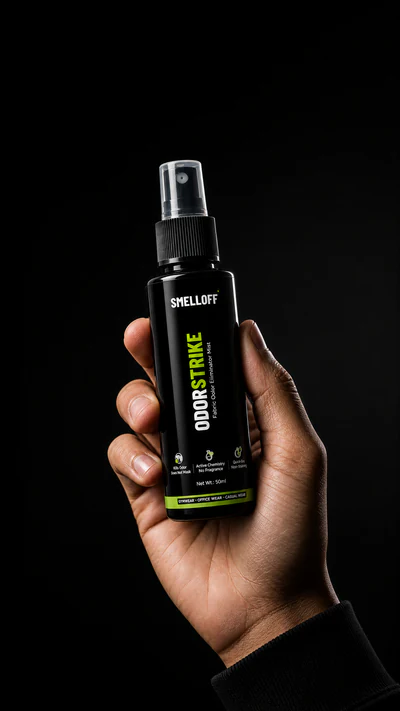
ODORSTRIKE — Fabric Odor Mist
50ml pocket spray. HPβCD traps the odor molecule, Zinc PCA neutralises it. up to 8 hours of odor protection on fabric under normal office/commute conditions, dry in 15–30 seconds, glycerine-free and oil-free with no stiff residue. Fabric only, never skin.
Read Next
Which Fabrics Hold Odor Most? Cotton, Polyester, Denim, Wool and Silk