
How to Keep Clothes Fresh While Travelling
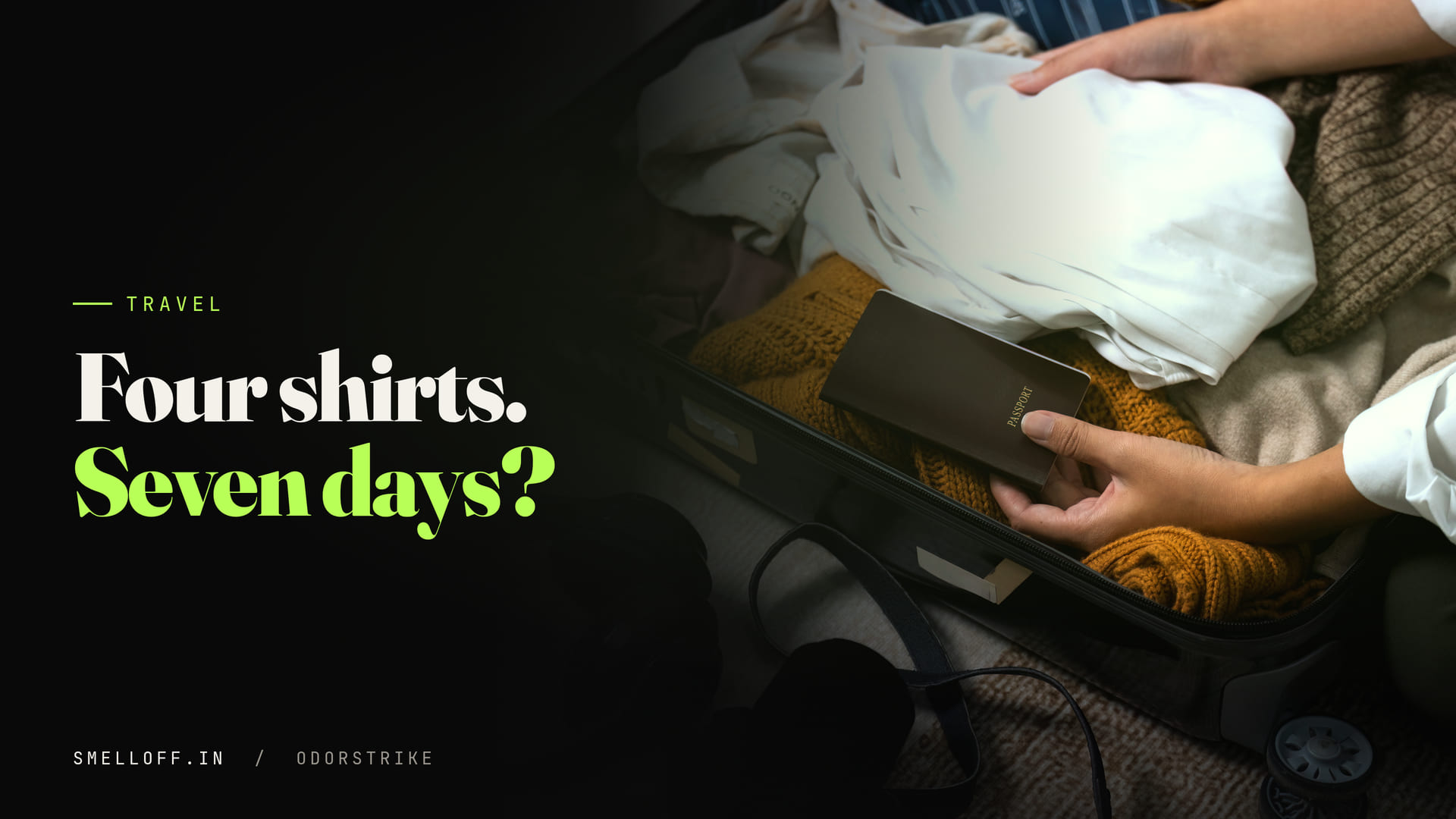
Packing light only works if the clothes survive a second wear. The part nobody plans for is what happens to a shirt after eleven hours on a train.
How do you keep clothes fresh while travelling?
Treat each garment at the end of the day, not the next morning. Hang it where air can move around it, then mist the collar, underarm panels and upper back with a water-based fabric odor mist and leave it overnight. That turns a second wear into a decision rather than a gamble, and it is what makes packing light work.
In this guide5 sections
Every packing guide tells you to take fewer clothes. None of them tell you what to do on day three, when the shirt you planned to wear again has been folded into a suitcase after a day in Jaipur and now smells like the inside of the suitcase.
Re-wearing is the whole mechanism behind travelling light. If a garment gets one wear, a week-long trip needs seven shirts and you are checking a bag. If it gets two, you are carrying four and moving through an airport in twenty minutes. The gap between those two outcomes is not the packing method. It is what you do with the clothes at the end of each day.
Why do clothes smell faster on a trip?
Travel stacks every condition that produces odor and removes every condition that clears it. More heat, more hours, less airflow, and no drying window.
A normal day at home involves a commute, an office and a return. A travel day is eight to fourteen hours of continuous wear, usually outdoors, usually carrying something. Sweat production goes up, and so does the time the fabric spends warm and enclosed under a bag strap or a jacket.
The odor itself comes from what skin bacteria do with the sweat and sebum left in the weave. The main by-products are compounds like 3M2H, which reads sour and stale, and isovaleric acid, which is sharper. Neither is present when you put the shirt on. Both accumulate through the day, and both stay on the fibre after you take it off.
Then the garment goes somewhere with no airflow. A hotel wardrobe is a sealed box. A suitcase is worse. At home a worn shirt hangs on a chair overnight and loses some of what it picked up. In a case, folded against other clothes, it loses nothing and shares what it has. This is the actual reason a suitcase develops a smell of its own by day four, and why the clean clothes at the bottom start smelling like the worn ones at the top.
Add humidity and it accelerates. A shirt packed even slightly damp after a monsoon afternoon in Kochi will make the entire case musty overnight, for the same reason laundry dried indoors goes musty. That mechanism is covered properly in the monsoon guide, and the short version is that fabric which cannot dry produces its own smell regardless of how clean it was.
Which garments can you actually re-wear?
Distance from skin decides it. The further a layer sits from high-sweat areas, the more wears it has in it.
This is the part that makes or breaks a packing list, and most people get it wrong by treating all tops the same.
| Garment | Realistic wears before washing | Why |
|---|---|---|
| Blazer, jacket, overshirt | 5–10 | Sits over another layer, barely touches skin |
| Jeans, chinos | 4–8 | Thick weave, low direct contact except waistband |
| Cotton shirt or kurta | 2 | Second wear works if the collar and underarms are treated |
| Cotton t-shirt | 1–2 | Full skin contact, but cotton releases odor more readily |
| Synthetic activewear | 1 | Polyester holds skin lipids, so odor returns fast on re-wear |
The practical packing rule that falls out of this: take one jacket, two pairs of trousers, and let the shirts do the rotating. Four shirts and a treatment routine covers a week. Seven shirts and no routine covers five days and smells by the end.
Synthetic activewear is the exception worth planning around. Polyester holds the skin lipids that odor-producing bacteria feed on, which is why a gym tee can smell within minutes of being put back on even after a wash. If you are running or hiking on the trip, pack one set per day or accept that you are washing them in a basin. The full explanation of why synthetics behave this way is in the fabric comparison.
What is the end-of-day routine?
Four steps, about ninety seconds, done at night rather than in the morning. Timing is the part people get wrong: a garment treated at 11pm has eight hours to settle, one treated at 8am has none.
- Take the garment off and hang it immediately. Do not fold it, do not put it in the case. A hanger on the wardrobe door or the bathroom hook is fine as long as air can reach both sides.
- Turn it so the high-odor zones face outward. On a shirt that means the collar, the underarm panels and the upper back between the shoulder blades. Those three carry most of it.
- Mist those zones from about 15 to 20 centimetres, two or three light passes, hand moving. Stop before the fabric looks wet.
- Leave it hanging overnight. In the morning it is dry, and you know whether it has another wear in it.
ODORSTRIKE is a 50ml pocket bottle built for this. HPβCD, a modified sugar ring, forms inclusion complexes with odor molecules, which means the molecule is held inside the ring instead of reaching your nose. Zinc PCA neutralises what remains, triethyl citrate lowers the local pH on the fibre, and zinc gluconate reduces how quickly the odor comes back. It is water-based with no oils, no dyes and no glycerine, dries in 15–30 seconds and gives up to 8 hours of odor protection on fabric under normal office/commute conditions.
The size is not incidental to travel. Liquids in cabin baggage generally have to be in containers of 100ml or less, carried in one transparent resealable bag, so a 50ml bottle clears the limit with room to spare and fits a jacket pocket for the day itself. Rules vary between airports and airlines and they change, so confirm the current requirement with your carrier rather than trusting a blog post about laundry.
If you want the technique rather than the summary, including how many sprays a garment actually needs and which zones matter on different cuts, the usage guide has it.
What do you do about a suitcase that already smells?
Separate, air, and stop adding to it. The case is a container, so the fix is mostly about what goes into it.
Keep one bag inside the case for worn clothes and keep it closed. A cloth laundry bag works, a plastic one traps moisture and makes it worse. The point is to stop worn garments touching clean ones for four days.
Never pack anything damp. A towel, a swimsuit or a shirt that felt almost dry will make the whole case musty overnight, and that smell then transfers to everything in it. If something is damp, it travels on the outside of the bag or in its own sealed pouch, and it comes out first at the next stop.
When you reach a room, open the case and leave it open. An hour with the lid up in moving air does more than anything you can spray into it. Then treat the garments you plan to wear again, not the whole contents.
On silk, wool, zari, embroidered pieces and anything labelled dry-clean only, spot-test a hidden seam first and let it dry fully before you judge it. On those fabrics plain water is the risk rather than the actives, and the same caution applies to any spray. If you are travelling with festive wear specifically, the festive wear guide covers those fabrics directly.
None of this replaces washing. A fabric odor mist resets a clean, dry garment that has picked up a smell. It does not clean a soiled shirt, does not remove stains, and does not rescue something that has been packed damp for days. On a long trip you will still need one laundry stop.
When do you need actual laundry on a trip?
Once anything is soiled, and once the reset stops holding. Both are easy to check and neither is negotiable.
Soiling is the obvious one. Food, chai, road spray, dust from a long bus ride on an unsealed road. Those are stains, and an odor product does nothing to a stain — different chemistry, different problem.
The reset test is the second. Treat a garment at night, check it cold in the morning, and be honest. If it reads clean, wear it. If the smell is still underneath, the compounds have built past what a surface treatment reaches and the shirt is done until it sees water. On a week-long trip that usually means one laundry stop around day four or five, which most hotels and every city in India can handle in a day.
The goal was never to avoid washing entirely. It was to stop needing seven shirts for seven days.
Sources
American Society for Microbiology. The Microbial Origins of Body Odor. ASM.org, 2021. asm.org
Bureau of Civil Aviation Security, Government of India. Cabin baggage and liquids guidance. bcasindia.gov.in
Odor Absorption Performance of Cotton Fabrics Functionalized with Beta-Cyclodextrin. Fibers and Polymers, 2025. link.springer.com
Frequently Asked Questions
How do you keep clothes fresh while travelling without laundry?
Treat each garment at the end of the day rather than the morning after. Hang it somewhere with airflow, turn the high-odor zones outward, and mist the collar, underarm panels and upper back with a water-based fabric odor mist. That gives the garment the whole night to dry and settle, so a second wear is a decision rather than a gamble. Pack for re-wear and it works.
Can you take a fabric spray in hand luggage?
Liquids in cabin baggage must generally be in containers of 100ml or less, carried in a single transparent resealable bag. A 50ml bottle is comfortably inside that limit, which is one of the practical reasons ODORSTRIKE is that size. Rules do change and vary by airport and airline, so check the current requirement with your carrier before you fly.
Which clothes can you re-wear on a trip and which cannot?
Outer layers re-wear well: jackets, blazers, jeans, chinos and overshirts sit away from the skin and pick up far less. Cotton shirts and kurtas usually manage two wears if treated between them. Anything worn directly against high-sweat areas gets one wear. Synthetic activewear is the worst case and should be treated as single-wear on a trip.
How do you stop a suitcase from making clothes smell?
Keep worn clothes separate from clean ones and keep anything damp out of the case entirely. A damp towel or a shirt packed slightly wet will make the whole suitcase musty within a day, because the enclosed space stops it drying. Use one bag for worn items, air the case when you reach a room, and never pack anything that is not fully dry.
How to keep clothes fresh in a suitcase?
Pack fully dry clothes, keep worn items in a separate bag, and mist residual odor on clean fabric before it goes back in. A damp shirt in a closed suitcase is what turns the whole bag.
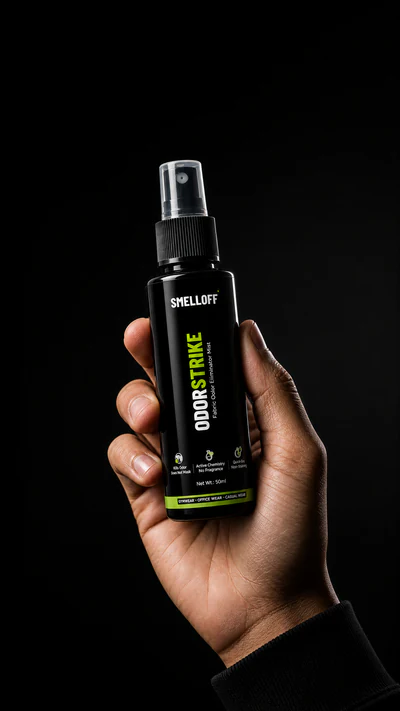
ODORSTRIKE — Fabric Odor Mist
50ml pocket spray, under the 100ml cabin liquid limit. HPβCD traps the odor molecule, Zinc PCA neutralises it. up to 8 hours of odor protection on fabric under normal office/commute conditions. Dries in 15–30 seconds with no stiff residue. Fabric only, never skin.
Read Next
How Often Should You Wash Jeans? (And What to Do In Between)