
How Often Should You Wash Jeans?
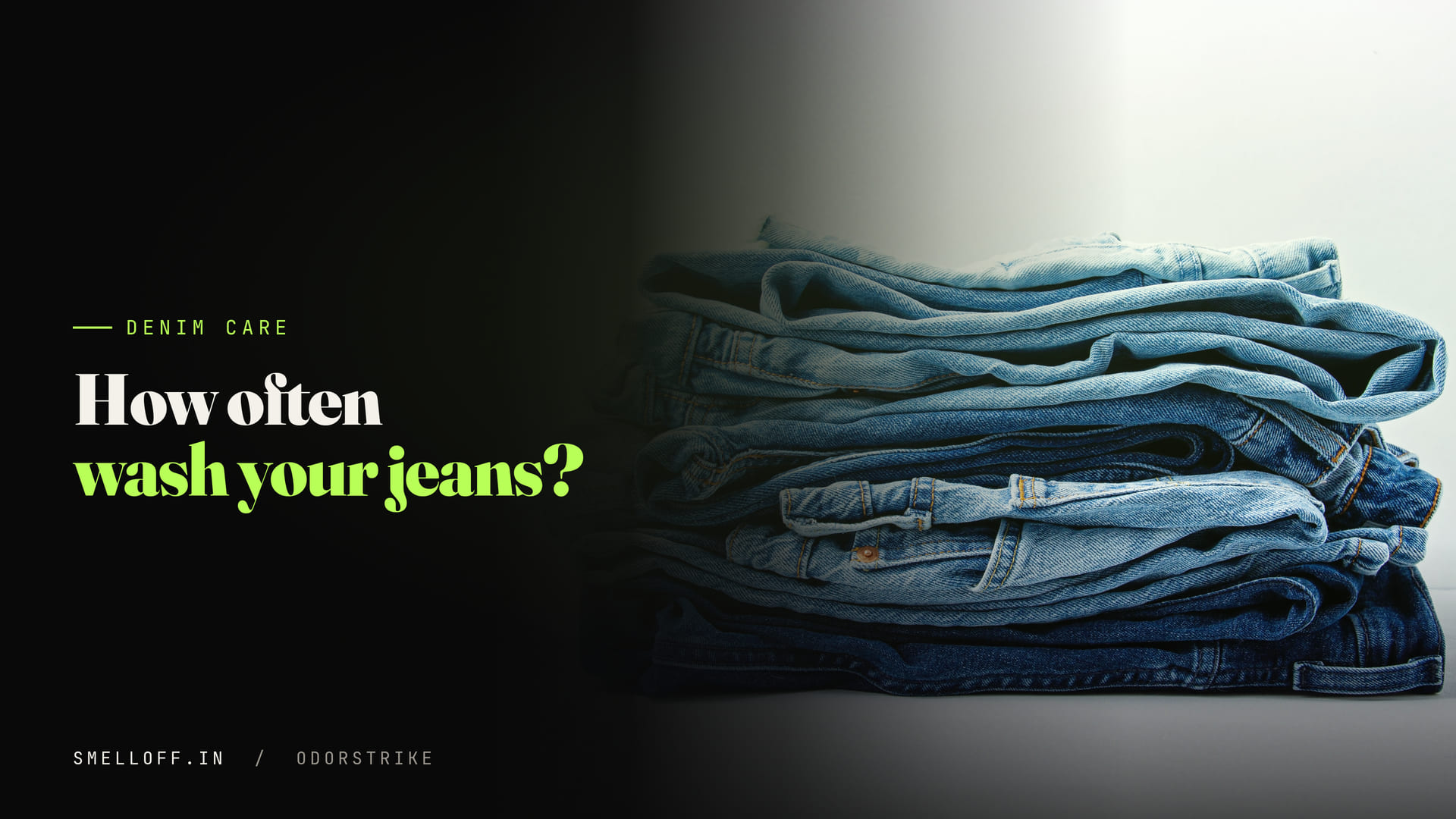
Denim forums say once a year. Your mother says every wear. Both are answering a different question from the one you are asking in an Indian summer.
How often should you wash jeans?
Wash jeans when they are dirty rather than on a schedule. In Indian conditions that usually falls between every five and ten wears, sooner in peak summer. Frequent washing pulls indigo off the yarn and slackens the fit, so the useful skill is managing smell between washes, not washing more often.
In this guide5 sections
The internet has two loud camps on this and neither of them lives in Chennai. One says denim should almost never be washed, because water and agitation destroy the fade pattern a good pair spends a year earning. The other says anything worn against your skin goes in the machine after every use.
The first camp is right about what washing does to denim and wrong about what 38 degrees does to a person. The second is right about hygiene and wrong about the cost. The workable answer sits between them, and it depends on separating two things that get treated as one: whether the jeans are dirty, and whether they smell.
How often should you actually wash jeans?
Wash on condition, not on count. Dirt, a stain, or a smell that will not reset are the three triggers. Everything else is habit.
For a typical office or college wearer in an Indian city, that works out at roughly every five to ten wears. If you ride a two-wheeler through Bengaluru traffic, or you are in Chennai in May, halve it. If you sit in air conditioning and walk to a car, you can stretch it.
Raw denim wearers go much further, sometimes six months or more, because unwashed raw denim develops the high-contrast fade at the knees, thighs and back pocket that the whole category is built around. That is a legitimate reason to delay a wash, but it is an aesthetic choice, not a hygiene claim, and the people who make it are usually rotating several pairs and airing them constantly.
The number that matters more than any of this is zero: the number of times you should wash a pair of jeans because they smell, when the smell could have been dealt with in half a minute. That is the wash you are paying for in fade and fit without getting anything back.
Why does frequent washing ruin denim?
Three things degrade at once: the cotton, the indigo and the elastane. A wash cycle is mechanical abrasion in hot soapy water, and denim is not built to enjoy it.
Indigo does not penetrate cotton yarn the way most dyes do. It sits in layers on the outside of the fibre, which is exactly why denim fades in the shapes your body makes. Every wash strips some of that surface layer indiscriminately, so the whole garment lightens instead of developing contrast. That is the difference between jeans that look worn and jeans that look tired.
The cotton itself abrades. Denim is a heavy fabric, usually somewhere between 11 and 14 ounces per square yard for everyday pairs, and that weight works against it in a drum: heavy wet fabric tumbling against itself is a lot of friction. It shows up first at the pocket edges, the hem and the crotch seam.
Stretch denim has a third problem. Most modern jeans carry one to three per cent elastane for recovery, and elastane does not like heat. Hot water and, far worse, a machine dryer break it down over time. That is the mechanism behind jeans that fit on Monday morning and bag out at the knee by Monday evening.
If you are washing, the low-damage version is simple: turn them inside out, cold water, gentle cycle, no softener, line dry in shade. Inside out protects the indigo surface. Shade protects it from sun bleaching. Skipping softener matters because the conditioning layer it leaves makes heavy cotton slower to dry, which in monsoon is its own problem, covered in the monsoon guide.
Why do jeans smell before they look dirty?
Because soiling and odor are produced by different things. Dirt is visible and comes off in water. Odor is a set of volatile compounds and it does not care what the fabric looks like.
Skin bacteria break down the sweat, sebum and dead skin your body leaves in a garment, and the by-products are what you smell. The main ones are 3M2H, a short-chain fatty acid with a sour, stale note, and isovaleric acid, which is sharper and is the same compound behind the smell of certain aged cheeses. Neither is visible. A pair of jeans can be spotless and still be carrying enough of both to clear a lift.
Denim holds them well for structural reasons. It is thick, tightly woven twill, and it is worn against the waistband, the seat and the inner thigh, which are high-sweat, low-airflow areas. Add a synthetic pocket lining, which many jeans have, and you get a small enclosed pouch that stays warm all day. The compounds accumulate in exactly the zones you cannot air out by hanging the jeans over a chair.
This is also why the freezer myth refuses to die. Cold makes volatile compounds less volatile, so frozen jeans genuinely smell fainter for as long as they are cold. Nothing has been removed. The compounds are still bound to the fibre and they come back with the temperature. It is a pause, not a fix.
"Are these jeans dirty?" is answered by looking at them. "Do these jeans smell?" is answered by the compounds in the weave. Washing answers both, expensively. Only one of them needs a wash most of the time.
What actually works between washes?
Airing helps a little, sunlight helps a little more, and treating the three high-odor zones handles the rest. Most of the folk methods are doing less than people think.
| Between-wash method | What it does to the odor | Effort |
|---|---|---|
| Hanging them overnight | Lets some volatile compounds disperse from the outer surface | None |
| Airing in direct sun | Helps, and dries residual moisture, but fades indigo over time | 2–3 hrs |
| The freezer | Nothing lasting. The compounds return with the temperature | Overnight |
| Perfume or body spray on the denim | Layers scent over the smell, and the oils can mark | Seconds |
| Fabric odor mist on the three zones | Traps and neutralises the compounds on the fibre | 15–30 sec |
The three zones on a pair of jeans are the inside waistband, the seat, and the inner thigh where the legs meet. Those hold the majority of what you are smelling. Spraying the whole garment wastes product and does not improve the outcome.
ODORSTRIKE is built for this specific job. HPβCD, a modified sugar ring, forms inclusion complexes with odor molecules, which means the molecule is held inside the ring rather than reaching your nose. Zinc PCA neutralises what is left, triethyl citrate lowers the local pH on the fibre, and zinc gluconate reduces how quickly the odor returns. It is water-based with no oils, no dyes and no glycerine, so there is nothing to leave a mark on dark indigo, and it dries in 15–30 seconds with up to 8 hours of odor protection on fabric under normal office/commute conditions.
Denim is one of the more forgiving fabrics to treat, but the technique still matters: 15 to 20 centimetres away, hand moving, two or three light passes, stop before the fabric looks damp. The full method is in the usage guide, and if you are wondering about marking on dark washes specifically, the staining guide covers black polyester and indigo denim directly.
When do jeans genuinely need a wash?
Visible soiling, any spill, and the point where a treated garment no longer resets. A mist buys wears between washes. It does not replace the wash.
Anything that landed on the fabric goes in the machine. Chai, oil, road spray from a wet commute, food. Those are stains, and no odor product removes a stain — that is not what the chemistry does.
The second trigger is the reset test. Treat the three zones, let the jeans sit an hour, and check them cold. If they read clean, you have another wear. If the smell is still there under the treatment, the compounds have built up past what a surface treatment reaches, and it is time for water.
The third is simply your own judgement about the day ahead. Denim in a Hyderabad May after eight hours out is a different garment from the same pair after a day in an office. The rule that survives contact with real weather is: wash when the jeans need it, treat when they do not, and stop washing on a calendar.
A fabric odor mist does not remove stains, does not clean soiled denim, and does not replace washing. It resets a clean garment that has picked up a smell, on fabric only, never on skin.
Sources
American Society for Microbiology. The Microbial Origins of Body Odor. ASM.org, 2021. asm.org
Odor Absorption Performance of Cotton Fabrics Functionalized with Beta-Cyclodextrin. Fibers and Polymers, 2025. link.springer.com
Frequently Asked Questions
How often should you wash jeans?
Wash jeans when they are dirty, not on a schedule. For most people in Indian conditions that lands somewhere between every five and ten wears, sooner in peak summer or if you commute on a two-wheeler. Raw denim owners stretch it much further to protect the fade pattern. The number is less useful than the rule: visible soiling, a stain or a smell you cannot reset means wash.
Does washing jeans too often ruin them?
It shortens their life. Every cycle abrades the cotton, pulls indigo off the yarn surface and stresses the elastane in stretch denim, which is what turns a good fit baggy at the knee and seat. Machine drying accelerates all three. Washing less, inside out, in cold water, on a gentle cycle is the single biggest thing you can do for how long a pair lasts.
Does putting jeans in the freezer remove the smell?
No. The freezer does nothing to the odor compounds already sitting on the fibre, so they are still there when the denim comes back to room temperature. It is a myth that has circulated for years because jeans smell fainter while they are cold. If you want the smell gone rather than paused, you need something that binds or neutralises the compounds, or a wash.
Why do jeans smell when they do not look dirty?
Because odor and soiling are different things. Skin bacteria break down what your body leaves in the weave into compounds such as 3M2H and isovaleric acid, and denim is thick, tightly woven and worn against high-sweat areas, so it holds them well. The fabric can look completely clean while carrying enough of those compounds to be obvious in a warm room.
Can you use a fabric spray on jeans?
Yes. Denim is one of the easiest fabrics to treat because it is sturdy cotton and it does not water-mark the way silk does. Mist the waistband, the seat and the inner thigh from about 15 to 20 centimetres, two or three light passes, and let it dry. ODORSTRIKE dries in 15–30 seconds with no oils or glycerine, so it leaves nothing on dark indigo.
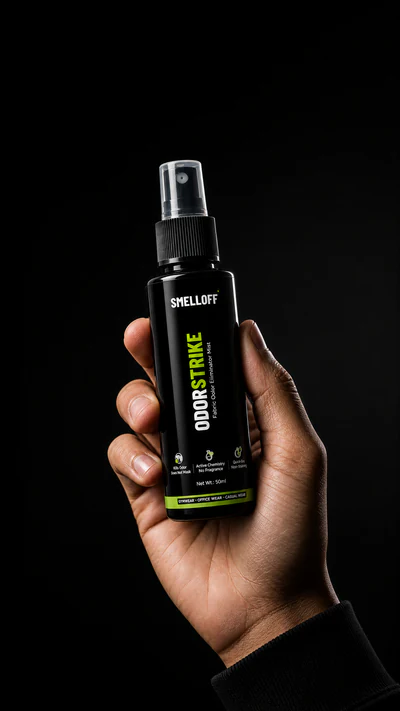
ODORSTRIKE — Fabric Odor Mist
50ml pocket spray. HPβCD traps the odor molecule, Zinc PCA neutralises it. up to 8 hours of odor protection on fabric under normal office/commute conditions. Dries in 15–30 seconds, glycerine-free and oil-free with no stiff residue. Fabric only, never skin.
Read Next
Which Fabrics Hold Odor Most? Cotton, Polyester, Denim, Wool and Silk