
Does Fabric Spray Stain Clothes?
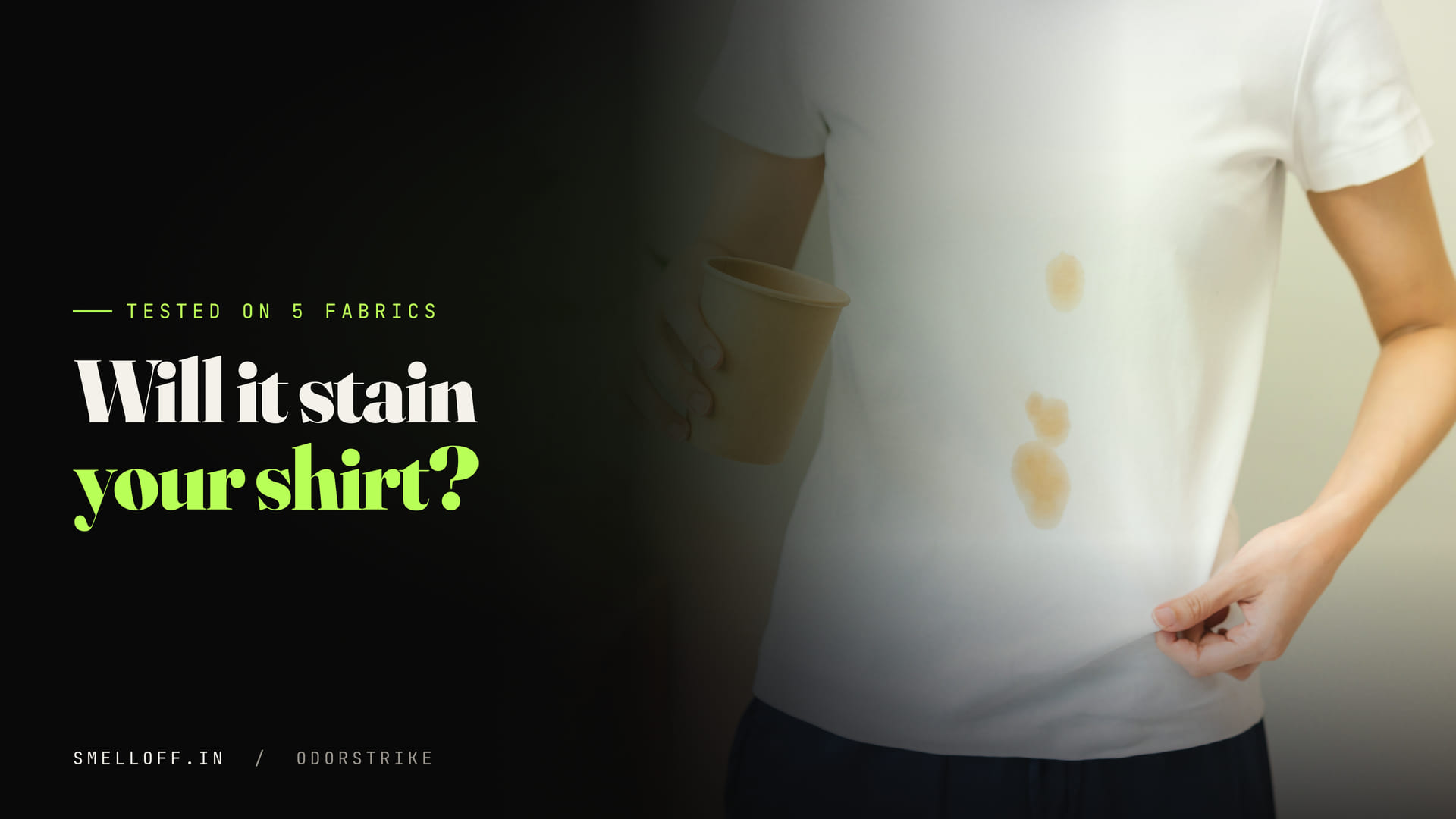
The single question that stops people buying a fabric mist. The honest answer depends entirely on what is in the bottle — and on how you hold it.
This is the question that decides the sale, and most brands answer it with a slogan. The honest version takes a minute longer, because "does fabric spray stain" is really two questions: does the formula leave something behind, and does the technique leave a mark. They have different answers.
The formula question is answerable from the ingredient list. The technique question is answerable from how you hold the bottle. Both are below, along with a fabric-by-fabric test we are still running.
What actually causes staining in a fabric spray?
Stains come from what stays on the fibre after the liquid evaporates: oils, dyes and a heavy fragrance load. Everything else dries off.
Fragrance oils are the biggest offender. A perfume-led fabric spray needs something to carry the scent and hold it on the cloth, and that carrier is usually an oil. Oil does not evaporate. It sits in the weave, darkens light fabric slightly, and picks up dust over the following days. On a white formal shirt it reads as a faint yellow shadow after a few wears.
Dyes are the second. Some sprays are tinted so the liquid looks premium in a clear bottle. There is no functional reason for colour in a product you spray onto clothing.
Glycerine is the third, and it is the one people miss because it sounds harmless. It is a humectant: its job is to hold water. On skin that is useful. On fabric it leaves a slightly tacky patch that never fully dries, which then attracts lint and dust. This is exactly why glycerine is excluded from ODORSTRIKE — the full reasoning is in the ingredients breakdown.
If a fabric spray lists an oil, a colourant or glycerine high in its ingredients, expect residue on dark fabric. If it lists water first and a named odor active near the top, it is built to dry clear.
Why the ODORSTRIKE carrier does not leave residue
ODORSTRIKE is carried in water and isopropyl alcohol, with no oils, no dyes and no glycerine. The alcohol carries the actives into the fibre and then evaporates, and the water goes with it.
That is the whole mechanism. The actives that stay behind — HPβCD and Zinc PCA — are used at levels far too low to be visible, and neither is greasy or coloured. HPβCD is a modified sugar ring; Zinc PCA is a zinc salt. Both dry to nothing you can see or feel. The formula sits at pH 5.5–6.0, close to the pH of skin and well inside the range that is gentle on everyday textile dyes.
The practical result is a dry time of about 10 seconds on cotton and polyester, which is short enough that you can spray a shirt and put it on. Anything that took two to four minutes to dry would leave the fabric damp long enough to ring.
ODORSTRIKE — Fabric Odor Mist
50ml pocket spray. HPβCD traps the odor molecule, Zinc PCA neutralises it. Fabric only, never skin. Dries clear in about 10 seconds.
The fabric test: five materials, marked at 0 hours and after a wash
We are running a controlled marking test across the five fabrics people ask about most — white cotton formal, black polyester tee, indigo denim, silk and wool — recording sprays applied, dry time, visible marking straight away, visible marking after one wash, and a verdict for each.
The results are not here yet, and we would rather say that than fill a table in. We are not going to publish numbers we have not measured. Nobody else in the Indian fabric-spray market has published a stain test at all, which is exactly why this one is worth doing properly rather than quickly. When it is finished it goes here, in full, including anything that does not flatter us.
In the meantime the honest answer to the question in the title is the one in the box at the top of this page, plus the spot-test below — which is what you should do on anything delicate regardless of whose spray it is.
Spot-test anyway — here is the 60-second version
Test a hidden area first on silk, wool, zari, heavy embroidery and anything labelled dry-clean only. Not because the formula is aggressive, but because those fabrics react to plain water.
Turn the garment inside out. Find a seam allowance, an inside hem or the tail of a shirt that tucks in. Give it one light spray from about 20 cm. Let it dry fully — a couple of minutes, not ten seconds, because you want to see the fully dried state. Then look at it in daylight rather than under a bulb.
If there is no change in colour, texture or stiffness, you are clear. This takes a minute and it is the difference between confidence and hoping.
How to spray so you never get a water mark
Distance and movement, not quantity. Water marks are an application problem and they are entirely avoidable.
- Hold the bottle 15–20 cm from the fabric. Closer than that and the spray lands as droplets instead of a mist.
- Keep your hand moving through the pass. A stationary nozzle soaks one spot.
- Use two or three light passes over the zone rather than one heavy one.
- Stop before the fabric looks wet. It should feel barely cool, not damp.
- Give it about 10 seconds in the air before wearing.
The zones worth treating are the ones that actually hold odor — inside collar, underarm panels, the upper back between the shoulder blades. Spraying the whole garment wastes product and increases the odds of an uneven patch. The full routine is in the usage guide.
One thing worth stating plainly, because it comes up in every conversation about fabric sprays: this is a fabric product. It goes on cloth, never on skin. It is not a deodorant and not a body spray, and the difference between those categories is covered in deodorant vs fabric mist.
<> <>Sources <>American Society for Microbiology. The Microbial Origins of Body Odor. ASM.org, 2021. asm.org <>Odor Absorption Performance of Cotton Fabrics Functionalized with Beta-Cyclodextrin. Fibers and Polymers, 2025. link.springer.comFrequently Asked Questions
Will fabric spray stain a white shirt?
A water-based fabric spray with no oils or dyes will not stain a white shirt, because there is nothing in it that dries coloured or greasy. Marks on white cotton almost always come from over-application: holding the nozzle too close soaks one patch, and that patch dries slower than the fabric around it, leaving a temporary ring. Spray from about 15–20 cm in a light even pass and the shirt dries uniformly.
Is fabric spray safe on black polyester?
Black polyester is the fabric that exposes residue fastest, because anything powdery or waxy shows up white against a dark synthetic. Sprays built on zinc ricinoleate or containing glycerine are the usual culprits. ODORSTRIKE contains neither, and dries clear on dark synthetics without a chalky film. As with any spray, mist lightly rather than saturating one area.
Can I use an odor spray on silk?
Silk needs a spot test first, every time. Silk is a protein fibre that water-marks easily, and the mark comes from the water itself rather than from the odor actives. Test a hidden seam or inside hem, let it dry fully, and check in daylight before spraying anywhere visible. The same caution applies to zari, heavy embroidery and anything labelled dry-clean only.
What actually causes stains in fabric sprays?
Three things: oils used as fragrance carriers, dyes added for product colour, and a very high fragrance load that leaves a tacky film as it dries. Glycerine is a fourth, which is why it is excluded from ODORSTRIKE — it holds moisture and can leave a slightly tacky patch that then attracts dust. A formula built on water and a fast-evaporating alcohol has none of these.
How do I avoid water marks when spraying?
Hold the bottle 15–20 cm from the fabric, keep the hand moving, and use two or three light passes rather than one heavy one. Do not spray until the cloth looks wet — a fabric mist works on contact, so a fine even coat is enough. Let it air-dry for about 10 seconds before you put the garment on.
ODORSTRIKE — Fabric Odor Mist
50ml pocket spray. Water and IPA carrier, no oils, no glycerine. Dries clear in about 10 seconds with zero residue. Fabric only, never skin.
Read Next
How to Use ODORSTRIKE: Sprays, Zones and Timing