
Can You Use Deodorant on Clothes? Deodorant vs Fabric Mist

They sit in the same bathroom, solve related problems and are often confused. But deodorant and fabric mist are not competing versions of the same product. They are made for different surfaces.
Not as a fix. Deodorant is made for skin, so use it on skin and a fabric mist on clothing. Sprayed on a shirt, deodorant mostly adds scent over the smell, and aluminium-based antiperspirants can leave white marks and yellow the underarms. Deodorant is body care. A fabric odor mist is textile care. Sweat, sebum and odor-related compounds can move from skin into a shirt during wear, so treating only the skin may leave odor in the fabric. Research on sportswear and textile malodor shows that the fabric itself plays an important role in how odor develops and persists. Read the sportswear review.
In this guide10 sections
- The mistake is treating "body odor" as one surface
- What deodorant is actually for
- What a fabric mist is actually for
- Is deodorant spray for the body or for clothes?
- Why the shirt can still smell after deodorant
- Should you stop using deodorant?
- Where ODORSTRIKE fits
- What a good fabric routine looks like
- The perfume trap
- The bottom line
The mistake is treating "body odor" as one surface
People usually say, "I smell." But there are really at least two separate questions: does my skin smell, and does the clothing touching my skin smell?
That distinction is easy to miss because both smells often arrive together. You shower, apply deodorant, put on a fresh shirt and feel sorted. Five or six hours later, the shirt has picked up sweat and skin-derived compounds. By then the fabric can have its own odor problem.
Textile research describes malodor as a process involving perspiration, skin microorganisms, transfer into fibres and the subsequent behaviour of odorants during use, washing and drying. In other words, clothing is not just a passive wrapper around the body. It is part of the odor system. See the textile malodor review.
What deodorant is actually for
Deodorant is a personal-care product applied to the body. Depending on the formula, it can help control odor, reduce the conditions that produce odor, or reduce wetness when an antiperspirant is involved.
The important point for this comparison is the surface. The product is designed with skin in mind: its feel, application, irritation considerations and use directions are based around the body.
That does not make deodorant bad for the clothing problem. It makes it incomplete. A product cannot be expected to treat the whole inside and outside surface of a garment when it is designed to be applied to skin.
What a fabric mist is actually for
A fabric mist is built around the clothing surface. It is intended to be sprayed onto fabric according to garment directions, usually after the garment is clean and dry.
The important distinction is not "spray versus spray." It is skin chemistry versus textile treatment.
Body problem → body product.
Clothing problem → fabric product.
Once you separate the surfaces, most of the confusion disappears.
Is deodorant spray for the body or for clothes?
For the body. Deodorant and antiperspirant are made for clean, dry underarm skin. A shirt needs a product made for fabric. The table shows where each one belongs and what happens when it lands on the wrong surface.
| Deodorant / antiperspirant | Fabric odor mist | |
|---|---|---|
| Goes on | Skin, mainly underarms | Clothes only, never skin |
| Its job | Slows odor from skin bacteria; antiperspirants also reduce sweat | Traps and neutralizes odor held in the fibres |
| On the wrong surface | On a shirt it adds scent over the smell, can leave white marks, and aluminium salts can yellow underarm fabric | On skin it is not made for the job: rinse with water |
| When to use it | Morning, on clean dry skin | Whenever the garment smells: before you leave, after the commute, before a meeting |
Why the shirt can still smell after deodorant
Sweat itself is not the whole story. Clothing can pick up a mixture of sweat, skin lipids, microbes and volatile compounds during wear. How strongly that smell persists depends on the textile, the amount of soil, the time between wear and washing and the previous washing history.
Polyester is a classic example. In a study of gym clothing, polyester shirts were rated as significantly less pleasant and more intense in odor than cotton shirts after exercise. The researchers also found differences in the microorganisms associated with synthetic and cotton textiles. Read the study.
A separate textile study found that polyester's greater hydrophobicity was associated with greater bacterial adhesion and sebum absorption in its experimental model. Read the textile study.
Should you stop using deodorant?
No. That would be the wrong conclusion.
Deodorant and fabric mist solve adjacent problems. You can use deodorant on your skin in the morning and still use a fabric mist on a shirt that needs a quick reset later. There is no contradiction in that routine.
The better question is: what needs to be treated right now?
- Skin odor before leaving home → deodorant/body care.
- A shirt that smells after commuting → fabric odor mist.
- A visibly dirty, oily or heavily sweat-soaked garment → washing.
- A delicate or dry-clean-only garment → follow the garment-care label rather than improvising.
Where ODORSTRIKE fits
Smelloff ODORSTRIKE is deliberately positioned as the clothing side of this routine. It is a 50ml fabric-only odor-control mist, not a deodorant and not a perfume. The current public formula is v3.1 with 11 listed ingredients, including HPβCD (hydroxypropyl beta-cyclodextrin) and Zinc PCA as hero actives. The public instructions are to spray from 15–20cm, using 2–3 sprays for a targeted reset, 4–5 for a full shirt and 5–6 for a jacket or denim hoodie. approximate air-dry time is 15–30 seconds when used as directed. See the current product facts.
It also has explicit boundaries: clothes only. Not skin, pets, leather, suede or dry-clean-only garments. Silk, zari and heavy embroidery should be patch-tested. Those limitations are part of the product, not fine print to ignore.
What a good fabric routine looks like
Morning
Shower. Use your normal skin deodorant if that is part of your routine. Put on a clean shirt. For an extra layer of clothing odor control, mist the garment according to the fabric product's instructions and let it dry.
Midday
If the shirt has picked up odor from commuting, heat or a long workday, a small targeted fabric reset can be practical. Focus on the actual odor zones instead of soaking the entire garment.
End of day
Use your judgment. A lightly worn shirt that remains clean may sometimes only need airing or a between-wash reset. A garment with visible dirt, oil or heavy sweat needs washing.
The perfume trap
Perfume can be excellent at what perfume is meant to do: make you smell like the fragrance. But it is not the same category as a fabric odor-control product.
This is where people get fooled by a strong first spray. The shirt smells "better" because the perfume is louder. Later, as the fragrance fades, the original fabric odor can still be there.
A fabric mist may contain some fragrance too. That does not automatically turn it into perfume. What matters is the product's intended purpose and mechanism.
The bottom line
There is no winner in deodorant vs fabric mist because they are not substitutes.
Deodorant belongs on skin. Fabric mist belongs on clothes. The reason the distinction matters is simple: the shirt itself can carry odor, and textile science shows that fibre type, microbes, sweat and washing history all influence that process. Sportswear review.
Once you treat the right surface with the right product, the routine gets easier. You stop spraying one problem onto the wrong surface and start dealing with the thing that actually smells.
Frequently Asked Questions
Is a fabric mist the same as deodorant?
No. Deodorant is a body-care product for skin. Fabric mist is clothing care designed to reduce unwanted odor on fabric.
Can I spray deodorant on clothes?
A skin deodorant is not a substitute for a clothing-specific odor treatment. Use a fabric product when the target is the shirt.
Why does my shirt smell even after I apply deodorant?
Because deodorant is used on skin while clothing also collects sweat and odor-related compounds during wear. The fabric can therefore develop its own odor.
Does fabric mist replace washing?
No. It is a between-wash or pre-wear tool. Dirty, stained, oily or heavily soiled clothing still needs washing or the appropriate garment-care process.
Can I spray deodorant on my clothes instead of using a fabric mist?
A deodorant is not a substitute for a clothing-specific odor treatment. Use a product that is explicitly designed for fabric if your target is the shirt itself.
Does a fabric mist replace washing?
No. Fabric mist is useful for clean garments and between-wash resets. Dirt, sweat, oil, stains and persistent buildup still require laundering or appropriate garment care.
Can deodorant be used on clothes?
No. Deodorant is for skin. Spraying it on a shirt can stain fabric and still miss odor already in the weave. Use a fabric-only mist on clothing. ODORSTRIKE is the fabric job — clothes only, never skin.
Sources & further reading
Sweat and odor in sportswear — iScience review
Biological and chemical processes that lead to textile malodour development
Microbial odor profile of polyester and cotton clothes after a fitness session
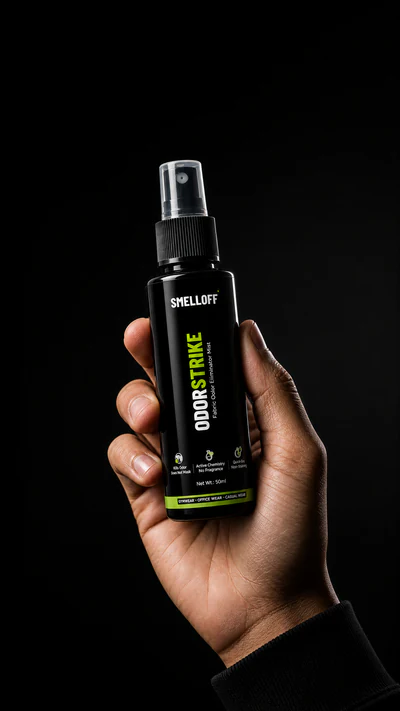
ODORSTRIKE — 50ml Fabric Odor Mist
₹229 prepaid · Free shipping · Clothing only
Buy now — ₹229 View product details