
Why Deodorant and Perfume Fail on a Sweaty Shirt
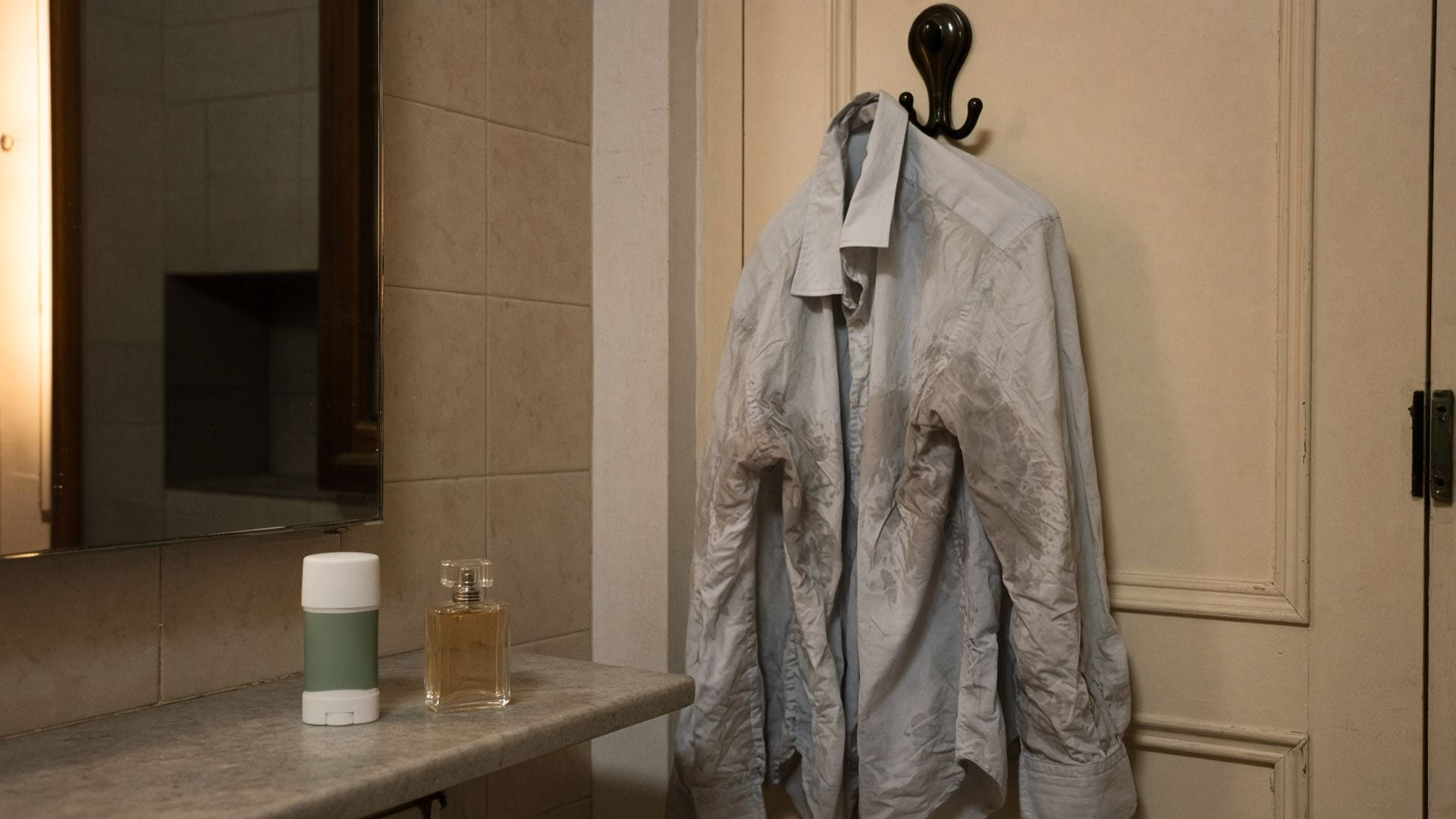
Deodorant is for skin. Perfume is for a clean dry shirt. Both on a worn weave can stain, clash, and get louder as the alcohol flashes off.
No. Deodorant and antiperspirant are skin products. On a shirt they leave aluminium salts that yellow the pits, waxes that smear white, and alcohol that flashes off without treating the odor already in the weave. Perfume on a sweaty shirt is worse, not better: top notes leave with the alcohol, sweat acids stay, and the mash is louder than either smell alone. The emergency is air, a change of shirt, or a fabric mist on dry cloth. It is not spray more.
In this guide10 sections
- Deodorant on a shirt is a skin product on a cloth problem
- What aluminium salts actually do to fabric
- White marks are a different stain. Treat them like one.
- Alcohol is a flash, not a fix
- Why perfume on a sweaty shirt smells worse
- Top notes leave. The acids stay.
- The mash is louder than either smell alone
- The emergency is not spray more
- What belongs on fabric, and what does not
- If the stain is already set
The bottle in your bag is for skin. The smell you just noticed is in the cloth. Those two facts do not become one product because the meeting is in four minutes.
Deodorant on a shirt is a skin product on a cloth problem
You can use deodorant on clothes in the same way you can use toothpaste on a plate. It will go on. Something will happen. It will not be the job you wanted.
Deodorant is built to sit on epidermis: a film of fragrance, an odor-reducing active, sometimes a wax stick. Antiperspirant is built to sit in a sweat duct: aluminium chlorohydrate or aluminium zirconium, designed to form a gel plug. Neither formula was asked to enter a weave, spare a dye, or deal with isovaleric acid that has already moved off your skin and into a polyester pit panel. The category split — skin product versus fabric mist — lives on its own page. This page is the failure. What the cloth actually does with what you just sprayed.
The shirt is not a second armpit
Skin sheds, reseals, and gets washed in a shower. Cloth keeps what you give it. A stick, a spray, an attar — once it is in the fibre, the next sweat does not dilute it. It cooks it.
What aluminium salts actually do to fabric
Most of what Indians call deodorant is antiperspirant. Read the back of the roll-on. If aluminium chlorohydrate or aluminium zirconium is in the first five ingredients, that is a sweat-blocking salt, not a perfume. On skin, the salt meets water in the duct and thickens. On a shirt, the same salt meets sweat proteins, sebum, and detergent residue in the underarm panel. The reaction is a yellowish, slightly stiff crescent. It is not dirt. It is a metal-protein complex that ordinary washing does not fully break.
Heat finishes the job. A warm dryer, a hot iron on the pit, a two-wheeler seat in April — any of those set the stain the way heat sets an egg. The shirt you were saving for Thursday becomes the shirt with the two pale smiles under the arms. Bleach on that yellow often darkens it. You did not stain a shirt with sweat. You stained it with a skin salt that had no business on cotton.
The yellow is a reaction, not a spill
Antiperspirant patents are blunt about this: yellowish, incrusted deposits come from aluminium actives interacting with sweat, skin fat, and laundry leftover. Fresh sweat is almost colourless. The colour arrives when the salt and the protein stay in the fibre and oxidise. That is why a white formal yellows in the pits first, and why a 'stronger' roll-on makes it worse.
White marks are a different stain. Treat them like one.
The chalky streak on a navy formal is usually not aluminium. It is the stick: stearyl alcohol, waxes, a dried emulsion that never dissolved because you put the shirt on before the pits were dry, or because you sprayed the cloth on purpose. It sits on top of the weave. Rubbing it with a damp towel smears it. Heat can help this one a little, which is the opposite of the yellow stain, which is why 'deodorant stain' as one search is a trap.
| What you see | What it usually is | What made it worse | What not to do |
|---|---|---|---|
| Yellow / tan crescent in the pits | Aluminium salt + sweat protein, set into the fibre | Heat: dryer, iron, a hot commute on a damp shirt | Chlorine bleach, more antiperspirant on the cloth, hot iron |
| White, waxy smear on a dark shirt | Stick wax and dried emulsion sitting on the surface | Shirt on while the pits are still wet; spraying the cloth | Rubbing with a wet hand in the lift. You will widen it. |
| Wet patch that smells like the spray | Alcohol carrier + fragrance oils in the weave | Aerosol deodorant used as a shirt mist | A second coat. The first one has not even flashed off. |
| Perfume that turned sour by lunch | Top notes gone; sweat acids and base notes still there | Spraying a worn, slightly damp shirt | Layering a different bottle on top of the mash |
Alcohol is a flash, not a fix
Aerosol deodorant is loud because of ethanol or isopropyl alcohol. The alcohol is a solvent. It throws fragrance into the air, then leaves. On skin that is a feature: projection, then a drier film. On a shirt that already holds sweat, the alcohol does three unhelpful things. It wets the fibre so the odor molecules already in the weave become more volatile — water and alcohol both turn the volume up. It carries the deodorant's own top notes into the room, so for ninety seconds you smell 'fresh'. And then it is gone, and what remains is whatever did not evaporate: the waxes, the salts, the heavier fragrance, and the sweat acids that were there before you touched the nozzle.
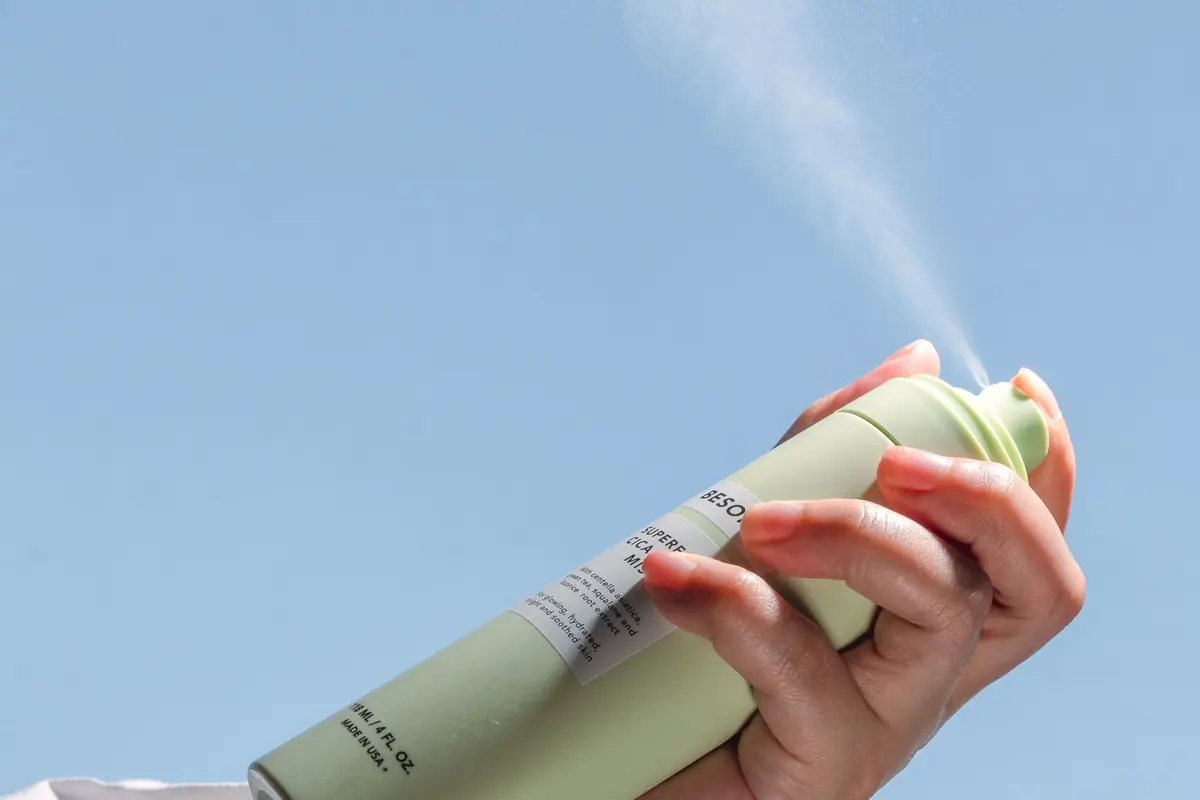
That is why the first sniff after a panic-spray feels like a solution and the third sniff, in the meeting, does not. You did not remove odor. You added a solvent pulse to a dirty cloth.
Why perfume on a sweaty shirt smells worse
Perfume is a timed collapse. Top notes — citrus, aldehydes, the bright opening — are small, volatile, and ride out with the alcohol in minutes. Heart notes hang longer. Base notes, the musks and woods, are stubborn on purpose. A sweaty shirt is already broadcasting its own base: short-chain fatty acids from bacterial breakdown of sweat. Isovaleric acid is the cheesy-sweat one. Butyric is the rancid one. They are not guests in a fragrance. They are the same chemical family perfumers use, in tiny doses, when they want an animalic warmth. At shirt-pit doses they are the smell.
Spray a citrus-woody EDT on that shirt and you do not get citrus-woody. You get a short, expensive top, then a collision. The acids do not leave when the bergamot does. The musks in the perfume have nothing to do except sit next to them. People call this 'perfume gone off'. The perfume did not go off. The shirt was never a blotter.
The desk-drawer bottle
The pattern is local and specific. Two-wheeler or auto to the office. Pits already damp. A travel deodorant in the bag, used on the shirt because the skin is clothed. Then, because that was not enough, the duty-free bottle from the drawer, two sprays on the placket. By 3pm the room smells like a club toilet with good intentions. Nobody in that room thinks you smell expensive.
Top notes leave. The acids stay.
This is the whole mechanism, and it is why 'spray more' is the wrong emergency. More perfume adds more alcohol and more top notes. Both are gone before the standup. More deodorant adds more salt and more wax to a panel that is already collecting both. The acids — the actual complaint — are in the fibre. A skin product cannot go and get them. A cover-scent can only stand in front of them for as long as the volatile fraction lasts.
The mash is louder than either smell alone
Noses are not polite. Two odor sources in the same air do not average. They interfere. A clean citrus on a clean dry collar can be fine — some people perfume a jacket lining and it behaves. A clean citrus on a pit panel that has been working since 9am is a mash: sweet, sour, and slightly chemical, with the alcohol's leftover bite. Colleagues will not diagnose the chemistry. They will sit one chair further away.
Attar and ittar have the same problem plus oil. An oil stain on a light kurta holds odor the way a kitchen holds tadka. If the cloth is already sweaty, you have given the acids a lipid film to live in. That is not tradition. That is a carrier mistake.
The emergency is not spray more
You noticed the shirt in a bathroom mirror, or a colleague stood upwind, or you raised your arm to the metro rail. The instinct is the nozzle. Kill the instinct. The protocol is subtract, then treat cloth as cloth. If the garment is wet with sweat, nothing you spray will dry honestly, and water itself makes clothing odor louder — that physics is a different page. Get it as dry as you can first.
- Stop sprayingPut the deodorant and the perfume down.
- Get air inUnbutton and pull the shirt off your skin.
- Dry itMoving air or a dry towel on the wet zones.
- Treat cloth as clothA fabric odor mist on dry collar and underarm fabric.
Deodorant goes on skin. A second coat on the shirt is how a stain and a smell mash end up in the same panel.
Four minutes, no second bottle
- Stop spraying — Put the deodorant and the perfume down. A second coat is how a stain and a mash get into the same panel.
- Get air between you and the cloth — Unbutton. Pull the shirt off the skin if you can. Stand in moving air — bathroom fan, a corridor, a balcony. Two minutes of airflow does more than two minutes of fragrance.
- Change if a spare exists — A clean dry shirt from a drawer beats any rescue of a worn one. If you have a T-shirt under a formal, the formal can come off for a few minutes while you air the pits of the layer against the skin.
- If you must keep this shirt, treat fabric, not skin — Inside collar, both underarm panels, upper back. Light passes of a fabric odor mist from 15–20 cm, on cloth only, never on skin. Let it dry 15–30 seconds. Do not perfume over it. Do not roll deodorant onto the same panel.
- Wash this one tonight — Pretreat the pits. Skip the hot dryer if you already see yellow. A mist is a wear-through, not a laundry replacement, and a panel full of aluminium wants detergent and time, not another skin product.
- Let antiperspirant dry on skin before the shirt goes on. Transfer is how salts reach cloth without you 'using deodorant on clothes'.
- Perfume a clean, dry garment — a jacket lining, a dupatta edge — or pulse points. Not a worn pit.
- Keep a spare shirt at work if your commute is a furnace. That is a protocol, not an admission.
- If the cloth smells, treat the cloth with a fabric product, then wash when you can.
- Do not spray roll-on, aerosol deodorant, or antiperspirant onto a shirt 'just this once'.
- Do not layer cologne on a shirt that already smells of you. Top notes will lie for a minute.
- Do not iron the pits to 'dry them faster' after a deodorant transfer. Heat sets the yellow.
- Do not use chlorine bleach on a yellow crescent and expect a white shirt back.
What belongs on fabric, and what does not
Skin still wants whatever you already use on skin. That argument is settled elsewhere: deodorant versus fabric mist is a category page, not this one. The failure mode is narrower. When the object in your hand is a skin formula, the object in the other hand — the shirt — should not receive it. A leave-on clothing mist is built to wet a fibre, flash a solvent, and leave actives that trap or quiet odor molecules. It is still not a wash. It will not lift an aluminium stain. It will not make a soaked gym shirt into a formal. It will, on a dry-enough garment, stop you reaching for the cologne.
If you want the mechanism of that mist — cage, zinc, citrate, solvent, a light fragrance that is supposed to fade — that is the odor-neutralizer page. If you want to know whether this shirt should be washed, misted, or just worn, that is the decision tree. This page has one job: stop the wrong bottle.
If the stain is already set
A yellow pit that has been through heat is a laundry problem with a low success rate. Acid soaks and enzyme pretreats sometimes move it; chlorine often makes it uglier; more antiperspirant on the same panel makes next month worse. A fabric mist will not bleach it, and should not be asked to. Wear the shirt on days the crescent is hidden, or retire it. The useful habit is upstream: dry the roll-on on skin, keep aluminium off the weave, and do not treat a panic with a second fragrance.
Nothing in a 50ml bottle un-bakes a stain
Odor in a clean-enough shirt can be quieted between washes. Aluminium-protein yellow cannot. If the panel is stiff and tan, you are in stain chemistry, not odor chemistry. Pretreat, wash, skip the hot dryer. Do not spray a cover over a crescent and call it handled.
You reached for deodorant or perfume because the shirt was already loud. ODORSTRIKE is the fabric-side tool for that moment: 50ml, Formula v3.1, light fragrance that fades, 15–30 seconds to dry, up to 8 hours on cloth under a normal office or commute — not a guarantee, not a skin product, not a wash. ₹229 prepaid. Cash on Delivery available. Spray the garment, not the pits of your body.
50ml fabric-only mist. Formula v3.1. Prepaid UPI ₹229. Cash on Delivery available. Light, subtle scent. Not a wash. Not for skin.
- American Society for Microbiology — The Microbial Origins of Body Odor (2021) — Fresh sweat is nearly odorless. The smell is volatile acids and related compounds produced when skin bacteria break down sweat. Those molecules are what a shirt holds, and what a perfume top note cannot cancel. Source
- Beiersdorf — US20140093463A1, textile staining by antiperspirants — Yellowish, incrusted underarm stains are described as an interaction of aluminium antiperspirant actives with sweat, sebum, and detergent residue — not as simple dirt, and not as easy to wash out. Source
- Callewaert et al. — Applied and Environmental Microbiology (2014) — After the same exercise session, polyester shirts were rated more intense and less pleasant than cotton, with a different microbial profile on the cloth. The odor people notice by afternoon is often the garment, which is why a skin spray on that garment misses. Source
- Amoore — Molecular Basis of Odor (isovaleric acid as a primary sweaty odor) — Isovaleric acid is a defining sweaty-cheesy odorant. It sits in the same chemical neighbourhood as notes perfumers use for animalic warmth. At pit-panel doses, a citrus opening on top of it reads as a clash, not a cover.
Frequently Asked Questions
Can I use deodorant on clothes in an emergency?
You can. You should not. On fabric, deodorant and antiperspirant leave salts, waxes, and a fragrance pulse that flashes off. The odor in the weave stays. You also risk a white smear or, over a few wears, a yellow pit stain. Air the shirt, change if you can, or mist the cloth with a fabric product. Do not use the roll-on as a shirt spray.
Why does perfume smell worse on a sweaty shirt?
Perfume is timed. Alcohol and top notes leave in minutes. Sweat acids — isovaleric, butyric, and their cousins — are already in the fibre and do not leave with the citrus. What you smell after the opening is a mash of leftover base notes and those acids. More perfume adds more mash, not more freshness.
Is it the aluminium that yellows the pits, or the sweat?
Mostly the meeting of the two. Fresh sweat is nearly colourless. Aluminium chlorohydrate and related antiperspirant salts bind sweat proteins and sebum in the fibre. Heat sets the yellow. A deodorant with no aluminium is less likely to yellow; it can still smear wax and still fail to treat odor in the cloth.
Can I spray cologne on a clean shirt instead of on skin?
On a clean, dry garment, a light spray on a lining or the inside of a placket is an old habit and usually behaves. On a worn, damp, or already smelly shirt it does not. If the cloth has today's sweat in it, cologne is the mash. If the cloth is yesterday's residue, cologne is still the mash. Clean and dry, or not at all.
My deodorant transferred onto the shirt. Now what?
Do not iron it. Do not wet-rub a white streak on a dark formal in the office bathroom — you will spread it. Let it dry, brush lightly, wash as soon as you can, pretreat the pits, and keep heat off that panel until you have seen the stain in daylight. Tomorrow, let the roll-on dry on skin before the shirt goes on.
Will a fabric mist fix deodorant already sprayed on the shirt?
It can quiet odor sitting in the fibre. It will not dissolve aluminium salts or lift a wax smear. If you have already coated the panel with antiperspirant, wash is the honest next step. Use a fabric mist on a shirt that smells, not on a shirt you have just waxed.
Is ODORSTRIKE a deodorant I can put on my shirt?
No. It is a fabric odor mist, not a deodorant, not a perfume, not for skin. The point of this page is that skin products fail on cloth. Do not reverse the mistake and put a cloth product on skin either. Garment, light passes, wait until dry, then wear.
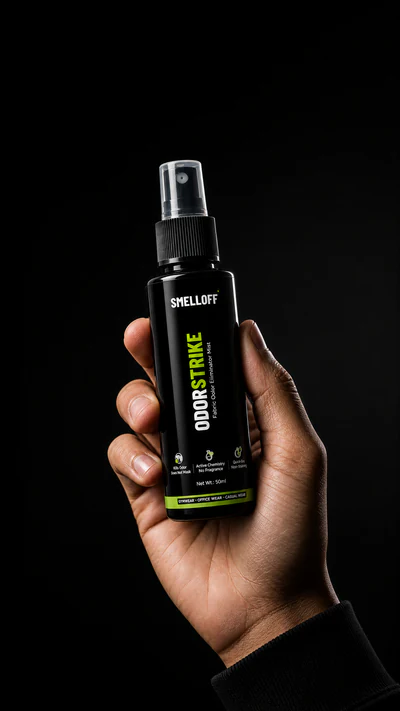
ODORSTRIKE — Fabric Odor Mist
50ml · ₹229 · Cash on Delivery available · For clothing fabric only
Buy now — ₹229 View product details