
Which Fabrics Hold Odor Most?
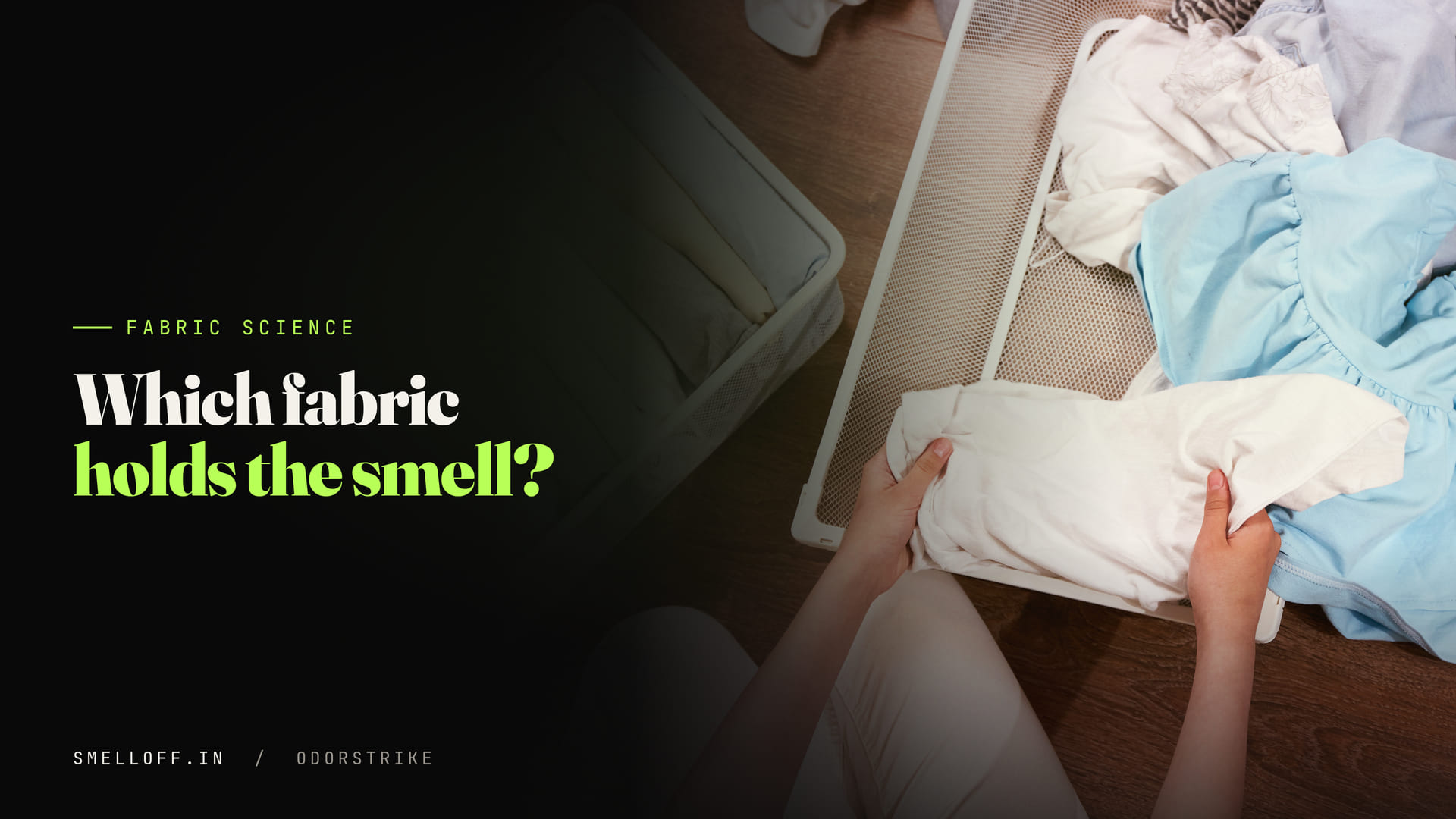
Two shirts, the same day, the same person. One is fine by evening and one is not. The difference is in the fibre, and it is not about how much you sweat.
Which fabric holds odor the most?
Polyester holds odor most, by a clear margin. It is oleophilic, so it attracts and grips the skin lipids that odor compounds are produced from, and those lipids survive a cold wash. Cotton absorbs far more sweat by volume but releases odor more readily. Wool sits between the two and generally performs best of the three.
In this guide6 sections
People assume odor is a function of how much they sweat. It is only partly that. Sweat itself is close to odourless when it leaves the body, and two people producing identical amounts can have completely different outcomes depending on what they are wearing.
What decides it is which parts of sweat a fibre chooses to hold on to, and whether a wash cycle can get those parts back out. Those two properties vary enormously between materials, which is why a cotton kurta and a polyester tee behave like different products in the same weather.
What actually produces the smell?
Bacteria on your skin break down what your body leaves in the fabric, and the by-products are what you smell. Fresh sweat is not the smell. It is the raw material.
Two components matter. Eccrine sweat is mostly water and salt and comes from most of the body. Apocrine sweat comes from the underarm and a few other areas, and it carries proteins and lipids. Sebum, the oil your skin produces continuously, is the third input and it is deposited on anything touching you.
The compounds that result are specific and well characterised. 3M2H, a short-chain fatty acid, gives the sour, stale note most people identify as body odor. Isovaleric acid is sharper and is the same compound that gives certain aged cheeses their smell. There are several more, but those two do most of the work on clothing.
The relevant point for fabric: those compounds are largely produced from and carried in the oily fraction, not the watery one. So a fibre's relationship with oil matters more than its relationship with water. That single fact explains most of what follows.
Why is polyester the worst case?
Polyester is oleophilic and hydrophobic: it repels water and attracts oil. That is exactly the wrong combination for a garment worn against skin.
Because it repels water, sweat is not absorbed into the fibre. It sits on the surface and evaporates or wicks along the yarn, which is genuinely useful and is why activewear is made from it. Because it attracts oil, sebum and the lipid fraction of apocrine sweat migrate into the fibre and bind there.
Then the wash fails to undo it. Cold water does not dissolve lipids, and standard detergent at 30 degrees is working against chemistry that would prefer 40 or above. The garment comes out visually clean and smelling clean, because the volatile compounds themselves have been rinsed away, while the lipid layer they were produced from is still in the fibre. Put the shirt on, warm it to body temperature, and the process restarts from a head start.
This is the mechanism behind what people call permastink, and there is published work behind it. Callewaert and colleagues compared the microbial and odor profile of polyester and cotton shirts after identical exercise sessions and found the two materials ended up with materially different outcomes, with polyester rating worse on odor. If your problem is specifically gym clothes that smell after washing, that post covers the stripping wash in detail.
Why does cotton behave differently?
Cotton is hydrophilic. It absorbs watery sweat into the fibre and gives most of it back in the wash. It holds more sweat and less trouble.
A cotton shirt on a Hyderabad afternoon absorbs a great deal of moisture, which is why it looks and feels wetter than a polyester one in the same conditions. That is a comfort problem, not an odor problem. The watery fraction it is absorbing is the part that contributes least to smell, and it washes out readily.
Cotton still picks up sebum, and a cotton shirt worn twice in summer will smell. The difference is that a normal cold wash removes considerably more of what accumulated, so cotton resets closer to baseline each time. Over months, that is the difference between a shirt that stays neutral and one that develops a permanent background note.
Denim is cotton with two complications: it is thick, so it dries slowly and holds more, and it is worn on the waistband, seat and inner thigh, which are low-airflow, high-contact zones. It is also washed far less often by design. That combination is covered separately in the jeans guide.
Where do wool, silk and blends fit?
Wool generally outperforms both cotton and polyester on odor. Silk is delicate rather than smelly. Blends behave like their worst component.
Wool moves moisture as vapour through the fibre rather than holding liquid at the surface, and its structure appears to hold odor compounds internally rather than releasing them to the air. This is why merino base layers get worn for days on treks without becoming unbearable, and it is a real material property rather than a marketing claim. It is not unlimited — wool worn hard for a week will smell — but the curve is much flatter.
Silk is a protein fibre and its issue is fragility, not odor retention. It water-marks easily, it is usually dry-clean only, and it is common in exactly the garments people cannot wash: sarees, kurtas, linings. Anything you do to silk needs a spot test first, and the risk is the water rather than what is dissolved in it.
Blends are the honest disappointment. A 60/40 cotton-polyester shirt does not average the two behaviours. The polyester fraction still binds lipids and still holds them through a cold wash, so the garment behaves closer to polyester than the ratio suggests. Treat any blend with meaningful synthetic content as a synthetic.
| Fabric | Odor retention | What to do between washes |
|---|---|---|
| Polyester, nylon, activewear | Highest. Binds skin lipids, survives cold wash | Treat after every wear, wash warm without softener |
| Cotton–poly blends | High. Behaves like its synthetic fraction | Treat between wears, wash as a synthetic |
| Denim | Moderate. Thick and slow-drying, rarely washed | Treat waistband, seat and inner thigh |
| Cotton | Moderate. Absorbs a lot, releases most of it in the wash | Treat collar, underarms, upper back |
| Wool and merino | Lowest of the common fibres | Air it; treat lightly, spot-test first |
| Silk, zari, embroidered | Low, but marks easily and rarely washable | Spot-test, then treat the lining rather than the face |
What do you actually do about it?
Wash synthetics warm and without softener, and treat every fabric between wears at the three zones that hold odor. The washing fixes the accumulation. The treatment covers the wear you are in.
On the wash side: warm water rather than cold for synthetics, a detergent with real surfactant capacity, no fabric softener at all. Softener is worth calling out because it is sold as the solution and is often the cause. It deposits a conditioning layer on the fibre, which on polyester means one more oily surface for odor compounds to bind to, and it slows drying, which creates its own problem in monsoon.
On the between-wear side, the target is the same three zones on almost every top: inside collar, underarm panels, and the upper back between the shoulder blades. On trousers it is the waistband, seat and inner thigh. Spraying the whole garment achieves nothing extra.
ODORSTRIKE is built for that job across fabrics. HPβCD, a modified sugar ring, forms inclusion complexes with odor molecules, holding the molecule inside the ring rather than letting it reach your nose. Zinc PCA neutralises what remains, triethyl citrate lowers the local pH on the fibre, and zinc gluconate reduces how quickly the odor comes back. It carries in a fast-drying water base with no oils, no dyes and no glycerine, which is what lets it work on black polyester without leaving a chalky film, and it dries in 15–30 seconds with up to 8 hours of odor protection on fabric under normal office/commute conditions.
On silk, wool, zari, velvet and anything labelled dry-clean only, spot-test a hidden seam and let it dry fully before judging it. That applies to any spray, ours included, and the staining guide goes through the five fabrics people ask about most.
A fabric odor mist does not remove stains, does not clean a soiled garment and does not replace washing. On heavily built-up synthetics it manages the wear you are in while a proper warm wash deals with the accumulation underneath.
What to buy if odor is your main concern
For everyday wear in Indian heat, cotton and merino are the low-odor choices and heavy synthetics are the high-odor one. That is a real trade-off, not a rule.
Polyester exists in activewear for good reasons: it is light, it dries fast, it does not sag when wet and it costs less. If you are running in Pune in June, a cotton tee is a worse garment in every respect except smell. The sensible response is to buy the synthetic and manage it, not to avoid it.
For office and daily wear, where the performance argument is weaker, cotton and linen genuinely reduce the problem. Merino is expensive in India and largely unnecessary outside the hills, but if you travel and re-wear, it earns its price.
And for anything you cannot wash often, whichever fibre it is made of, the between-wear routine is what keeps it wearable. That is the same routine for a ₹400 tee and a ₹40,000 sherwani.
Sources
American Society for Microbiology. The Microbial Origins of Body Odor. ASM.org, 2021. asm.org
Callewaert C. et al. Microbial odor profile of polyester and cotton clothes after a fitness session. Applied and Environmental Microbiology. journals.asm.org
Odor Absorption Performance of Cotton Fabrics Functionalized with Beta-Cyclodextrin. Fibers and Polymers, 2025. link.springer.com
Frequently Asked Questions
Which fabric holds odor the most?
Polyester, and by a clear margin. Polyester is oleophilic, meaning it attracts and holds oily substances, so it grips the sebum and skin lipids that odor compounds are produced from. Those lipids survive a cold wash, and body heat releases what is bound to them on the next wear. Cotton absorbs far more sweat by volume but gives up odor more readily in the wash.
Why does polyester smell but cotton does not?
The two fibres attract different things. Cotton is hydrophilic, so it soaks up watery sweat and holds it away from the surface, and most of that washes out. Polyester repels water but attracts oil, so sweat sits on the surface while skin lipids sink into the fibre. Odor compounds concentrate in those lipids, which is why a polyester tee can smell within minutes of being put on.
Does wool smell less than synthetic fabric?
Generally yes. Wool manages moisture differently from both cotton and polyester, moving water vapour through the fibre rather than holding liquid at the surface, and its structure appears to hold odor compounds inside the fibre rather than releasing them. That is why merino base layers are worn for several days on treks. It is a real effect, not marketing, though it is not unlimited.
Does fabric softener make clothes smell worse?
On synthetics it usually does. Softener deposits a conditioning layer on the fibre, which adds another oily surface for odor compounds to bind to and makes the fabric slower to dry. On polyester activewear that is the opposite of what you want. Skip softener on synthetics entirely, and use it sparingly on cotton if you use it at all.
Can you use the same fabric spray on every material?
A water-based mist with no oils or dyes works across cotton, polyester, denim and wool blends without leaving residue. Silk, zari, velvet and anything labelled dry-clean only need a spot test on a hidden seam first, because those fabrics can water-mark from plain water regardless of what is dissolved in it. Test, let it dry fully, then check in daylight.
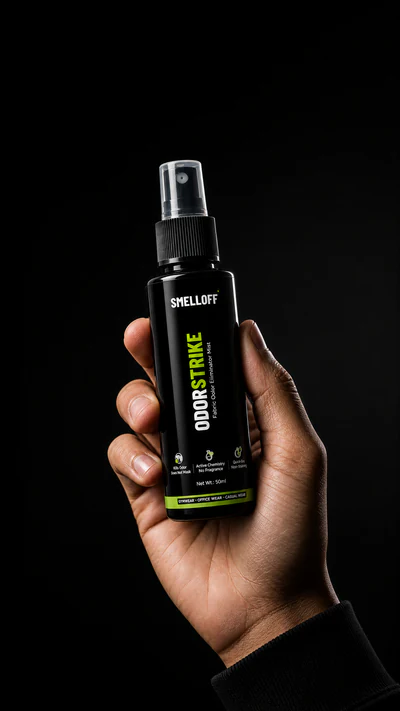
ODORSTRIKE — Fabric Odor Mist
50ml pocket spray. HPβCD traps the odor molecule, Zinc PCA neutralises it. Works on cotton, polyester, denim and wool blends. up to 8 hours of odor protection on fabric under normal office/commute conditions, dry in 15–30 seconds, no stiff residue. Fabric only, never skin.
Read Next
Why Gym Clothes Still Smell After Washing (and the Fix)