
Gym Clothes Still Smell After Washing? 5 Reasons and the Fix
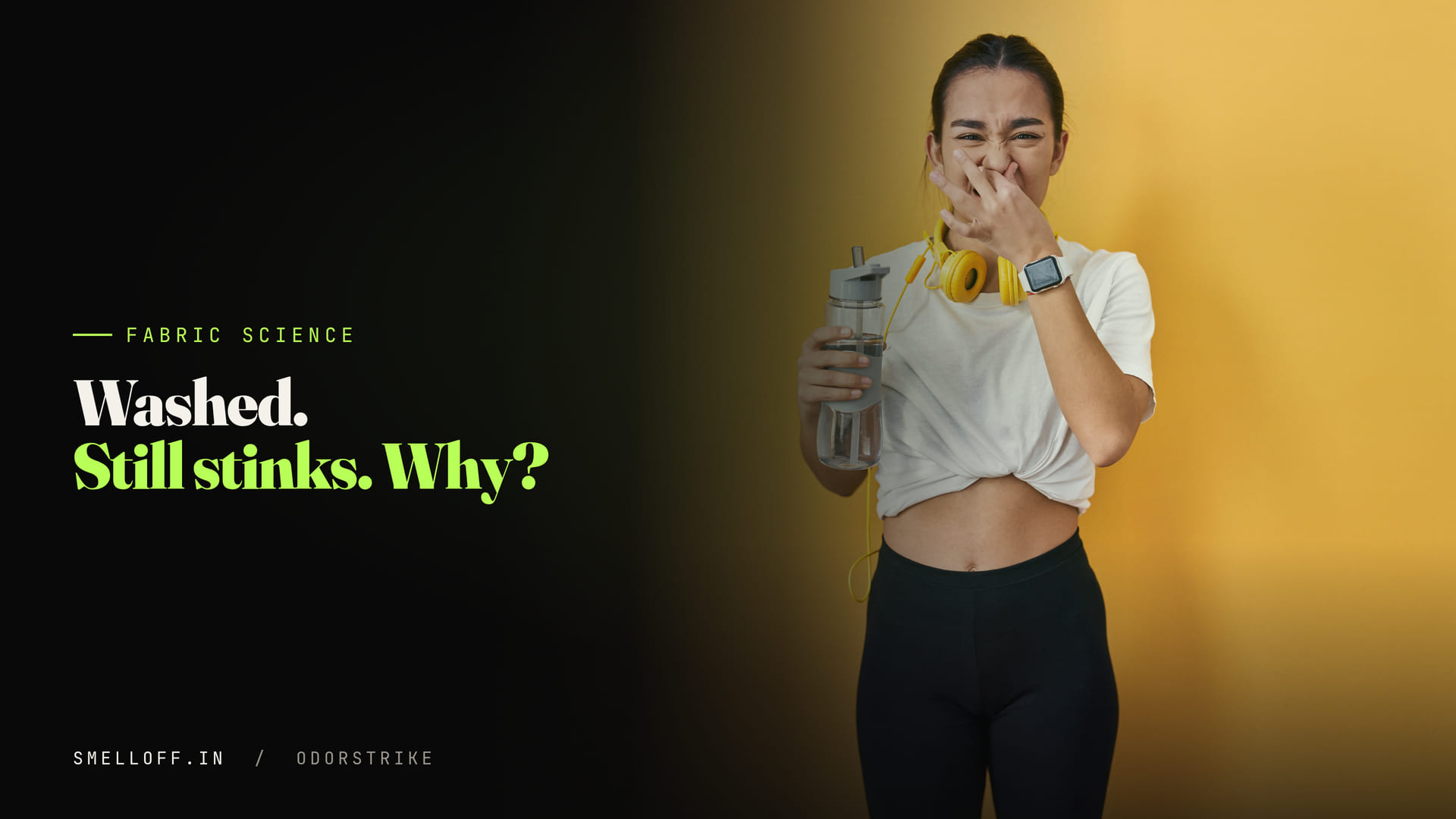
That "clean shirt" smell that disappears when the tee is dry and comes roaring back during the first five minutes of your next workout is real. Laundry happened. The odor problem did not completely reset.
Gym and dri-fit clothes smell after washing because polyester holds onto skin oils, and the bacteria that break them down into odor, more than cotton does, and a quick, cool wash does not fully lift them. Body heat then releases the smell again. Wash inside out soon after training, skip fabric softener, dry fully, and treat the underarms between washes. Read the polyester/cotton study.
In this guide8 sections
- Why do gym and workout clothes still smell after washing?
- Why do dri-fit shirts smell after washing?
- What does a normal wash miss?
- How do you get the smell out of gym clothes?
- Where does a fabric odor mist fit?
- Should you spray perfume on a smelly gym shirt?
- Should you wash the shirt again immediately?
- When is an old gym tee past saving?
Why do gym and workout clothes still smell after washing?
A gym tee that smells after washing is not necessarily proof that you washed it badly or that you are unhygienic. Textile malodor is a real interaction between sweat, skin microorganisms, the fabric and what happened to the garment between workouts and laundry.
A 2023 review of sweat and odor in sportswear describes sports garments worn next to the skin as a place where sweat and the skin microbiome interact, creating conditions for malodor. The review also discusses fibre type, odor measurement and different odor-control approaches. Read the review.
Why do dri-fit shirts smell after washing?
Dri-fit shirts smell after washing because polyester grips skin oils, and the bacteria that feed on them, and a quick cool wash does not fully lift either. "Dri-FIT" is Nike's name for its polyester performance fabric, and most gym tees sold in India, branded or not, are the same kind of polyester or polyester blend. The fibre moves water quickly, which is why it feels dry, but it attracts the oily fraction of sweat (sebum and skin lipids) rather than letting it rinse away.
Polyester is popular in gymwear for good reasons: it can be lightweight, durable and quick-drying. But quick-drying does not mean quick-to-forget odor.
In a controlled study of shirts after a fitness session, polyester garments were rated as significantly less pleasant and more intense in odor than cotton garments. The researchers also observed differences in the microbial communities associated with synthetic and cotton clothing. Study details.
Another study focused on bacterial behaviour in textiles found that higher hydrophobicity in polyester was associated with greater bacterial adhesion and sebum absorption in its experimental system. Read that study.
So when someone says, "My Dri-FIT smells the second I sweat," that is not an imaginary problem. Heat and moisture can make previously retained compounds much easier to detect.
What does a normal wash miss?
Washing is still the first-line reset when a garment is dirty. But the result depends on the whole laundry process, not only the presence of detergent.
| What happened | Why it can matter |
|---|---|
| Shirt sat wet in the hamper | Warm, damp storage gives odor time to develop before washing. |
| Cold or short wash | May not remove all accumulated skin oils and soil from stubborn areas. |
| Heavy softener use | A coating on fibres can change how the garment behaves and may work against the goal of a clean technical fabric. |
| Slow drying | A garment that stays damp for too long can develop or retain a stale odor. |
| Old buildup | Repeated wear can create a persistent fabric history that one ordinary cycle does not always erase. |
The key is to diagnose the stage where the smell is coming back. If the shirt smells strongly before washing, focus on laundry. If it smells clean when dry but turns "old gym bag" the moment it gets damp, persistent textile residue is a likely part of the problem.
How do you get the smell out of gym clothes?
1. Do not leave sweaty gear sitting wet
Hang the shirt or otherwise allow it to dry before a later wash if immediate laundering is not possible. A sealed, damp bundle is a bad temporary storage system.
2. Wash inside out, and soon
The underarm and back panels carry most of the oil, and it sits on the inside face of the fabric. Turning the shirt inside out puts that face where the water and detergent work hardest. Washing within a day of the workout stops the residue setting in a damp bag.
3. Use the normal dose of detergent and leave room in the drum
More detergent is not more clean. Excess can stay in the fabric after rinsing, and a crammed drum stops clothes moving freely enough to rinse clean. Wash gym clothes in a load that leaves a hand's width of space at the top.
4. Follow the care label
Technical fabrics have different washing requirements. Use the temperature and cycle the garment maker recommends instead of assuming hotter is always better.
5. Skip unnecessary fabric softener on performance sportswear
If the manufacturer recommends avoiding softener, follow that instruction. The goal is not to make the shirt feel softer at any cost; it is to clean the performance fabric while preserving its intended behaviour.
6. Dry completely
Do not fold or throw the shirt back into a drawer while seams and underarm sections are still damp.
7. Escalate when the odor is persistent
If a garment keeps smelling strongly after sensible laundering, it may need a deeper laundry reset or replacement. A spray is not a substitute for removing heavy soil.
Where does a fabric odor mist fit?
A fabric odor mist makes sense after the garment is clean and dry, when the problem is a residual or between-wash odor rather than visible dirt.
That is the role of Smelloff ODORSTRIKE. The current product is a 50ml fabric-only odor-control mist. Smelloff's public formula is v3.1 with an 11-ingredient INCI list and HPβCD plus Zinc PCA as hero actives. The use directions are 15–20cm from the fabric, with 2–3 sprays for a targeted reset, 4–5 for a full shirt and 5–6 for a jacket or denim hoodie; approximate air-dry time is 15–30 seconds when used as directed. See the current product facts.
That distinction matters. If a shirt is dirty, wash it. If the shirt is clean but has the familiar post-commute or pre-gym residual odor, a fabric-only reset is a different tool.
Should you spray perfume on a smelly gym shirt?
Perfume can make a shirt smell different. That is not the same as solving fabric odor.
Some fabric products also contain fragrance. The honest way to evaluate them is to ask what the product is designed to do, not whether the bottle has a pleasant scent. ODORSTRIKE, for example, is explicitly a fabric odor-control product with a light fragrance. The scent is not positioned as the primary odor-control mechanism.
Should you wash the shirt again immediately?
Not always. Ask three questions:
- Is it visibly dirty or heavily sweaty? Wash it.
- Does it smell clean when dry but turn noticeable when warm or damp? Investigate persistent textile odor and improve the laundry reset.
- Is it clean, dry and only mildly stale between wears? Airing or a fabric odor mist can be a practical reset.
This decision is more useful than a blanket rule such as "never rewear" or "always spray." Clothing care gets easier when you match the tool to the state of the garment.
When is an old gym tee past saving?
Sometimes the shirt is simply at the end of its useful life. If the same garment has been washed, dried, soaked in sweat and reworn hundreds of times, there is only so much a consumer product can do. Persistent buildup inside textile fibres is not a personal failure. It is a material problem.
Good fabric care can extend the useful life of clothing. It cannot make a permanently compromised textile brand new.
Dirty → wash. Clean but residual odor → air or use a fabric odor mist. Persistent odor after proper care → deeper laundry reset or retire the garment.
Frequently Asked Questions
Why do my gym clothes smell after washing?
Because sweat, skin oils, microorganisms and odor compounds interact with the fabric itself. Synthetic textiles can be especially stubborn, and washing/drying conditions affect what remains.
Why does my Dri-FIT shirt smell again when I sweat?
Heat and moisture can make residual odor compounds in synthetic fabric easier to detect. Polyester can also behave differently from cotton with sweat-related soil.
Should I use fabric softener on gym clothes?
Check the garment-care instructions. Many technical garments have specific guidance, and avoiding unnecessary softener can be sensible when the goal is to preserve fabric performance and minimise buildup.
Can ODORSTRIKE replace washing?
No. ODORSTRIKE is for clean, dry clothing as a fabric odor-control reset. Wash garments with significant dirt, sweat, oil or stains.
Does fabric softener make gym clothes smell worse?
Fabric softener can leave a coating on fibres. For performance sportswear, it is often better to follow the garment maker's care instructions and avoid assuming more softness means better odor removal.
Can a fabric odor spray fix gym clothes that smell after washing?
A fabric odor spray can help with residual odor on a clean, dry garment between wears. It does not replace laundering when the fabric has significant soil or buildup.
Why do workout clothes still smell after washing?
Workout clothes — dri-fit, gym tees, polyester tights — still smell after washing because the fibre holds skin oils a cold cycle does not dissolve. Softener coats the residue in. Strip-wash to reset; a fabric mist is for between wears on a clean shirt, not to dissolve old biofilm.
Sources & further reading
Callewaert et al. — polyester vs cotton clothing odor after fitness
Bacterial life cycle in textiles and fibre hydrophobicity
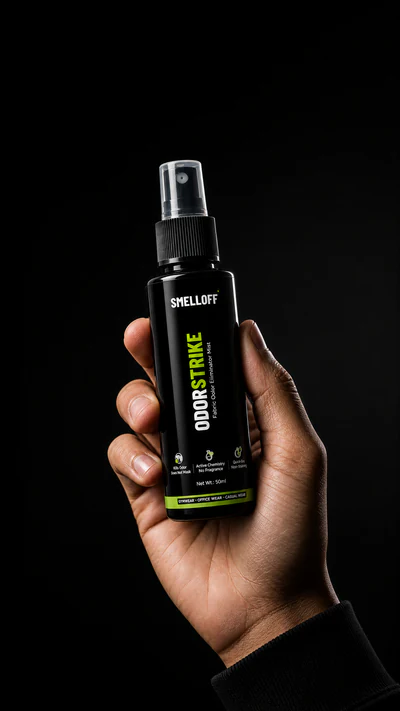
ODORSTRIKE — Fabric Odor Mist
50ml · ₹229 prepaid · Clothing only
Buy now — ₹229 View product details