
Should You Wear a Vest Under Your Shirt for Sweat Smell?

The cotton banian is one of the oldest Indian answers to sweat. Fashion sites call it outdated; tailors and fathers swear by it. Here is what it actually does for sweat smell, and when it helps or does not.
Should you wear a vest under your shirt to stop sweat smell?
Yes, for most office and formal shirts. A thin cotton vest absorbs underarm and back sweat before it reaches the shirt, so the shirt stays drier, smells less and lasts longer between washes. Choose a fitted cotton vest, change it daily, and skip it only in extreme heat with very light linen shirts.
In this guide6 sections
Ask a tailor in any Indian market and he will tell you: wear a banian under that shirt. Ask a style blog and it will tell you the opposite. On sweat smell, the tailor is right more often than not.
What does a vest actually do under a shirt?
It takes the sweat first, so less of it reaches the shirt. The vest becomes the layer you wash every day.
Cotton next to the skin pulls sweat in; polyester leaves it on the surface.
Cotton absorbs a lot of moisture. Textile standards such as ASTM D1909 list cotton's commercial moisture regain at about 8.5%, against 0.4% for polyester. In plain terms, cotton next to the skin pulls sweat in, while a polyester shirt lets it sit on the surface where bacteria turn it into odour. Researchers at Ghent University found polyester held far more odour than cotton after the same session (Callewaert, 2014).
So a cotton vest under a polyester-blend office shirt is a sweat sponge between your skin and the fabric that holds smell worst.
Does a vest make you hotter in Indian weather?
A little, but usually less than a sweat-soaked shirt stuck to your back.
A thin vest adds a light layer, and in dry heat above 40°C some people find it too much. In humid cities and air-conditioned offices, most find the opposite: the shirt does not cling, damp patches do not show, and the shirt dries faster on the hanger. The fit matters: a loose, thick vest is hot; a thin, fitted one is barely noticed.
Which vest should you buy?
Thin, fitted, 100% cotton or cotton-rich, in a colour that does not show through.

- Cotton or cotton-modal: absorbs sweat; avoid fully polyester vests for this job.
- Fitted, not tight: it should follow your body without rolling up.
- Sleeveless or short sleeves: short sleeves cover the underarms and protect shirt armpits best.
- Skin tone or light grey under white shirts: a white vest shows through a white shirt more than a skin-tone one.
- Enough to rotate: at least five, so one is always fresh.
Does wearing a vest mean you can rewear the shirt?
Often, yes, if the shirt passes a sniff test at the collar and underarms.
Change the vest daily; it is the layer that takes the sweat. A shirt worn over a vest in an air-conditioned office can usually manage a second wear if you hang it to air overnight and check the collar. The collar still touches your neck, so it is the first place to smell. Our guide on how many times you can wear a shirt covers the sniff test.
How do you keep the shirt fresh on a second wear?
Air it overnight, then treat the collar before you put it on.
Hang the shirt on a proper hanger in moving air, not on a chair. Before you wear it again, mist the inside of the collar and the underarms with a fabric odor spray from 15–20 cm and let it dry. ODORSTRIKE clothing deodorant does this with HPβCD, which traps odour molecules in the fibres, and Zinc PCA, which neutralises them, instead of covering them with perfume. A vest plus a refreshed collar is the combination that gets a good shirt through a second day.
When should you skip the vest?
Under very light linen or kurtas in dry heat, and when the vest itself is not fresh.
A loose linen shirt or a cotton kurta in dry heat is already breathable, and a vest can be too warm. And a vest that is not washed daily makes things worse, not better: it becomes the smelly layer. If you skip it, choose cotton shirts and refresh the underarms at lunch.
A vest reduces how much sweat reaches the shirt; it does not stop sweating. A fabric odour spray refreshes clean clothes and is never for skin. Vests and shirts that are sweaty or stained still need washing.
Sources
ASTM International ASTM D1909: Standard tables of commercial moisture regains and commercial allowances for textile fibers. ASTM standard D1909-13. store.astm.org
Callewaert, C. et al. Microbial odor profile of polyester and cotton clothes after a fitness session. Applied and Environmental Microbiology, 2014. pmc.ncbi.nlm.nih.gov
Frequently Asked Questions
Does wearing a vest under a shirt reduce sweat smell?
Yes. A cotton vest absorbs sweat before it reaches the shirt, so the shirt stays drier and smells less. Change the vest daily.
Is it too hot to wear a vest in Indian summer?
A thin, fitted cotton vest adds little heat, and in humid weather or AC offices most people find it more comfortable. In dry heat above 40°C, some prefer a loose linen shirt without one.
What colour vest is best under a white shirt?
Skin tone or light grey shows through least. A bright white vest can show its outline under a white shirt.
Can I wear the same shirt twice if I wear a vest?
Often, if it passes a sniff test at the collar and underarms after airing overnight. Refresh the collar before the second wear.
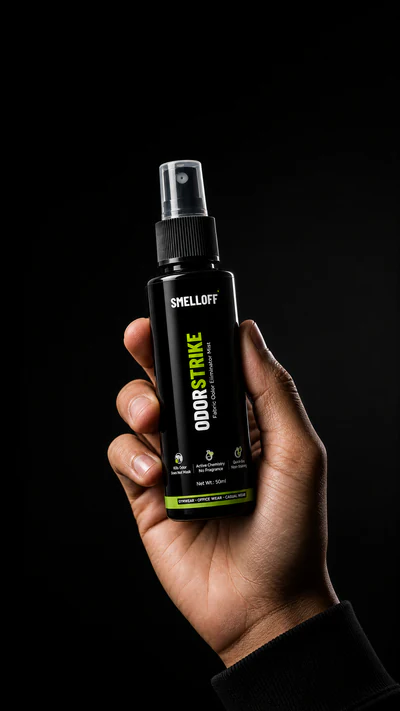
ODORSTRIKE — Fabric Odor Mist
50ml pocket spray for clothes. HPβCD traps odor molecules in the fabric and Zinc PCA neutralises them, instead of covering them with perfume. Dries in 15–30 seconds, up to 8 hours of odor protection on fabric under normal office/commute conditions. Fabric only, never skin.
Buy now View product details