
How Many Times Can You Wear a Shirt Before Washing It?

There is no single number, and the cleaning-industry charts were written for cooler countries. A practical, garment-by-garment answer for Indian heat and humidity, the three checks that decide whether something goes back on or into the bucket, and how to stretch a wear without smelling.
How many times can you wear a shirt before washing it?
In Indian weather, wash a t-shirt or anything worn against the skin after every wear. A formal shirt worn over a vest in AC can usually go two wears if it passes a sniff test at the collar and underarms. Trousers and jeans manage three or four, sweaters three or four. Visible sweat, stains or smell always mean wash.
In this guide6 sections
The question sounds simple and the internet answers it with confidence: shirts once, jeans after five wears, sweaters after six. Then you try to apply that chart to a Chennai October or a Delhi May, and it falls apart by lunchtime.
Wear counts depend on three things the charts leave out: how much you sweat in that garment, what it is made of, and whether anything sits between it and your skin. Here is a version built for how Indians actually dress.
How many wears does each garment get?
Anything that touches skin all day gets one wear; outer layers get several. The American Cleaning Institute's guidance, as published by Utah State University Extension, is t-shirts every wear, jeans and trousers every 3–4 wears and sweaters every 3–4. Adjusted for Indian heat:
| Garment | Indian summer / humid months | Cooler months, AC office |
|---|---|---|
| T-shirt, vest, innerwear | 1 wear | 1 wear |
| Formal shirt, no vest | 1 wear | 1–2 wears |
| Formal shirt over a cotton vest | 1–2 wears | 2 wears |
| Cotton kurta | 1 wear | 1–2 wears |
| Formal trousers, chinos | 2–3 wears | 3–4 wears |
| Jeans | 3 wears | 4–6 wears |
| Sweater, cardigan (over a shirt) | — | 3–4 wears |
| Blazer, jacket | Air after each wear | Clean a few times a season |
These are upper limits, not targets. A single wear on a 38°C day with a two-wheeler commute can finish a shirt that would have lasted two days in a Bengaluru December.
Why does Indian weather cut the number down?
More sweat means more food for the skin bacteria that make odor, and humidity keeps the fabric damp enough for them to keep working. Fresh sweat barely smells; the smell comes from bacteria breaking down what sweat leaves behind.
The American Society for Microbiology describes underarm odor as the work of skin bacteria such as Staphylococcus hominis converting odorless sweat compounds into sulphur-containing thioalcohols, some of the most smell-dense molecules the body produces. A shirt soaks up both the sweat and some of the bacteria. In dry, cool air the fabric dries quickly and the process slows. In a humid Mumbai afternoon it does not, which is why humid cities burn through clean shirts faster.
Does the fabric change the answer?
Yes. Polyester and poly-blends should be washed sooner than cotton, linen or wool. It is the most consistent finding in textile odor research.
In a study published in Applied and Environmental Microbiology in 2014, researchers at Ghent University had volunteers wear cotton and polyester shirts through a fitness session. The polyester shirts smelled more intense and less pleasant after incubation, and they grew more of the micrococci associated with strong odor. Rachel McQueen's group at the University of Alberta found the same ranking with sensors: polyester the most odorous, cotton low to medium and wool the least. So a poly-cotton office shirt that "looks fine" often needs washing a wear earlier than a pure cotton one. The polyester guide explains why.
How do you decide if a shirt can be worn again?
Run three checks: sniff the collar and underarms, look at the collar band, and remember the day it had. If any one fails, it goes in the wash.
- The sniff test, done right. Smell the inside of the collar and the underarm seam, not the chest. Do it after the shirt has hung for a few minutes away from your own body smell. Any sour or musty note means wash.
- The collar check. A grey or yellow line on the inner collar band is skin oil. It will smell by midday the next time you wear it, even if it smells fine now.
- The day it had. A shirt that sat in an AC office for six hours is a different shirt from one that went through a crowded bus, a lunch near a kitchen and a meeting you were nervous about. If you sweated through it, wash it.
How do you get an extra wear without smelling?
Air it properly the evening you take it off, then treat the zones that hold smell before you put it back on. Most second-day smell comes from what you do with the shirt between wears, not from the wear itself.
- Hang it open, not on a chair. A shirt draped over a chair back or thrown on the bed stays damp at the underarms overnight. Put it on a hanger with space around it, ideally where a fan reaches.
- Never put a worn shirt back in the almirah the same evening. It passes its smell to the clean clothes next to it.
- Treat the collar, underarms and upper back in the morning. A fabric odor mist like ODORSTRIKE on those zones, 2–3 sprays each from 15–20 cm, then 15–30 seconds to dry. HPβCD traps odor molecules and Zinc PCA neutralises them, which is different from spraying deodorant on the shirt.
- Wear a cotton vest under formal shirts. It takes the sweat that would otherwise go straight into the shirt and is cheap to wash daily.
For the full morning decision — wash it, mist it or wear it as is — see the decision guide.
Is washing less often actually better for clothes?
For outer layers, yes: every wash costs fabric, colour and shape. Denim fades, formal trousers lose their crease, wool felts and polyester pills. Washing jeans and trousers only when they need it keeps them looking new longer, which our jeans guide covers in detail.
For anything that touches skin, the answer does not change. Underwear, vests, socks, gym and sports clothing and t-shirts are washed after every wear. No spray replaces that.
A fabric odor spray helps a clean-looking garment through one more wear. It does not clean sweat, oil or stains out of fabric and does not replace washing. If the shirt is visibly soiled or smells sour after airing, wash it.
Sources
Hunsaker, T. The Dirt on Laundry: How Often to Wash? Utah State University Extension, 2021 (citing the American Cleaning Institute). extension.usu.edu
Callewaert, C. et al. Microbial odor profile of polyester and cotton clothes after a fitness session. Applied and Environmental Microbiology, 2014. pmc.ncbi.nlm.nih.gov
University of Alberta. How to minimize the lingering smell on your workout clothes (Rachel McQueen). Folio, 2018. ualberta.ca
American Society for Microbiology. The Microbial Origins of Body Odor. ASM.org, 2021. asm.org
Frequently Asked Questions
Can I wear a shirt twice before washing?
A formal cotton shirt worn over a vest in an air-conditioned office can usually manage two wears if the collar and underarms pass a sniff test after airing. T-shirts, and any shirt you sweated through, should be washed after one wear in Indian weather.
How many times can you wear jeans before washing them?
About three wears in hot, humid months and four to six in cooler months, as long as they do not smell and are not stained. Air them between wears.
Do polyester shirts need washing more often than cotton?
Yes. Studies from Ghent University and the University of Alberta both found polyester holds more body odor than cotton, so poly-blend shirts usually need washing a wear sooner.
Is it unhygienic to rewear a shirt?
Not if it is an outer layer that is clean, dry and passes the sniff test. Underwear, vests, socks and anything worn for exercise should be washed after every wear.
Can a fabric spray let me skip washing?
It can help a clean-looking shirt through one more wear by treating the smell in the collar, underarm and back zones. It does not clean the fabric and does not replace washing.
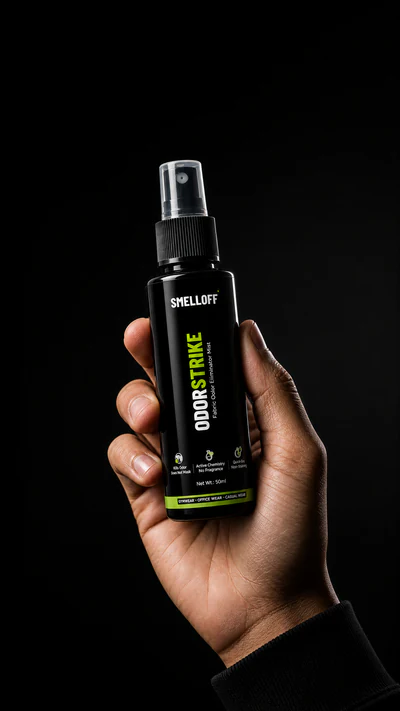
ODORSTRIKE — Fabric Odor Mist
50ml pocket spray for clothes. HPβCD traps odor molecules in the fabric and Zinc PCA neutralises them, instead of covering them with perfume. Dries in 15–30 seconds, up to 8 hours of odor protection on fabric under normal office/commute conditions. Fabric only, never skin.