
How to Keep a Work Uniform Fresh Between Washes

Retail floors, hotel front desks, hospitals' admin wings, security cabins, airline counters, delivery fleets and factory floors: millions of Indians wear a uniform six days a week, often with only two or three sets. Why uniforms smell faster than your own clothes, and a routine that keeps them fresh between washes.
How do you keep a work uniform from smelling between washes?
Rotate at least two sets, wear a cotton vest underneath, and hang the uniform open in moving air as soon as your shift ends. Before the next shift, treat the collar, underarms and back with a fabric odor spray and let it dry. Wash it whenever it is visibly soiled or still smells after airing.
In this guide6 sections
A uniform is the hardest-working garment most people own. It is worn for nine or ten hours, often on your feet, often in a mix of AC and outdoor heat, and usually in a polyester-viscose blend chosen because it survives industrial washing and does not crease. With two sets and a six-day week, each set gets worn three days running unless you wash every night — which, in a monsoon week, it may not dry from.
Why do uniforms smell faster than your own clothes?
Long shifts, synthetic blends and too few sets. Each of those on its own makes clothes smell sooner; uniforms usually have all three.
- Polyester and PV blends hold body odor. In a Ghent University study published in Applied and Environmental Microbiology, polyester shirts smelled more intense and less pleasant than cotton after wear, and grew more of the bacteria tied to strong odor. Most Indian uniforms are polyester-viscose or polyester-cotton.
- Long shifts give bacteria time. Body odor comes from skin bacteria breaking down sweat, as the American Society for Microbiology describes. Ten hours of slow, steady sweat in a warm fabric is a long working day for them too.
- Moving between AC and heat. Security staff, delivery partners and retail staff go in and out of air conditioning all day. Each cycle dampens and dries the fabric, which is exactly when odor builds.
- Back-to-back wear. A uniform worn on Monday and put back on on Tuesday has had one evening to recover, often folded in a bag.
How many uniform sets do you need?
Three is comfortable; two works only with a good routine. If your employer issues two, a third shirt bought at your own cost pays for itself in shirts that last longer.
With three sets you can wash after every wear and still have one drying and one ready. With two, alternate them — never wear the same set two days running — and wash each set every second wear at the latest, or after every wear in summer.
What should you do the moment your shift ends?
Get the uniform off, open and in moving air within the hour. What happens in the first evening decides how it smells the next morning.
- Change before you travel home if you can. A uniform worn on a crowded bus home collects another hour of sweat and street smell.
- Never leave it folded in your bag or locker. A damp uniform rolled up overnight is the fastest way to a sour smell.
- Hang it on a hanger, buttons open, where a fan reaches it. Turn it inside out so the underarms and collar face the air.
- Hang trousers by the hem so the waistband airs.
How do you refresh a uniform before the next shift?
Sniff the collar and underarms, then treat those zones and let them dry. If it passes airing with only a faint smell, a fabric odor spray handles the rest.
Mist the inside of the collar, the underarm seams and the upper back from 15–20 cm: 4–5 sprays for a full shirt, 2–3 for the trouser waistband. Let it dry for 15–30 seconds before you put it on. ODORSTRIKE uses HPβCD to trap odor molecules and Zinc PCA to neutralise them, rather than adding perfume — useful where a strong scent is unwelcome at work, such as a hotel front desk, a hospital reception or a food counter. A 50ml bottle fits in a uniform pocket or locker and gives up to 8 hours of odor protection on fabric under normal office/commute conditions.
On long shifts, use the meal break: step into a washroom, dab off sweat, then treat the collar and underarm fabric of the shirt (held away from your body or taken off) and let it dry before you go back out.
How should you wash uniforms so they stop smelling?
Warm water, inside out, no softener, fully dry before folding. Most persistent uniform smell is a washing and drying problem, not a body problem.
- Turn shirts inside out so the underarms get the most detergent contact.
- Use the warmest temperature the care label allows; a 15-minute cold quick-wash does not lift body oils from polyester.
- Skip fabric softener on polyester uniforms — it coats fibres and traps odor.
- Dry fully in moving air before folding. A uniform that takes all night to dry indoors smells sour by morning, which our indoor drying guide fixes.
- Clean the washing machine itself if everything smells after washing; here is how.
What about uniforms you cannot wash every day?
Blazers, waistcoats and jackets get aired and treated daily, and cleaned a few times a season. Hotel and airline blazers, security jackets and corporate waistcoats are often dry clean or gentle wash only. Air them on a wide hanger every evening, treat the lining at the collar and underarms, and send them for cleaning on a schedule rather than when they smell. Check the care label first; do not spray anything marked dry clean only.
A fabric odor spray keeps a clean uniform fresh between washes. It does not remove stains, grease or sweat marks and does not replace washing. Fabric only, never skin. Not for leather, suede or dry-clean-only items.
Sources
Callewaert, C. et al. Microbial odor profile of polyester and cotton clothes after a fitness session. Applied and Environmental Microbiology, 2014. pmc.ncbi.nlm.nih.gov
American Society for Microbiology. The Microbial Origins of Body Odor. ASM.org, 2021. asm.org
Frequently Asked Questions
Why does my uniform smell even after washing?
Most uniforms are polyester blends, which hold body oils and odor more than cotton. A short cold wash does not lift them, and slow indoor drying adds a sour smell. Wash inside out on the warmest setting the label allows, skip softener and dry fully in moving air.
How many times can I wear a uniform before washing?
In hot or humid months, wash uniform shirts after every wear. In cooler months, with a vest underneath and proper airing, a shirt can manage two wears if it passes a sniff test at the collar and underarms.
Can I use a fabric spray on a polyester uniform?
Yes. ODORSTRIKE is made for cotton, polyester, denim, wool and blends. Spray the collar, underarms and back from 15–20 cm and let it dry for 15–30 seconds.
Will a fabric spray leave a strong smell on my uniform?
No. ODORSTRIKE has a light fabric scent that fades. It traps and neutralises odor rather than adding perfume, which suits workplaces where strong scents are discouraged.
How do I keep a uniform blazer fresh?
Air it on a wide hanger every evening, treat the lining at the collar and underarms, and have it cleaned on a regular schedule. Do not spray dry-clean-only items.
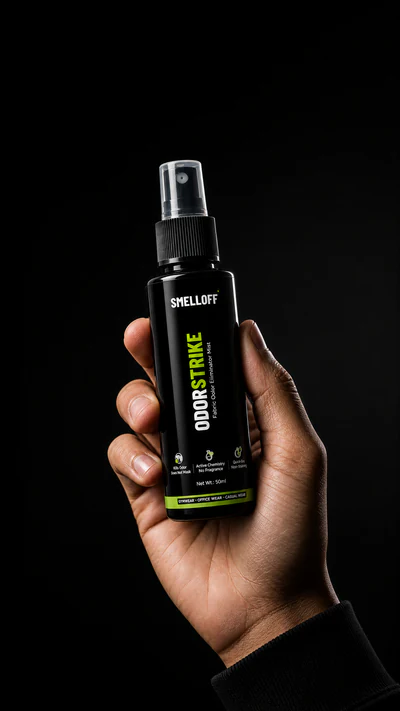
ODORSTRIKE — Fabric Odor Mist
50ml pocket spray for clothes. HPβCD traps odor molecules in the fabric and Zinc PCA neutralises them, instead of covering them with perfume. Dries in 15–30 seconds, up to 8 hours of odor protection on fabric under normal office/commute conditions. Fabric only, never skin.