
Why Does the Washing Machine Make Clothes Smell? 6 Spots to Check
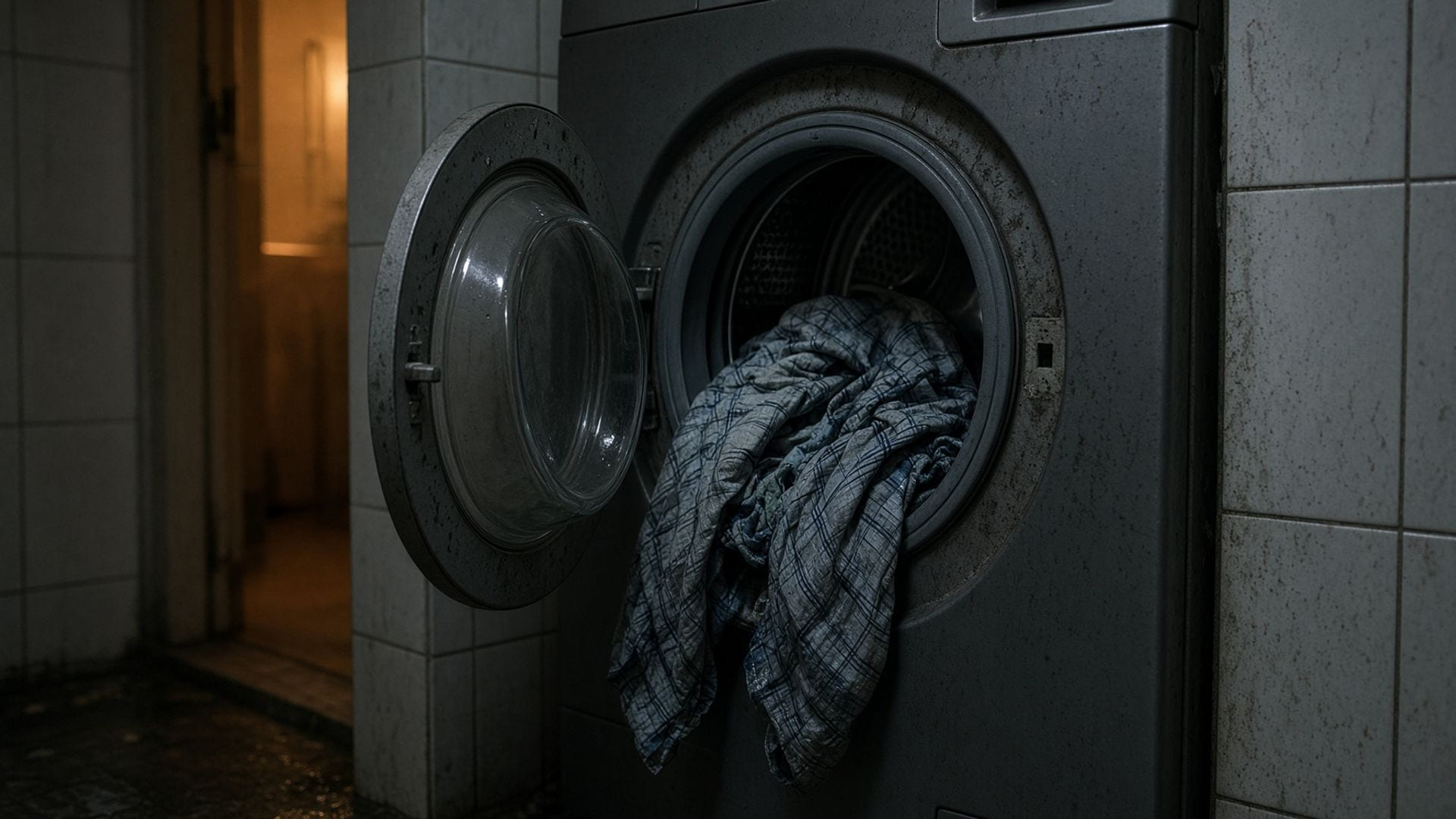
A biofilm in the gasket. A wet load left long enough to go sour. Front-loaders in Indian bathrooms do both.
Clothes come out smelling because the machine put the smell on them: a biofilm in the gasket and drum, a wet load left long enough to go sour, or both. Front-loaders in Indian bathrooms fail more often because the door stays shut. The fix is wiping, heat, and timing — not a stronger detergent, and not a lecture about gym polyester.
In this guide10 sections
- Why do clothes smell when they come out of the machine?
- Two clocks, one sour chemistry
- The gasket is a dark wet fold
- Front-loader vs top-loader in an Indian flat
- The forgotten wet load
- Softener, overdose, and the food the film eats
- How to tell machine-smell from shirt-smell
- Why a rewash often fails
- A maintenance protocol that actually holds
- When the machine is fine and the drying is the problem
A shirt can go into the wash clean of yesterday and come out smelling like a wet cupboard. That is not a fibre mystery and it is not 'the detergent stopped working'. The appliance has a climate. If you feed that climate, it hands the climate back.
Why do clothes smell when they come out of the machine?
Two failure modes, often on the same Tuesday. The machine itself is colonised — rubber gasket, detergent drawer, drum wall, drain filter — and every cycle rinses a little of that colony onto the load. Or the load was fine at the beep and then sat wet in a closed drum until someone remembered it. Those are the same sour chemistry on two clocks: a drum that never dries, and a load that waited.
The wash can add odor
Laundry is supposed to take smell off cloth. A dirty machine and a forgotten wet pile do the opposite. If the load smelled worse coming out than going in, stop blaming the shirt.
Two clocks, one sour chemistry
The compound people describe as 'wet towel left in a bag' is not detergent. On laundry, a well-studied culprit is 4-methyl-3-hexenoic acid, a sour, wet-cloth note produced by Moraxella osloensis — a bacterium isolated from smelly washed textiles and found in washing-machine filters and household wet zones. It is not the only organism in a gasket. It is the one with a name you can hang the smell on.
A biofilm is not dirt you can see and decide to ignore. It is a living film — bacteria and fungi in a slime of their own making — stuck to rubber and plastic where water lingers. Detergent residue, fabric-softener wax, skin cells, lint and hair are food. Warmth is the Indian bathroom. Darkness is the closed door. Time is every night you shut the machine because the bathroom is also a shower.
The machine has a microbiome
Surveys of household washers keep finding the same cast in the detergent drawer and rubber seal: Pseudomonas, Brevundimonas, Acinetobacter, Rhizobium, and, in malodorous machines and towels, Moraxella. Low-temperature washes do not reset that community. They rinse it.
The gasket is a dark wet fold
Front-loaders need a rubber boot to keep the door sealed while the drum throws water. The boot is an accordion of folds. After every cycle those folds hold a ring of water, plus whatever came out of pockets. Peel it back. If you find grey slime, black specks, a forgotten coin and a smell that is bigger than the room, you have located the factory.
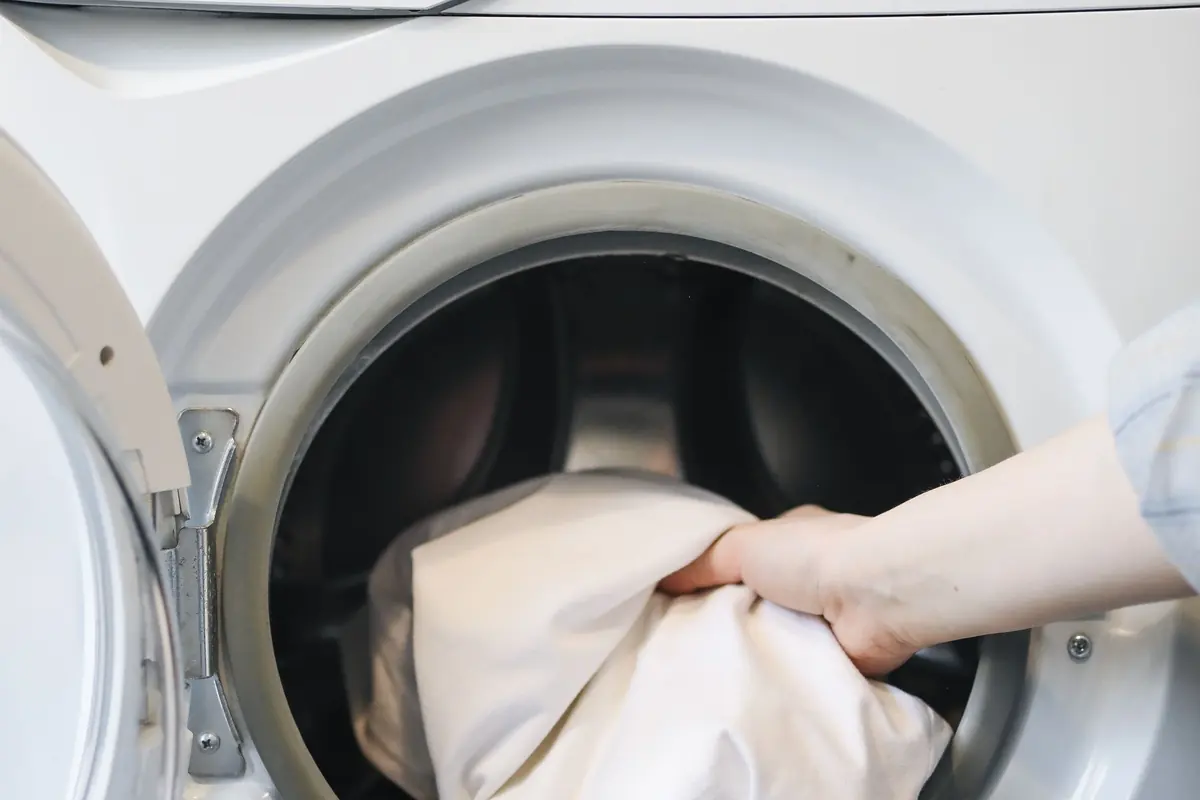
The detergent drawer is the second factory. It stays damp, it is fed concentrated product, and in hard-water cities it grows a fur of residue. The drain-pump filter is the third — standing water, lint, the button that left the shirt last month. People deep-clean the drum with a 'tub clean' sachet and never open the filter. The smell votes for the filter.
Front-loader vs top-loader in an Indian flat
India still runs both, often in the same housing society. The physics is not a brand war. It is whether the wet parts are allowed to dry.
A front-loader is a closed system. The gasket seals it. Moisture stays in. Manufacturers say leave the door ajar. In a 2BHK the machine lives in the bathroom, the bathroom is used, the door of the machine is shut so the bathroom door can close, and the gasket never dries. That is the Indian front-loader problem in one sentence. Energy-efficient, water-thrifty, and a greenhouse unless you fight it.
A top-loader with a pulsator does not have that boot. The tub is open-topped. Air can get in if the lid is left up. People still slam the lid because of lizards, children, and the belief that a closed machine is a tidy machine. A closed wet tub is still a closed wet tub. Semi-automatics fail the same way if the wash tub is left full, or if the spin-load is dumped in a bucket 'for later'.
| Part | Front-loader in a bathroom | Top-loader / semi-automatic | What interrupts it |
|---|---|---|---|
| Door gasket / boot | Folds hold water every cycle. Main factory. | No boot. Not the issue. | Wipe dry after every wash. Leave door ajar. |
| Detergent drawer | Damp, residue-fed, often ignored. | Usually a simpler tray, still gunks up. | Pull it out. Wash. Dry. Dose less. |
| Drum / tub wall | Closed, low-water, biofilm behind the drum. | More open, still slimy if lid stays shut. | Hot maintenance cycle. No softener. |
| Drain / lint filter | Standing water goes sour. | Lint trap or hose; still a swamp if ignored. | Empty on a schedule, not after it stinks. |
| The load itself | Sits sealed if you forget it. | Sits sealed under a closed lid. | Hang within minutes. Never 'until morning' in-machine. |
| The room | Bathroom steam, door shut, no dryer. | Same room problem if that is where it lives. | Door ajar between uses. Exhaust if you have one. |
The bathroom install
Most Indian front-loaders sit next to a shower, under a geyser, with no tumble dryer and no laundry room. Leaving the porthole open fights the household. Do it anyway, even a crack, and wipe the boot. A machine that only opens for the next wash is a terrarium.
The forgotten wet load
Power cut. Office. Maid's day off. 'I'll hang it after dinner.' A wet cotton load in a warm closed drum is a fermentation project. Bacteria already on the cloth and in the machine get hours of moisture and no rinse. The beep was clean-ish. Midnight is sour. Morning is a second wash that people swear does not work.
How long is too long? There is no virtuous number. A load left through a workday in Hyderabad heat is already late. Overnight is late. 'I forgot it for two days' is a reset, not a hang. Rewash on the warmest cycle the fabric allows, hang at once, and treat the machine as contaminated because it just incubated a pile of wet cloth.
Softener, overdose, and the food the film eats
Front-loaders use little water. Extra detergent does not make extra clean. It makes extra residue, and residue is food. Fabric softener is worse for this particular problem: it is designed to deposit a waxy layer. That layer coats the gasket and the drawer as cheerfully as it coats the shirt. You have been feeding the biofilm and calling it freshness.
Vinegar is not a universal odor killer — that autopsy is another page — and dumping it into every wash will not replace wiping the boot. A manufacturer tub-clean or a hot empty cycle has a real job: heat and a maintenance chemistry against the film. The weekly human job is mechanical. If you only add liquids and never take a cloth to the rubber, you are seasoning the machine.
How to tell machine-smell from shirt-smell
- Machine-smell is already there when you open the porthole, before you lift a garment. Sour, wet-cloth, slightly cheesy or musty. The empty drum smells like the load.
- Forgotten-load smell is the same family, but the cloth is the loud thing and the machine may only be guilty of being a closed box for eight hours.
- A single shirt that smells at the pits after a proper dry is a garment-zone or soil problem, not this page.
- Gym polyester that still smells after a good wash is lipids in the fibre. Different chemistry, different article. Do not strip-wash a cotton school uniform because a Dri-Fit explainer told you to.
Sniff the empty machine. Sniff the gasket fold. Sniff a towel that had no sweat on it. If the unused towel stinks, the appliance is the source. If only the worn shirt stinks, stop prosecuting the drum.
Why a rewash often fails
You run the sour load again, cold, with extra detergent, door shut at the end, hang it packed on the rod. You have re-inoculated the cloth in the same dirty box, left it wet, and dried it badly. The rewash can work if you first interrupt the machine, then use a warmer cycle the fabric allows, then hang at once with spacing and air. Skipping the first step is how people decide 'nothing works'.
Heat has a job. So does a cloth on the rubber.
A hot maintenance cycle that never comes with a wiped gasket is a ritual. A wiped gasket with a cold, overstuffed, softened weekly wash is a slower ritual. Do both. Neither is optional in a bathroom front-loader.
A maintenance protocol that actually holds
After every wash, plus one monthly reset
- Hang the load the minute it beeps — Not after dinner. Not in the drum on pause. If you cannot hang now, do not start the cycle. A delayed hang is how a clean wash becomes a sour one without any help from the gasket.
- Wipe the gasket, every time — Peel back the folds. Cloth, dry. Get the ring of water, the lint, the grey film. Leave the door ajar — a crack if the bathroom must close. Front-loader non-negotiable. Top-loader: leave the lid up if lizards can be managed with a mesh or a habit.
- Pull and rinse the detergent drawer — Weekly is better than 'when it looks furry'. Residue is food. Dry it before it goes back. Dose detergent to the load and the water hardness, not to the size of your feelings about yesterday's shirt.
- Skip softener on the wet months, and most other months — It coats the machine and slows drying on the line. If you want less static, use less, rarely. Do not use it as a smell strategy. It is a film.
- Empty the drain filter on a calendar — Standing water in that pocket goes sour and talks back up the drum. Once a month is a grown-up interval. After it smells is an autopsy.
- Run a hot maintenance cycle monthly — Empty drum, hottest programme the manual allows, whatever cleaner the manufacturer specifies. This is for the film you cannot reach with a cloth. Then wipe the gasket again, because the cycle just steamed the boot.
- Empty the machine as soon as it finishes.
- Wipe the front-loader gasket dry after every wash.
- Leave the door or lid ajar so the wet parts can dry.
- Clean the drawer and the drain filter on a schedule.
- Run a monthly hot maintenance cycle as the manual describes.
- Rewash a forgotten sour load warm, then hang at once.
- Shut the porthole 'to keep the bathroom neat' and leave it for days.
- Heap extra detergent because the last load smelled.
- Pour softener in as a deodorant for the drum.
- Leave a wet load overnight and call the morning rewash a mystery.
- Treat a sour unused towel as a polyester problem.
- Ignore the filter until the machine sounds like a drain.
- Hang at the beepIf you can’t hang now, don’t start the cycle.
- Wipe the gasketPeel back the folds; dry the ring, lint and film.
- Door ajarNon-negotiable on a front-loader.
- Rinse the drawerWeekly. Residue is food.
- Dose rightDetergent to the load and water hardness; skip softener.
When the machine is fine and the drying is the problem
An empty drum that smells of nothing, a gasket you wiped, a load you hung immediately — and the shirt still smells after a night on a packed rod — is not this article. That is indoor drying without air. Do not tub-clean a machine that already did its job. Go hang the cloth as if the room were the second half of the wash, because it is.
- Kubota H. et al. — Moraxella Species Are Primarily Responsible for Generating Malodor in Laundry (Applied and Environmental Microbiology, 2012) — Moraxella osloensis isolated from smelly washed textiles produces 4-methyl-3-hexenoic acid, a major laundry malodor component, and shows up on machine filters and other wet household surfaces. Source
- Zinn M-K. et al. — A Comprehensive View of Microbial Communities in the Laundering Cycle (Microorganisms, 2022) — Washing-machine drawers and rubber seals carry a stable community (Pseudomonas, Brevundimonas, Acinetobacter, Rhizobium and others). Malodorous machines and towels are more often associated with Moraxella and skin-related genera. Source
- Consumer Reports — Mold in Your Washing Machine: Mystery and the Menace (2020) — Front-loaders are closed systems: the gasket seals moisture in. Residual moisture after the cycle is named as the biggest contributor to odor-causing growth. Leave the door ajar; dirty laundry seeds the machine. Source
- Jacksch S. et al. — Influence of Sampling Site and other Environmental Factors on the Bacterial Community Composition of Domestic Washing Machines (Microorganisms, 2020) — Door seal, detergent drawer, sump and wash fibres are distinct microbial habitats. The detergent drawer held the highest diversity. Colonisation is named as a source of machine and laundry malodour, not a cosmetic afterthought. Source
Frequently Asked Questions
Why do my clothes smell after the washing machine?
Either the machine is putting biofilm and stagnant-water odor onto the load, or the wet load sat in a closed drum long enough to go sour, or both. Sniff the empty gasket. If that stinks, you found the source.
Why do clothes smell sour if I leave them in the washer?
Wet cloth, warmth, no air, time. Bacteria on the fabric and in the machine keep working. The cycle ended. The climate did not. Hang as soon as it beeps, or you are fermenting laundry.
Are front-loaders worse than top-loaders for smell?
They are worse at drying themselves. The rubber boot holds water in the dark. In Indian bathrooms the door stays shut, so the boot never dries. Top-loaders fail too if the lid stays down on a wet tub, but they do not have that accordion of wet rubber.
Does fabric softener stop washing-machine smell?
No. It feeds it. Softener is a deposit by design. On a low-water front-loader that deposit coats the gasket and drawer, which is food for the film that makes the smell. Skip it.
How often should I clean a front-loader gasket in India?
Wipe it dry after every wash. That is the whole sentence. A monthly deep-clean without the daily wipe is how the film comes back between rituals.
Is this why gym clothes still smell after washing?
Usually not. Gym synthetics holding skin oils through a cold wash is a fibre-and-lipid problem. This page is the appliance handing sourness to whatever you put in it, including unused towels. If only the Dri-Fit stinks and the bath towel is fine, go to the gym page, not the gasket.
Will a hotter wash alone fix a smelly machine?
It helps the film you cannot reach. It does not replace wiping the boot, emptying the filter, or hanging the load on time. Heat without access is a scented drum for one cycle.
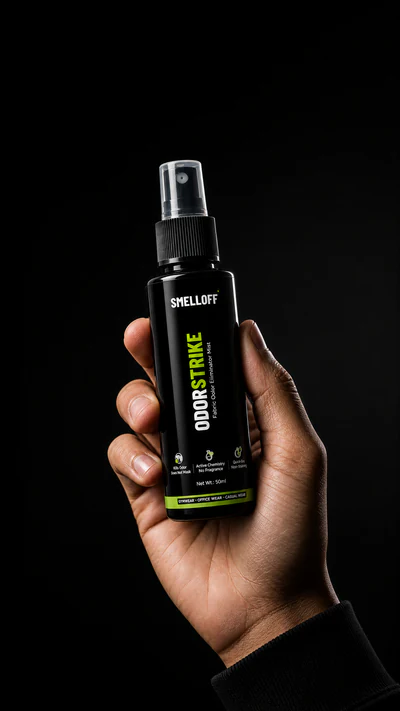
ODORSTRIKE — 50ml Fabric Odor Mist
Clothing-only · ₹229 prepaid · Free shipping pan-India
Buy now — ₹229 View product details