
How to Dry Clothes Indoors Without a Damp Smell
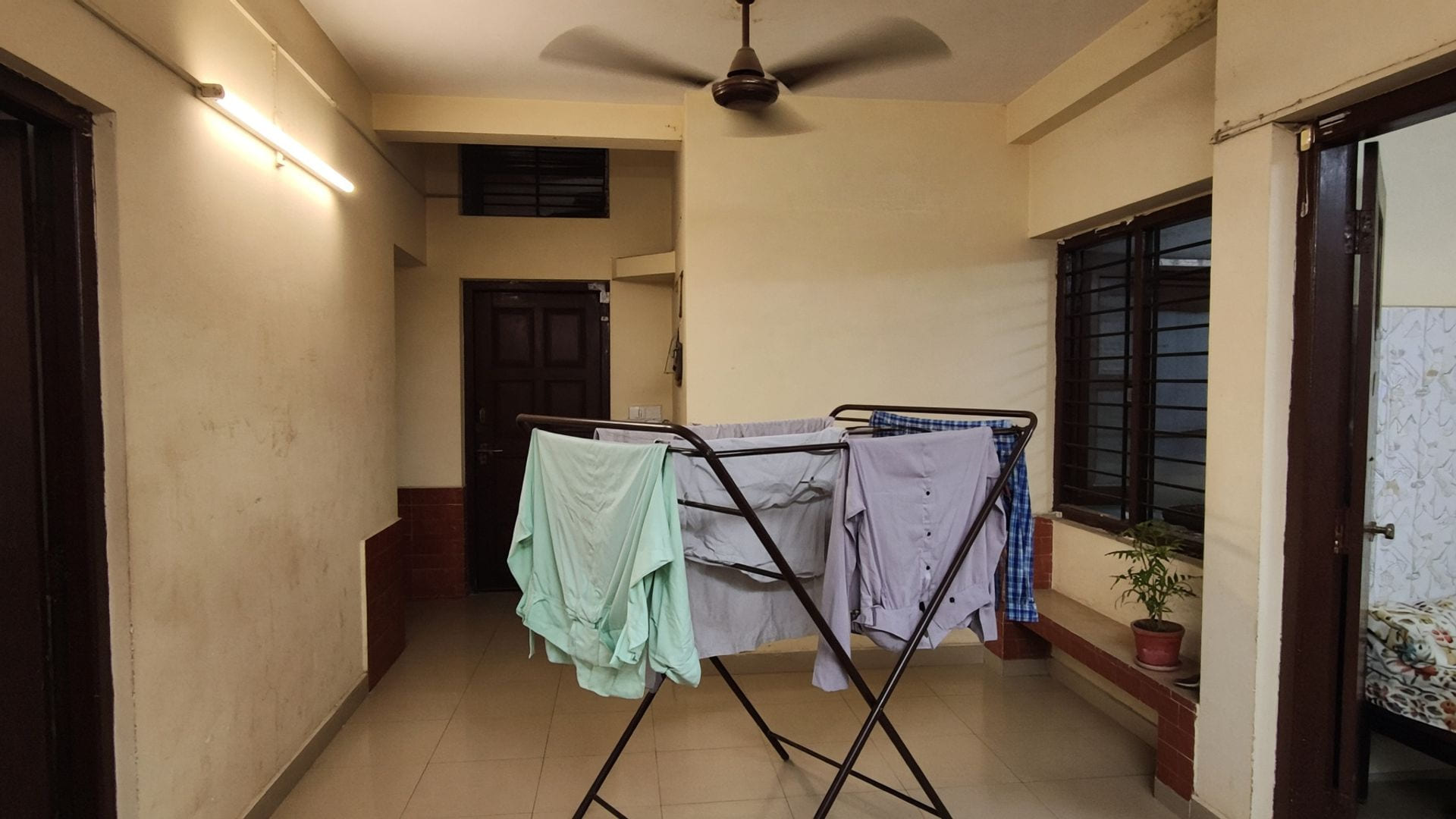
A ceiling rod in a closed bathroom is not a drying system. Space, air, a balcony hour, and seams that are actually dry.
Space the garments so no two damp pits share a fold, put moving air on them, steal a balcony hour when the rain pauses, and do not call a shirt dry until the seams are dry. Still air in a closed Indian flat is how clean laundry starts smelling like the room it dried in.
In this guide12 sections
- How do you dry clothes in an Indian apartment without them smelling?
- Why still air is the actual enemy
- The ceiling rod is a system, not a dump
- Spacing so the pits do not overlap
- The balcony hour
- Point the fan at the cloth
- The monsoon window protocol
- Dry to the seam, then wait once more
- Night loads, bathrooms, and the 10pm wash
- Airing a worn shirt is not the same job as drying a wet one
- The indoor drying protocol
- When the method has already failed
Most Indian apartments do not have a garden, a dryer, or a terrace that is actually yours. They have a ceiling rod, a balcony the size of a yoga mat, a fan, and a window that is either raining or facing someone else's drying. The method is not 'more detergent'. It is airflow, spacing, and an honest definition of dry.
How do you dry clothes in an Indian apartment without them smelling?
Hang the load as soon as the cycle ends. Give every garment its own air. Point a fan at the cloth, not at the sofa. Use the balcony for the hour it is not raining. Finish indoors if you have to. Touch the seams before you fold. If the underarm panel, the collar fold or the waistband is still cool and slightly heavy, it is not dry. It is damp wearing a dry surface.
Dry is a seam test, not a glance
A shirt that looks dry on the chest and is still wet in the pit will smell like the room by morning. Pinch the double layers. If they are cool, wait.
Why still air is the actual enemy
Fabric dries because water leaves the fibre and enters the air around it. If that air is already wet, and not moving, the water has nowhere to go. The shirt sits there looking busy. It is not drying. It is holding a private climate against its own cloth.
Moving air strips the saturated layer off the fabric surface and replaces it with slightly drier air, which restarts evaporation. That is why a ceiling fan on a spaced rod beats a 'well ventilated' room with the fan off. Heat without movement is a closed kitchen. Movement without heat still works.
Humidity is capacity, airflow is the pump
The US EPA's practical rule for indoor mould is moisture control: dry wet materials within 24–48 hours, and keep indoor relative humidity below 60 percent, ideally 30–50. An Indian monsoon room often sits above that for weeks. You cannot legislate the monsoon. You can move air across cloth so the drying window closes before the cloth becomes a damp habitat.
This page is the method. The chemistry of the musty note that appears when that window stays open — geosmin, the wet-cupboard smell — lives on the monsoon page. Do not wait for the smell to name the problem. Close the window that creates it.
The ceiling rod is a system, not a dump
The rod above the living-room fan is the default clothesline of urban India. It is also how a whole wash becomes one thick garment. You hang the shirts, then the towels, then the school uniforms, then the jeans, until the rod looks full and you feel efficient. You have built a damp sandwich.
Load it like a map
- Shirts and kurtas on hangers, not folded over the rod. A hanger opens the pit and the placket. A rod fold closes both.
- Towels and bedsheets at the ends, with a palm of space, because they hold the most water and throw it into whatever they touch.
- Innerwear and socks on a separate small rack or the back of a door with the door ajar — not stuffed between two jeans.
- Heavy denim last, and never in the middle of the rod, where it will drip onto everything already 'almost dry'.
If the rod only fits eight garments without them touching, you have an eight-garment rod. The rest wait on hangers on the fan hook, the curtain rod, the back of a chair. Ugly. Faster. The smell does not care about your interior.
Spacing so the pits do not overlap
Two t-shirts hung so the underarms kiss will dry as one padded vest. The pit is already the slowest zone on a shirt — double cloth, residual body soil even after a wash, a fold if you used the rod instead of a hanger. Press two of those zones together and you have invented a climate.
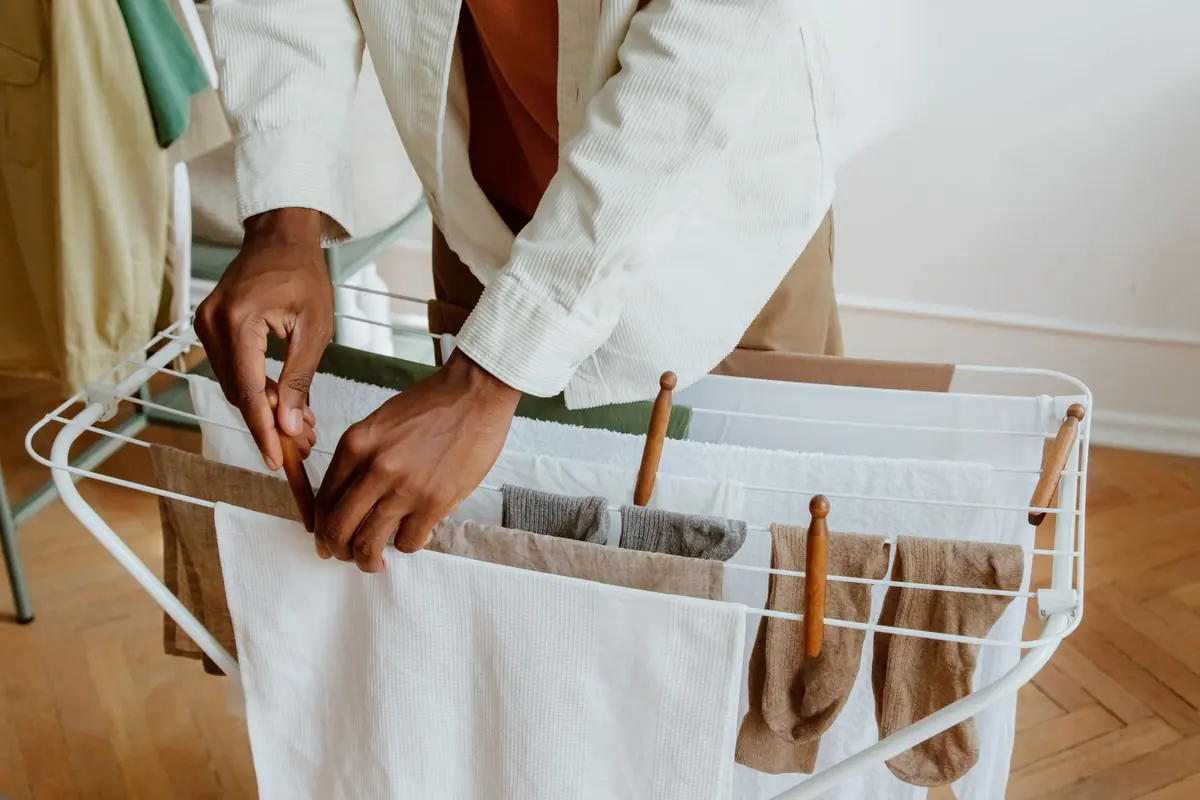
Leave a finger of air between garments at the widest point, not at the hem. Hems hang apart while chests and pits still touch. That is the usual lie of a packed rod. Turn shirts to face the fan. Inside-out is useful on dark cotton so the pit panel, not the print, takes the air.
The 2BHK drying map
Rod over the fan. Clothes horse in the corridor if the living room is a bedroom by 10pm. Balcony for the rain-break hour. Never the bathroom unless it has a working exhaust and an open door, which most do not. The bathroom is a steam cupboard that happens to have a tap.
The balcony hour
A balcony is not automatically outdoors. A three-foot slab facing a shaft, with the neighbour's clothes on the other side of the grill, is a damp corridor with a view. Use it when three things are true: it is not raining onto the cloth, there is some moving air, and you will bring the load in before the next shower, which in July is a scheduling problem, not a vibe.
The honest use of an Indian balcony is a timed burst. Hang the spaced load. Steal forty minutes to two hours of actual air. Bring it in before the cloth takes rain, shaft-smell, or the neighbour's cigarette. Finish on the indoor rod with the fan on. People who leave a full wash on the balcony overnight in monsoon are not drying. They are marinading.
Point the fan at the cloth
The cheapest dryer in an Indian home is already on the ceiling. Turn it toward the rod — or put a pedestal fan on the floor aimed across the hangers, not blasting one towel in the face. Cross-flow beats a single hot blast. You want air changing at the fabric surface, not a shirt flapping like a flag while the pits stay closed.
A closed AC bedroom is not a drying room unless you accept the trade. The machine pulls moisture out of the air, which helps evaporation, and it also recirculates the same cabin air over damp cotton, which can leave a sweet-stale room note on the cloth. If that is the only dry room you have, run the fan as well, keep the load spaced, and do not fold into the almirah from that room until the seams pass the pinch test. The stale-AC story is a different page. The method here is still airflow.
The monsoon window protocol
Open the window for air, not for rain. A grill window on the windward side during a squall will wet the load you just hung and add street smell. Crack it on the leeward side, or open it in the gap between showers, and pair it with the fan so the room actually exchanges air instead of swirling.
Cross-ventilation — two openings, a path through the room — is the adult version of 'I opened a window'. One window in a closed 2BHK just makes that wall interesting. If you only have one opening, the fan is not optional. It is the other opening.
You cannot dry faster than the air allows
On a still 85 percent humidity afternoon, even a perfect rod will be slow. The job is to be less slow than mould's schedule, not to pretend a closed bathroom will finish jeans by dinner. Split the load. Dry school uniforms and tomorrow's shirt first. Let the towels wait on a second shift.
Dry to the seam, then wait once more
The surface of a cotton shirt dries first. The collar band, the underarm panel, the waistband, the jeans thick-seam at the fork — those are last. Folding on a dry-looking chest is how the almirah gets a sour corner by Wednesday.
- Pinch the underarm seam. If it is cool or dark-damp, keep hanging.
- Open the collar and feel the inner fold, not the outer show-side.
- For trousers, check the waistband inside and the thick inner-thigh seam.
- For towels, the middle of the panel, not the hem. Towels lie.
- When it passes, give it another twenty minutes in moving air. That is the margin monsoon eats.
Night loads, bathrooms, and the 10pm wash
The machine finishing at 10pm is a standard Indian plot. You will not get sun. You still hang. A wet load left in the drum overnight is a different failure — that is the machine page — but dumping the same load in a plastic basket 'until morning' is the same chemistry in a different bucket.
Hang what you can with the fan on. Prioritise shirts, school wear, anything that has to leave the house in the morning. Towels and jeans can take the second shift at 6am, including a balcony hour if the sky is behaving. Do not use the bathroom as the night dryer unless the door stays open and an exhaust actually runs. A closed bathroom after a shower is a rainforest. Your 'drying' clothes are a humidifier with sleeves.
| Setup | What the cloth experiences | Smell risk |
|---|---|---|
| Packed ceiling rod, fan off, doors shut | One thick damp object in still air | High by morning |
| Bathroom, door closed, after a shower | Steam added to wet fibre | Highest |
| Spaced hangers, ceiling or pedestal fan | Moving air at the surface, seams still need time | Low if you wait for seams |
| Balcony hour, then indoor fan finish | Burst of outdoor air, then controlled indoor dry | Lowest in monsoon if you beat the rain |
| AC bedroom, no fan, folded from 'feels dry' | Drier air, recirculated room note, hidden seam damp | Medium — stale more than musty |
| Almost-dry stack in the almirah | Sealed damp in the dark | Guaranteed by Wednesday |
Airing a worn shirt is not the same job as drying a wet one
A washed load is full of water. A worn office shirt is mostly dry, with warm-damp zones at the pit, collar and back. Airing the worn shirt is a short protocol: hanger, open the pit, twenty to forty minutes of moving air, then decide if it is another wear or a wash. Do not hang a sweaty shirt against a wet towel on the same rod. You will transfer moisture into a garment that was trying to lose it.
The wash-or-wear decision is its own page. The drying rule underneath it is the same: air has to move, pits cannot overlap, and you do not imprison a still-damp garment in an almirah because the clock said bedtime.
The indoor drying protocol
From spin cycle to almirah without the room-smell
- Empty the machine at once — Wet cloth in a closed drum is a delay you will pay for twice — once as sour laundry, once as a wetter indoor hang. Hang within minutes, not after dinner.
- Shake open, then hang on the right tool — Shirts and kurtas on hangers. Towels and sheets with a full panel exposed. Nothing folded over the rod if you can help it. Inside-out for pit panels.
- Space so nothing important touches — A finger of air at the chest and underarm, not only at the hem. If the rod is full, split the load. A second shift is faster than a packed first shift that never finishes.
- Turn on moving air — Ceiling fan over the rod, or a pedestal fan across the hangers. Open a window that is not raining in. Bathroom only with door open and exhaust on.
- Steal the balcony hour if you have one — Spaced load, rain not hitting cloth, bring it in before the next shower. Finish indoors. Do not leave it out overnight in monsoon as a personality trait.
- Dry to the seam, then the extra twenty minutes — Pinch pits, collar fold, waistband, towel centre. When they pass, wait a little longer in moving air, then fold. Almost-dry is how cupboards learn to smell.
- Hang within minutes of the cycle ending.
- Use hangers for shirts so the pits open.
- Leave a finger of air at the widest point of each garment.
- Run a fan at the drying load, not as room décor.
- Use the balcony as a timed hour, then finish indoors.
- Pinch seams before you fold.
- Pack the ceiling rod until it looks 'done'.
- Dry in a closed bathroom after a shower.
- Leave a wet load in a bucket until morning.
- Fold on a dry-looking chest with a cold pit.
- Hang two underarms against each other 'just for tonight'.
- Call monsoon balcony-overnight a drying strategy.
- Empty at onceHang within minutes, not after dinner.
- Shake and hangShirts on hangers, inside out for the underarm panels.
- Space itIf the rod is full, split the load.
- Move the airCeiling or pedestal fan across the hangers.
- Dry to the seamCollar band, underarms and waistbands dry last. Check them.
When the method has already failed
If the cloth is dry to the seam and still smells like a cupboard, you are no longer in a drying problem. You are in a musty-compound problem, and that is the monsoon page. If the cloth came out of the machine already sour, look at the drum and the hours the load sat — that is the machine page. This page has one job: do not manufacture the next smell while the laundry is trying to become dry.
- US EPA — A Brief Guide to Mold, Moisture and Your Home — Moisture control is mould control. Dry wet materials within 24–48 hours. Keep indoor relative humidity below 60 percent, ideally 30–50. Air movement is named as a practical drying tool. Source
- World Health Organization — Guidelines for Indoor Air Quality: Dampness and Mould (2009) — Persistent dampness and a musty odour are practical indicators that a material has stayed wet too long. The health advice is to prevent dampness, not to perfume it. Source
- India Meteorological Department — Monsoon-season relative humidity across large parts of India routinely sits in the range where indoor air has little spare capacity to take water off wet cloth. That is the climate the apartment protocol is built for. Source
- US EPA — Mold Course, Chapter 2 (Humidity) — Indoor RH at or above 60 percent is treated as a moisture problem. Increasing air circulation and temperature increases drying speed. Still, humid rooms are named as a growth condition, not a laundry strategy. Source
Frequently Asked Questions
How do I dry clothes indoors in an Indian apartment without the damp smell?
Space them, put a fan on them, and do not fold until the seams are dry. A packed rod in still air is the usual reason a 'clean' wash smells like the living room. The bathroom is almost always the wrong room.
Is a ceiling fan enough, or do I need sun?
Sun is a bonus, not the requirement. Moving air is the requirement. A fan on a spaced load will finish a cotton shirt in conditions where a packed rod in a 'sunny' closed room will not. Steal sun on the balcony when it exists. Do not wait for it.
How much space should I leave between hanging clothes?
Enough that the widest parts do not touch — chests, pits, towel panels. A finger of air at the pit is the test. Hems hanging apart while pits kiss is how people think they spaced the load and still get a smell.
Can I dry clothes in the bathroom?
Only if the door stays open and an exhaust or window actually moves air, and you are not showering in there while the load hangs. Most Indian bathrooms fail all three. Use the living-room rod and a fan.
What if it is raining and I have no balcony?
Then the protocol is indoor-only: hangers, spacing, fan, split the load, dry-to-the-seam. It will be slower. It will still beat a closed bathroom. Prioritise tomorrow's clothes on the first shift.
When is a shirt actually dry enough to put in the almirah?
When the underarm seam, the inner collar fold and any waistband or cuff double-layer are dry to a pinch, plus a short extra spell in moving air. A dry chest is not a dry shirt.
Does this replace dealing with monsoon mustiness?
No. This is how you avoid manufacturing it. If the garment already smells of wet cupboard after it is fully dry, that is mould chemistry, not a hanging tip — and it is a different page.
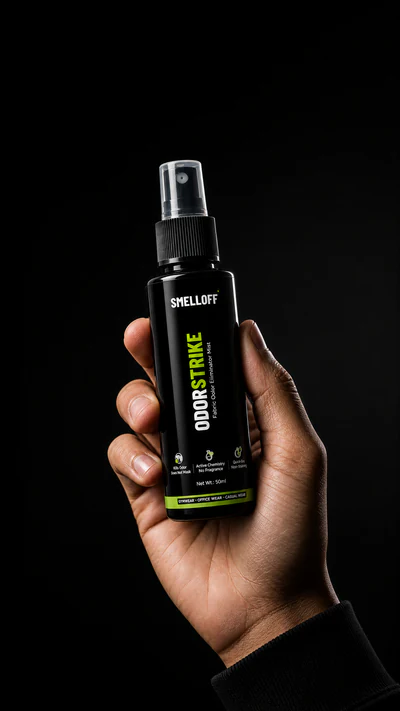
ODORSTRIKE — Fabric Odor Mist
50ml · ₹229 · Cash on Delivery available · For clothing fabric only
Buy now — ₹229 View product details