
Why Clothes Smell Musty in Monsoon (and How to Fix It)
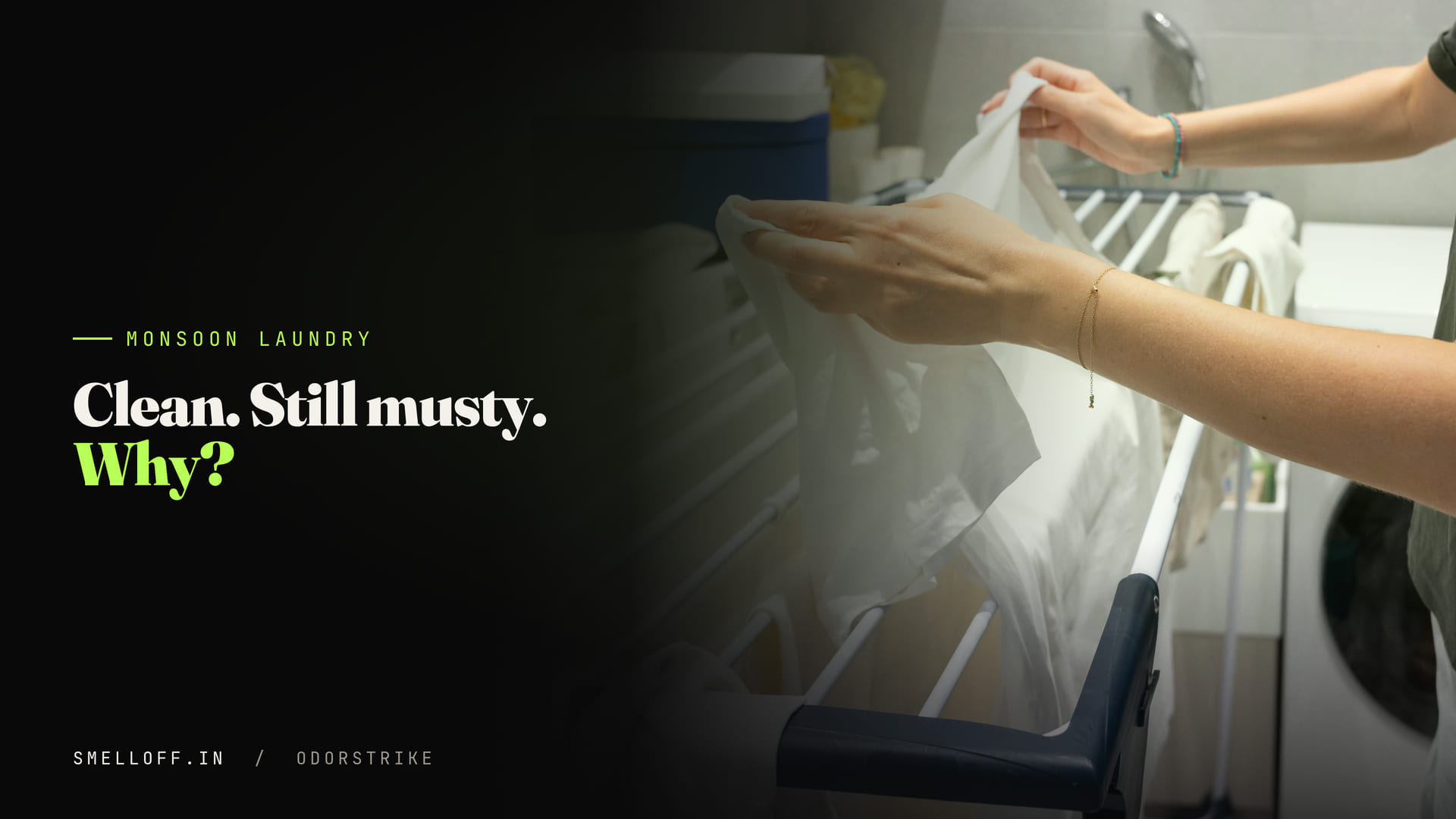
The smell that arrives after the wash, not before it. What is actually being produced on the fibre while your shirt hangs in the balcony for eight hours, and what removes it.
Why do clothes smell musty in monsoon?
Clothes smell musty in monsoon because fabric that takes hours to dry stays damp long enough for mould and bacteria on the fibres to release 1-octen-3-ol and geosmin, the compounds behind that wet-cupboard smell. A cold re-wash rarely removes them and fabric softener slows drying further. Drying the garment properly, then treating it, is what works.
In this guide6 sections
Every year from June the same complaint arrives: the clothes are clean, the wash cycle ran fine, and the shirt still smells like the inside of an old almirah. People assume the machine has gone bad or the detergent has stopped working. Neither is usually true.
The musty smell is not left over from before the wash. It is manufactured afterwards, on clean fabric, during the hours the garment spends drying in air that has no capacity left to absorb water. That distinction matters, because it means the fix is not a better detergent.
What actually causes the musty smell?
Two compounds do most of the work: 1-octen-3-ol and geosmin. Both are produced by mould and by common soil bacteria, and both need only moisture and time.
1-octen-3-ol is often called mushroom alcohol, because it is the dominant smell of raw mushrooms. Geosmin is the smell of the first rain on dry ground. On its own, in a field, geosmin is pleasant enough that perfumers use it. Coming off a shirt collar it reads as damp, stale and slightly earthy, and the human nose is unusually sensitive to it. Most people can detect geosmin at concentrations far below what they can detect for ordinary household smells.
Both belong to a group called microbial volatile organic compounds. The World Health Organization's guidance on dampness and mould treats that characteristic musty odour as one of the practical indicators that a material has stayed wet for too long. In a building that means a wall. On your balcony it means a pair of jeans.
This is worth separating from sweat smell, which people often lump in with it. Sweat odor on fabric comes from a different set of compounds, mainly 3M2H and isovaleric acid, produced when skin bacteria break down what the body leaves behind in the weave. A garment that was worn, sweated in, and then washed and dried badly can carry both smells at once, which is why it can seem like nothing helps.
If the smell is strongest when the garment is warm or slightly damp and fades when it is bone dry, you are dealing with musty compounds. If it appears an hour after you put a clean shirt on, that is sweat odor and it is a different problem.
Why does re-washing make it worse?
Because a re-wash puts the garment straight back into the conditions that created the smell. You remove some of the compounds, then hand the fabric another six hours of damp.
Indian households mostly wash cold. Cold water is kinder to colours, cheaper, and it is what a standard cycle defaults to. It is also not warm enough to shift the oily residue that odor-producing bacteria sit in, so a cold cycle removes the surface and leaves the foundation. Run that cycle a second time and you have doubled the drying load without changing the underlying condition.
Fabric softener is the part people get wrong most often, because it is marketed as the solution to exactly this complaint. Softener works by depositing a thin conditioning layer over the fibre. That layer is water-repellent by design, which is what makes the fabric feel smooth. It also means the garment releases moisture more slowly and stays damp for longer. You have made the drying window worse and added a fragrance that sits on top of the musty note instead of removing it. The result is a shirt that smells of lavender and cupboard at the same time.
There is a related trap with the machine itself. A front-loading drum that is closed straight after a cycle keeps a film of water and a rubber gasket in the dark, which is a reliable way to grow the same organisms and then transfer them onto the next load. Leaving the door open between washes costs nothing.
Why is indoor drying in high humidity the real problem?
Fabric dries because water moves from the wet cloth into drier surrounding air. When that air is already close to saturated, the water has nowhere to go, and the garment simply stays wet.
Through July and August, relative humidity in Mumbai, Chennai, Kochi and coastal Andhra routinely sits above 80 per cent for days at a stretch, and Hyderabad is not far behind during an active spell. Hang a wet cotton shirt in a closed room at that humidity and it can take most of a day to dry. Hang it in a bathroom, which is the default for a lot of flats, and it may never fully dry between wears.
The practical consequence is that airflow matters more than heat. Air that is moving carries the saturated layer away from the fabric surface and replaces it with slightly drier air, which restarts evaporation. A ceiling fan on a drying rack will beat a closed balcony on a still, wet day, even though the balcony is nominally outdoors. Spacing matters for the same reason. Two garments touching on a line dry as one thick garment.
Here is what the common fixes actually do, which is not always what they are sold as doing.
| What you do | What it does to the musty smell | Realistic time |
|---|---|---|
| Re-wash cold, dry indoors again | Removes some compounds, then produces a fresh batch during drying | 6–10 hrs |
| Add fabric softener | Slows drying and layers fragrance over the smell | 8–12 hrs |
| Wash warm, dry with a fan and spacing | Removes the residue and closes the drying window | 3–5 hrs |
| Iron or steam the dry garment | Drives off some residual moisture, does little to the odor itself | 2–3 min |
| Fabric odor mist on a dry garment | Traps and neutralises the odor already on the fibre | 15–30 sec |
How do you reset a garment without water?
Get it genuinely dry first, then treat the three zones that hold odor. Spraying a damp garment adds moisture to a problem made of moisture, so the order is not optional.
Dry means dry to the touch at the seams and the double-layered areas, not just across the flat of the back. Collars, cuffs, waistbands and the underarm panel hold water longest because they are two or three layers thick. Those are also, unhelpfully, the zones that carry the most odor.
Once the garment is dry, a fabric odor mist works on a different principle from a wash. ODORSTRIKE carries four actives in a fast-drying water base. HPβCD, a modified sugar ring, forms inclusion complexes with odor molecules, which in plain terms means the molecule gets held inside the ring and stops reaching your nose. Zinc PCA neutralises what remains. Triethyl citrate lowers the local pH on the fibre and acts as a competing substrate, and zinc gluconate reduces how quickly the odor comes back. The mechanism behind the trapping step is covered properly in the HPβCD guide.
The practical version: hold the bottle 15 to 20 centimetres away, use two or three light passes across the inside collar, the underarm panels and the upper back, and stop before the fabric looks wet. It dries in 15–30 seconds and gives up to 8 hours of odor protection on fabric under normal office/commute conditions. Because there are no oils, no dyes and no glycerine in it, there is nothing left to mark a light shirt. The full technique, including how many sprays a garment actually needs, is in the usage guide.
On silk, wool, zari and anything labelled dry-clean only, spot-test a hidden seam first and let it dry fully before you judge it. On those fabrics the risk is plain water, not the actives, and that applies to any spray. There is more on which fabrics need care in the staining guide.
When do you genuinely need to re-wash?
When the garment is dirty, when it has been wet for days, or when you can see mould. A mist is for a clean garment that has picked up a smell. It is not a shortcut around laundry.
Visible mould is the clearest line. Black or green speckling on cotton is a colony that has grown into the fibre, and no spray removes it. That is a hot wash, sunlight if you can get it, and on badly affected items an honest assessment of whether the garment is worth saving.
The second line is time. A load left in the drum over a long weekend, or a bag of clothes that got soaked on the way home and stayed packed, has had days rather than hours to develop. Treating the surface of that will not reach what is in the weave.
The third is simply dirt. If the shirt has been worn twice in Hyderabad summer, the answer is a wash. A mist buys you the wear between washes and the situation where washing is not available or not sensible, which in monsoon is often the case because the drying is the bottleneck rather than the machine.
A fabric odor mist does not remove visible mould, does not fix a garment that has been wet for days, and is not a substitute for washing dirty clothes. It resets a clean, dry garment that has picked up a smell. Everything above that line still needs water.
A monsoon routine that actually holds
Five habits remove most of the problem, and none of them cost anything. The aim is to shorten the window in which fabric is wet.
- Hang the load within minutes of the cycle ending. Wet laundry sitting in the drum is the single biggest cause.
- Give every garment space on the line. Overlapping items dry as one thick item.
- Run a fan at the drying rack. Moving air beats warm still air in high humidity.
- Skip softener during the wet months. It is working against you.
- Leave the machine door open between loads so the drum and gasket dry out.
Then treat the garment you are about to wear rather than the whole wardrobe. Collar, underarms, upper back, half a minute, and you have the wear back. If the smell you are chasing is sweat rather than damp, the mechanism and the fix are slightly different, and this explainer covers where the two categories separate.
Sources
World Health Organization. WHO Guidelines for Indoor Air Quality: Dampness and Mould. WHO, 2009. who.int
American Society for Microbiology. The Microbial Origins of Body Odor. ASM.org, 2021. asm.org
India Meteorological Department. Monsoon and humidity observations. mausam.imd.gov.in
Frequently Asked Questions
Why do my clothes smell musty even after washing them?
Because the smell is created after the wash, not before it. A garment that takes six or eight hours to dry indoors stays damp long enough for mould and bacteria already on the fibres to release 1-octen-3-ol and geosmin. The detergent removed the dirt, but the drying conditions built a fresh batch of musty compounds. Fixing the drying is what fixes the smell.
Does fabric softener help with monsoon musty smell?
It usually makes it worse. Softener works by depositing a thin conditioning layer on the fibres, and that layer is water-repellent, so the garment holds moisture for longer and dries more slowly. Slower drying is the exact condition that produces the musty smell. The softener fragrance then sits on top of the musty note rather than removing it, which is why the shirt smells of both.
Can you remove musty smell from clothes without washing them again?
Yes, if the garment is properly dry and not visibly mouldy. Get it fully dry first with airflow, then treat the collar, underarm panels and upper back with a water-based fabric odor mist. ODORSTRIKE uses HPβCD to trap odor molecules and Zinc PCA to neutralise them, dries in 15–30 seconds and gives up to 8 hours of odor protection on fabric under normal office/commute conditions. It does not replace washing a dirty garment.
What is the difference between musty smell and sweat smell?
They come from different compounds. Musty smell is mostly 1-octen-3-ol and geosmin, produced by mould and soil bacteria in damp conditions, and it reads as wet cupboard or old rain. Sweat smell comes from compounds such as 3M2H and isovaleric acid, produced when skin bacteria break down what your body leaves in the fabric. A garment stored damp can carry both at once.
How long can clothes stay damp before they start to smell?
In practice the trouble starts once drying stretches past a few hours, which is normal for indoor drying in monsoon humidity. A garment left balled up in a bucket or a machine drum overnight will almost always smell by morning. The single most effective habit is not letting wet laundry sit: hang it out within minutes of the cycle finishing, with space and airflow around each item.
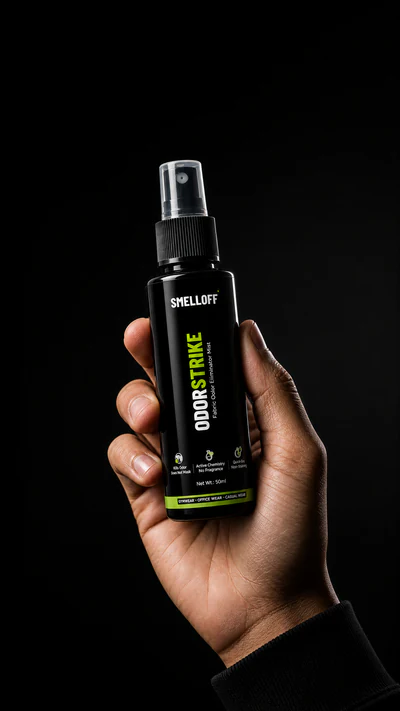
ODORSTRIKE — Fabric Odor Mist
50ml pocket spray. HPβCD traps the odor molecule, Zinc PCA neutralises it. up to 8 hours of odor protection on fabric under normal office/commute conditions. Dries in 15–30 seconds, glycerine-free and oil-free with no stiff residue. Fabric only, never skin.
Read Next
How to Use ODORSTRIKE: Sprays, Zones and Timing