
What Is a Fabric Odor Eliminator?

A fabric odor eliminator isn't perfume, air freshener or deodorant. It's a specific category that neutralises smell on clothing at a molecular level. Here's exactly how it works and what to look for.
What is a fabric odor eliminator?
A fabric odor eliminator is a spray that removes smell from clothes by neutralising the odor compounds trapped in the fibres, rather than masking them with fragrance like a perfume or air freshener. A mist such as ODORSTRIKE traps odor molecules with HPβCD and neutralises them with Zinc PCA, goes on the fabric not the skin, and dries clear with no stiff residue.
In this guide5 sections
"Fabric odor eliminator" sounds like marketing language for an air freshener you point at your shirt. It isn't. It's a distinct product category with a specific job: removing smell from clothing — not the air, not your skin — by acting on the odor molecules themselves. Once you understand the difference between eliminating and masking, you can read any label in the category and know in seconds whether it actually works.
Let's define it properly, then look at the chemistry, the ingredients that matter, and how to use one correctly.
What is a fabric odor eliminator (and what isn't it)?
A fabric odor eliminator is a liquid you mist onto fabric, where it acts on the compounds responsible for smell. It is not a perfume (which adds a scent on top), not a room air freshener (which scents the air), and not a deodorant (which works on your skin to slow sweat and bacteria). It's the only one of the four that targets the smell already living in your clothes.
This matters because the smell that bothers you isn't on your skin — your morning shower handled that. It's in the fabric: the shirt, the jacket, the gym tee that absorbed yesterday's sweat. Fresh sweat is nearly odorless; the smell is created when skin bacteria break it down into volatile compounds, which then sit in the cloth.(American Society for Microbiology) That's why a deodorant and a fabric mist solve different problems, and why people who keep reapplying deodorant still notice the smell returning.
How does masking differ from neutralizing?
Masking is the cheap, common approach. You add a strong fragrance that your nose notices instead of the bad smell. The odor compounds are still there; they're just outnumbered for a while. As the fragrance fades — and it fades fast on a warm body — the original smell comes back, now mixed with stale perfume. Anyone who's sprayed deodorant over a sweaty shirt knows the result.
Neutralising is chemically different. Instead of adding a smell, the active ingredient changes or captures the odor molecule so it can no longer reach your nose. There's nothing to fade, because the smell source has been deactivated, not hidden.
This single distinction separates products that work from products that buy you twenty minutes. When you evaluate any fabric spray, the first question is: does it mask or neutralise?
Which ingredients actually work?
Two actives genuinely neutralise fabric odor, and the good products are built around one or both.
Zinc PCA is a zinc salt of pyrrolidone carboxylic acid, a molecule found naturally in skin. It has a specific affinity for the volatile acids that cause sweat smell — isovaleric acid, butyric acid — and chemically binds them so they can't volatilise into the air. It doesn't smell of anything itself; it simply switches the odor off. You can read the full breakdown in our guide to Zinc PCA.
Beta-cyclodextrin is a ring-shaped sugar molecule that physically traps odor compounds inside its cavity — like a molecular barrel that captures the smell and closes around it. It's the active behind several well-known fabric sprays. Both approaches eliminate rather than mask; the best formulas pair an active with a fast-evaporating carrier so it reaches into the fibre.
It's worth knowing that fragrance isn't automatically the enemy. A small amount of light scent in a neutralising formula is fine — it gives a clean finish while the active does the real work. The problem is the inverse: a product that is mostly fragrance with no neutralising active, sold as an odor 'eliminator'. The ratio is what tells you which one you're holding, which is why reading past the marketing on the front of the bottle to the ingredient list on the back matters.
If the ingredient list is dominated by 'fragrance/parfum' with no named odor-neutralising active, you're buying a masking spray. Look for zinc PCA or cyclodextrin near the top of the list.
What should you avoid on the label?
Avoid sprays that lead with fragrance and little else — they mask. Avoid heavy 'fabric softener' style conditioning agents in a freshening spray; they coat fibres and can seal odor in over time. Be cautious with anything that leaves a visible residue or a damp, sticky feel, especially on formal or light-coloured clothing.
A good fabric odor eliminator should be almost boring on the label: a named neutralising active, a light carrier, minimal fragrance, and a clear statement that it's for fabric only — not skin. If a product blurs the line and claims to be a body spray and a fabric spray and a room spray, it's probably mastering none of them.
A room air freshener and a fabric odor eliminator can look almost identical on a shelf. The difference is the target: a room spray scents the air for a few minutes and settles; a fabric eliminator is formulated to bind to textile fibres and act on the odor held there. Using a room spray on your clothes wastes it; it isn't built to penetrate or neutralise fabric odor.
How do you use one correctly?
Technique matters more than people expect. Hold the bottle about 15cm from the garment and mist evenly — you want the fibres lightly dampened, not soaked. Target the zones that actually carry odor: collar, underarms and back on shirts; waistband, seat and inner thighs on trousers and jeans.
Let it dry. A good formula dries clear in 15–30 seconds and leaves no mark, so you can use it on the way out the door. For prevention, spray clean clothes before storing sweaty kit, and freshen between wears so odor never gets a chance to build. ODORSTRIKE was designed around exactly this — a zinc-based eliminator in a 50ml pocket spray that works on cotton, polyester, denim and linen and dries clear every time.
Used this way, a fabric odor eliminator quietly changes your wardrobe maths: you wash less, your clothes last longer, and you stop carrying yesterday into today. It's the missing third step between deodorant for your skin and detergent for your laundry — the one that handles what your skin already left on your clothes.
Source
American Society for Microbiology. The Microbial Origins of Body Odor. ASM.org, 2021. asm.org
Frequently Asked Questions
What does a fabric odor eliminator actually do to the smell?
A fabric odor eliminator breaks the smell down at its source: its actives bind and trap the volatile odor molecules in the fibres so they can no longer become airborne and reach your nose. Nothing is simply covered up. That is why a true eliminator keeps a shirt neutral as the day goes on, while a perfume fades and the original odor returns.
How is a fabric odor eliminator different from perfume or air freshener?
A fabric odor eliminator differs from perfume or air freshener by removing odor instead of adding scent. Perfumes and room sprays layer fragrance over the smell, which returns as the scent fades, and air fresheners are made to disperse in a room, not to treat cloth. An eliminator like ODORSTRIKE neutralises the odor compounds in the fabric itself and dries clear.
What ingredients make a fabric odor eliminator work?
A fabric odor eliminator works through named neutralising actives rather than fragrance, most commonly beta-cyclodextrin, which traps odor molecules in its ring-shaped cavity, and a zinc active like Zinc PCA, which binds the sweat compounds so they cannot turn volatile. ODORSTRIKE combines both. Seeing one of these near the top of the ingredient list is the sign of a real eliminator.
Does a fabric odor eliminator leave residue on clothes?
A good fabric odor eliminator leaves no stiff residue, because it is water-based and dries clear without oils or dyes. ODORSTRIKE dries in 15–30 seconds with no stiff residue and is safe on dark fabric, leaving no stiffness or white marks. Apply a light even mist rather than soaking one area, and the cloth feels and looks exactly as it did before spraying.
Is a fabric odor eliminator safe on all fabrics?
A fabric odor eliminator that dries clear is safe on everyday fabrics like cotton, polyester and denim, drying clear without marks. On delicate materials such as silk, wool or heavy embroidery, mist lightly from a short distance and test a hidden spot first. ODORSTRIKE is made to dry clear on clothing fabrics, but a light, even hand matters most on the most delicate ones.
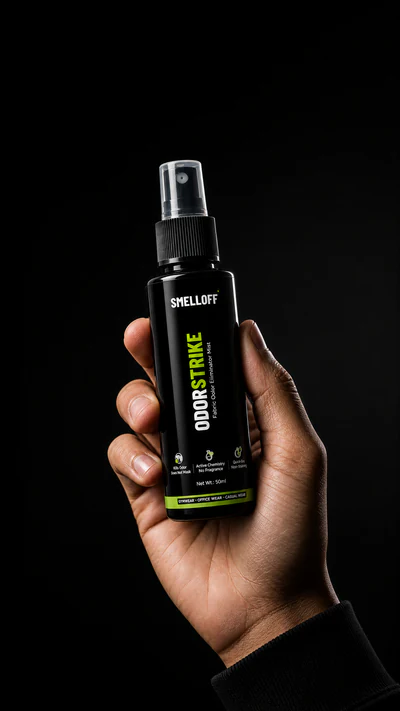
ODORSTRIKE — Fabric Odor Mist
50ml pocket spray. Zinc-based formula. Works on cotton, polyester, denim, blends, wool. Dries clear in 15–30 seconds with no stiff residue. Fabric only.
Read Next
Zinc PCA: The Fabric Odor Ingredient Explained