
Cyclodextrin (HPβCD) in Deodorant and Fabric Spray, Explained

HPβCD is the exact ring-shaped molecule ODORSTRIKE uses to trap smell inside fabric. It's a smarter, more soluble form of beta-cyclodextrin — here's what that means and why it matters.
What is cyclodextrin spray / HPβCD on fabric?
HPβCD is hydroxypropyl beta-cyclodextrin — a ring-shaped sugar molecule with a hollow centre that physically traps odor compounds inside its cavity so they can no longer reach your nose. The hydroxypropyl groups make it far more water-soluble and heat-stable than plain cyclodextrin, so it sprays as a fine, even mist and dries with no stiff residue. That is why it leads the odor-trap layer in fabric formulas like ODORSTRIKE — it captures the smell molecule itself instead of covering it with scent.
In this guide7 sections
You may have read about beta-cyclodextrin — the ring molecule that physically traps odor instead of masking it. HPβCD is the version that actually goes into a good fabric spray. The letters stand for hydroxypropyl beta-cyclodextrin, and that small modification is the difference between a lab curiosity and a product that sprays clean, stays clear in the bottle, and survives an Indian summer.
Here's what HPβCD is, why the hydroxypropyl form matters, and what it's actually doing on the fibres of your shirt.
Founder's note: When I was formulating ODORSTRIKE in Hyderabad, plain beta-cyclodextrin kept crystallising and clouding the mist in the heat. Switching to HPβCD fixed it — same odor trap, but soluble and stable enough for a spray you carry in your pocket. The full 30-day wear test is in my ODORSTRIKE review.
What is HPβCD?
Start with the parent molecule. Beta-cyclodextrin is a ring of seven glucose units bonded into a circle — not flat, but shaped like a tiny bucket with a hollow centre. The outside is water-friendly; the inside cavity is water-repelling, and that cavity is what grabs smell.
HPβCD is that same ring with small hydroxypropyl groups attached to its rim. The cavity — the part that traps odor — is left intact. What changes is how the molecule behaves in liquid: those added groups make HPβCD dramatically more soluble in water and far more resistant to crystallising out. Plain beta-cyclodextrin is only modestly soluble and can fall out of solution; HPβCD dissolves freely and stays dissolved.
Hydroxypropylation breaks up the tidy hydrogen-bond network that makes plain beta-cyclodextrin want to crystallise. The result is a molecule with the same odor-trapping cavity but much higher aqueous solubility and thermal stability — which is exactly why HPβCD is the cyclodextrin of choice in pharma, cosmetics and fine fabric sprays.
What is cyclodextrin in deodorant?
Cyclodextrin in a deodorant is an odor absorber: a ring-shaped sugar made from starch whose hollow centre holds smelly molecules so they evaporate less. On an ingredient list it appears as "cyclodextrin" or "hydroxypropyl cyclodextrin". In a deodorant it works on skin; in a fabric spray the same trap works inside the fibres, which is where a re-worn shirt keeps its smell.
The difference is where the odor lives. Deodorant slows the bacteria on underarm skin each morning. By afternoon, the sweat and skin oil already in the shirt carry their own smell, and a skin product cannot reach it. That is the job a cyclodextrin fabric mist does: ODORSTRIKE puts HPβCD on the clothes, never on skin.
How does HPβCD trap odor?
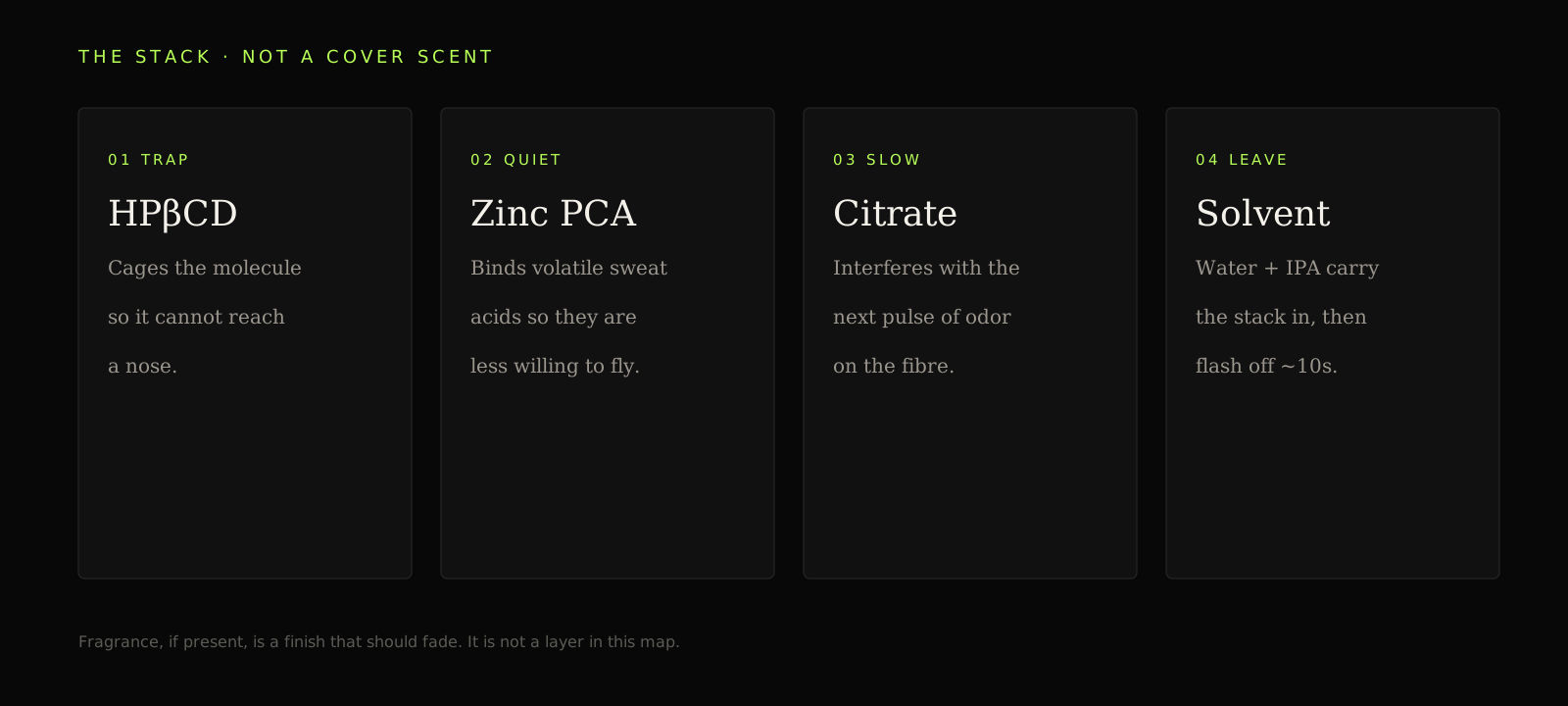
Small oily odor molecules slot into the ring's water-repelling cavity and stay held there, so they never evaporate up to your nose.
Picture the HPβCD ring as a microscopic barrel. Sweat-odor compounds — small, oily, volatile molecules — are the right size and character to fall into that barrel's hollow centre. Once inside, the molecule is held by the water-repelling interior, forming what chemists call an inclusion complex. The smell molecule is now physically captured, and because it's trapped it can't volatilise into the air. If it can't reach the air, it can't reach your nose.
The shape selectivity is the clever part. The cavity has a fixed internal diameter, so it preferentially captures molecules that fit it — and many sweat-odor compounds happen to be in that size range. Research on cotton fabric functionalised with beta-cyclodextrin confirms the treated cloth absorbs pungent odor vapours by forming these inclusion complexes.(Fibers and Polymers, 2025) That's why cyclodextrin chemistry is good at body odor specifically, rather than being a blunt, absorb-everything approach like a powder. It's targeted by geometry.
Why does the hydroxypropyl form matter for a spray?
A pocket fabric mist needs an odor trap that dissolves cleanly, sprays fine and doesn't quit in the heat — that's precisely where HPβCD beats plain cyclodextrin.
Three things make HPβCD the right pick for a fabric spray you actually carry:
- It sprays as a fine, even mist. High water solubility means it dissolves completely, so the actuator produces a uniform fog that lands across the fabric instead of spitting or clogging.
- It dries with no stiff residue. Because it stays in solution rather than crystallising, it doesn't leave a powdery or stiff film on the cloth — it disappears as the mist flashes off.
- It survives Indian heat. The hydroxypropyl form is far more thermally stable, so the formula doesn't cloud, separate or lose performance sitting in a bag at 40°C.
That last point is not academic. Plenty of odor actives look great in a temperate lab and fall apart in a Hyderabad summer. HPβCD keeps trapping odor when the mercury climbs — one of the reasons it survived our prototyping when other approaches didn't.
Which odor compounds does it target?
It captures the main sweat-odor culprits — small volatile fatty acids like isovaleric acid, produced when skin bacteria break down sweat.
Sweat smell isn't one molecule; it's a family of small volatile organic compounds released when skin bacteria break down sweat oils — fresh sweat itself is nearly odorless.(American Society for Microbiology) The main culprits are isovaleric acid (the cheesy, sour note), butyric acid (sharp and rancid) and various sulfur compounds. These are precisely the kind of small, hydrophobic molecules that fit an HPβCD cavity well — which is why a cyclodextrin-based spray works across gym sweat, stale office-shirt smell and the sour note in clothes that still smell after washing.
Trapping the molecule is only half the job, though. To actually shut odor down you also want to deal with the bacteria producing those compounds — which is why HPβCD is paired with Zinc PCA in a true fabric odor eliminator.
HPβCD vs fragrance: what's the difference?
Fragrance covers a smell that is still there; HPβCD removes the odor molecule from circulation entirely.
A pure-fragrance spray adds a smell your nose prefers and hopes it drowns out the bad one. The odor molecules are untouched — still on the fabric, still volatilising — so as the fragrance fades on your warm body, the original smell resurfaces, now layered with stale perfume. Anyone who's sprayed deodorant over a sweaty shirt knows the result.
HPβCD takes the smell molecule out of play. There's nothing to fade because the source is captured, not hidden. The honest way to read a fabric-spray label is to check whether a named encapsulating active like cyclodextrin leads the formula, or whether it's mostly 'fragrance/parfum' — the latter is a masking product wearing the language of an eliminator. It's the trait that separates the best fabric odor sprays in India from cheap perfume sprays.
That's the whole reason we built ODORSTRIKE around HPβCD as its first layer: capture the molecule, then neutralise it. Trap, don't mask.
Is cyclodextrin safe, and how is HPβCD different from beta-cyclodextrin?
Cyclodextrins are among the most studied odor and flavour carriers there are. Plain beta-cyclodextrin is a permitted food additive in the EU (E459), and HPβCD is used as an excipient in approved oral and injectable medicines. On clothes, HPβCD dries clear and does not bleach or weaken cotton, polyester, denim or wool. ODORSTRIKE is still a fabric product: do not spray it on skin.
The difference between the two is solubility. Beta-cyclodextrin dissolves at only about 18.5 mg per mL of water at 25 °C, so it crystallises out of a spray and can clog the nozzle. Adding hydroxypropyl groups raises that to more than 1,200 mg per mL (Saokham et al., Molecules, 2018), with the same odor-trapping cavity. That is why a mist uses HPβCD.
Sources
Odor Absorption Performance of Cotton Fabrics Functionalized with Beta-Cyclodextrin. Fibers and Polymers, 2025. link.springer.com
Saokham P, Muankaew C, Jansook P, Loftsson T. Solubility of Cyclodextrins and Drug/Cyclodextrin Complexes. Molecules 23(5):1161, 2018. PMC6099580
American Society for Microbiology. The Microbial Origins of Body Odor. ASM.org, 2021. asm.org
Frequently Asked Questions
What is HPβCD (hydroxypropyl beta-cyclodextrin)?
HPβCD is hydroxypropyl beta-cyclodextrin, a modified version of the ring-shaped sugar molecule beta-cyclodextrin. Small hydroxypropyl groups are added to the ring, which keeps the odor-trapping cavity intact but makes the molecule far more water-soluble and stable. That solubility is why it works so well in a fine fabric mist: it dissolves cleanly, sprays evenly, and dries without leaving a powdery residue.
How is HPβCD different from regular beta-cyclodextrin?
HPβCD traps odor the same way as plain beta-cyclodextrin, but it is much more soluble in water and more stable in heat. Ordinary beta-cyclodextrin has fairly low water solubility and can crystallise out; the hydroxypropyl groups on HPβCD prevent that, so a spray built on it stays clear, disperses uniformly across fabric, and holds up in Indian summer temperatures rather than separating in the bottle.
Does HPβCD remove odor or just mask it?
HPβCD genuinely removes odor rather than masking it. Its ring-shaped cavity physically captures the odor molecule and holds it there, so the compound can no longer evaporate to your nose. Nothing is being covered by a stronger scent — the smell source is taken out of circulation, which is why the effect does not fade and re-surface the way a perfume spray does.
Is HPβCD safe to use on clothes?
HPβCD is safe on everyday clothing fabrics. It is a starch-derived cyclodextrin used widely in textiles, cosmetics and pharmaceuticals, and it dries clear without damaging cotton, polyester, denim or wool. As with any fabric spray, mist lightly instead of soaking the cloth, keep it to fabric rather than skin, and test delicate or embroidered items in a hidden spot first.
Why does ODORSTRIKE use HPβCD instead of plain cyclodextrin?
ODORSTRIKE uses HPβCD because a pocket fabric mist needs an odor trap that stays dissolved, sprays fine and survives heat. The hydroxypropyl form gives clean, even coverage with no stiff residue and stable performance in a hot climate, then pairs with Zinc PCA to neutralise the captured compounds. It is the first of ODORSTRIKE's four layers — trap the molecule, then shut it down.
What is cyclodextrin in deodorant?
Cyclodextrin is a ring-shaped sugar molecule that can trap odor compounds. In a deodorant it would sit on skin. ODORSTRIKE is not a deodorant: it uses HPβCD (hydroxypropyl beta-cyclodextrin) on fabric only, so the trap works in the weave of a shirt rather than on the body.
What is a cyclodextrin spray?
A cyclodextrin spray uses ring-shaped cyclodextrin molecules to trap odor instead of covering it with perfume. ODORSTRIKE is a fabric cyclodextrin spray: HPβCD dissolves in a fine mist, dries clear, and cages odor on clothes. It is not a room spray and not for skin.
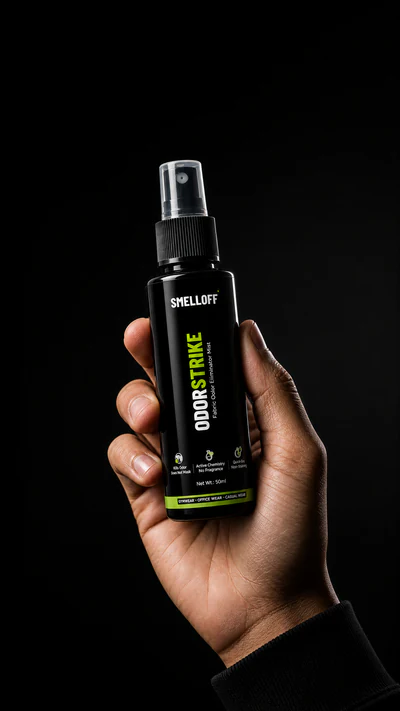
ODORSTRIKE — Fabric Odor Mist
50ml pocket spray built on HPβCD + Zinc PCA. Works on cotton, polyester, denim, blends, wool. Dries clear in 15–30 seconds with no stiff residue. Fabric only.
Read Next
Beta-Cyclodextrin: How It Traps Odor Molecules in Fabric