
How to Get Smell Out of a Hoodie Without Washing

The hoodie you wear four days a week looks exactly as clean as it did in January and does not smell that way. Washing it every week is the obvious fix and it is also what turns a good one thin and flat inside.
How do you get the smell out of a hoodie without washing it?
Turn it inside out, hang it open in moving air for twenty to thirty minutes, then mist the underarm area, the collar and hood lining, the cuffs and the front pocket with a water-based fabric odor mist. Let it dry fully before folding it. Treating the inside is the point — the outer face is not the side that smells.
In this guide6 sections
A hoodie occupies an odd position in a wardrobe. It is worn like an outer layer, so it does not feel like something that needs washing every time. It is also made of the most odor-retentive construction in your cupboard, so it behaves like something that does.
Most people resolve that by washing it weekly, and a hoodie washed weekly for two years is a noticeably worse hoodie. There is a better way to run one, and it starts with understanding why the smell shows up so far ahead of any visible dirt.
Why does a hoodie smell before it looks dirty?
Two things stack: an enormous inner surface area, and a fibre that grips skin oils. Either alone would be manageable. Together they make fleece the hardest-working odor trap most people own.
Start with the construction. Sweatshirt fleece is knitted as a flat loop-back fabric and then mechanically brushed, which pulls the loops open into a raised pile. That process is the entire point of a hoodie — the pile traps air, and trapped air is what keeps you warm. It also multiplies the surface area of the inner face many times over compared with the flat knit it started as. Every one of those raised fibres is a surface that skin contact can deposit onto.
Then the fibre. Most hoodies sold in India are polyester or a poly-cotton blend, chosen for cost, shape retention and quick drying. Polyester is oleophilic: it attracts and holds oily substances. Sweat itself is close to odorless — what smells is what skin bacteria produce when they metabolise the lipids and proteins in sebum, as the American Society for Microbiology sets out plainly. Polyester holds onto exactly that oily fraction, and a cold wash does not readily dissolve it.
The evidence for the fibre difference is specific rather than folkloric. A 2014 study in Applied and Environmental Microbiology had participants wear cotton and polyester shirts through the same fitness session and then had trained assessors rate the garments after incubation. The polyester shirts were rated significantly less pleasant, and the microbial communities differed — Micrococcus species, associated with malodour, were enriched on the polyester and essentially absent from the cotton. Same person, same session, different fibre, different result. The wider breakdown is in the fabric comparison.
Put a brushed polyester pile against a person's skin for eight hours a day and you have built an efficient collector, wearing something that will look pristine for two years.
What does washing a hoodie every week cost you?
The pile and the ribbing, in that order. Neither loss is reversible, and both are what separate a hoodie you still like from one you keep out of habit.
The raised pile is mechanically fragile. Every wash and every tumble compresses and mats it, and matted fleece does not spring back. That is the whole story of why an old sweatshirt feels thin and faintly slick on the inside rather than soft: the fibres are still there, they are just lying flat. Heat accelerates it, and a dryer accelerates it a great deal.
Ribbing goes next. Cuffs and hem ribbing rely on elastic recovery, and repeated hot water and agitation take that recovery away. A cuff that has stopped gripping does not go back, and once the cuffs are loose the garment reads as old regardless of the state of the rest of it.
| Approach | What it does | Cost to the garment |
|---|---|---|
| Wash it every week | Removes everything, reliably | Flattens the pile, slackens the ribbing |
| Body spray over it | Adds a second smell to the first | None, but it does not work |
| Freezer trick | Slows bacteria for a few hours. The smell returns with body heat | None, and no lasting effect |
| Air it inside out | Clears the volatile fraction and the trapped moisture | None |
| Fabric odor mist on four zones | Traps and neutralises what airing leaves behind | None |
| Wash every five to ten wears | The reset. Necessary, just not weekly | Acceptable at that interval |
How often should you actually wash a hoodie?
Every five to ten wears, if it is worn over a t-shirt. Sooner if it went against bare skin, got slept in, or came through a genuinely sweaty commute.
The logic is layering. When a hoodie sits over a t-shirt, the t-shirt is the garment doing the absorbing, and it should be washed every single time. The hoodie is a second layer that catches a fraction of the same load, mostly at the points where it touches skin directly — the neck, the wrists and the underarms when you reach.
Worn against bare skin, that logic collapses and the hoodie becomes the t-shirt. Then it is on the same schedule as one. The same applies to sleeping in it, which puts eight uninterrupted hours of skin contact and body heat into a pile that is designed to hold both.
Denim jackets and overshirts follow the same rule for the same reason, and the denim washing guide works through where that logic holds and where people take it too far.
How do you refresh a hoodie between washes?
Inside out, air it, then treat four zones. The four are where skin actually touches the garment, and they are not distributed evenly.
Turn it inside out first. This is the step people skip and it decides whether the rest works. The odor is on the inner face because that is the side against your skin, and misting the outside of a hoodie treats a surface that was never the problem.
Air it on a wide or padded hanger for twenty to thirty minutes near a window or a fan. Heavy knits hold body-heat moisture long after you take them off, and damp warm pile is exactly the condition bacteria need to keep working overnight. Getting that moisture out is half the job and costs nothing.
Then the four zones. The underarm area, which is the highest-concentration point on any garment. The inside of the collar and the hood lining, which take what comes off your neck and hairline. The cuffs, which are in constant contact with wrists and get pushed up and pulled down all day. The front pocket, which is a warm enclosed pouch that your hands live in, and which almost nobody thinks to treat.
ODORSTRIKE is designed for exactly this: a clean garment you do not want to put through another cycle. HPβCD, a modified sugar ring, forms inclusion complexes with odor molecules, holding the molecule inside the ring rather than letting it reach your nose. Zinc PCA neutralises what remains, triethyl citrate lowers the local pH on the fibre, and zinc gluconate reduces how quickly the odor comes back. It carries in a fast-drying water base with no oils, no dyes and no glycerine, so nothing is deposited into the pile, and it dries in 15–30 seconds with up to 8 hours of odor protection on fabric.
Technique on pile differs from technique on a woven shirt. A raised fleece takes up more liquid per pass than a flat weave, so use two or three light passes rather than one heavy one, hold the bottle 15 to 20 centimetres away, keep the hand moving, and stop before the surface looks wet. The general method is in the usage guide.
Spot-test on a hidden area first. Spray fabric only. On a hoodie that means the inside of the hem or the inside of the pocket bag. Apply one light spray, let it dry completely, and check it in daylight before treating anywhere visible. Let it dry fully before folding — a thick knit put away damp smells musty within a day.
Does this work on fleece, sherpa and denim jackets?
Yes, and the heavier the layer the more useful it is, because the heavier the layer the less often you can realistically wash it.
Sherpa and teddy linings are the same principle as fleece with even more pile, so they benefit most and need the lightest touch. Denim jackets hold odor at the collar and underarm and almost nowhere else, so treating those two zones covers it. Quilted and padded jackets take a light pass on the lining only — the shell is not where the smell is, and saturating a padded garment is a slow-drying problem you do not want.
The one thing worth repeating across all of them: the smell lives on the inner face. Every one of these garments is treated inside out.
What will this not fix?
Dirt, stains and a hoodie that has already gone musty in storage. Those are different problems with different answers.
An odor mist does not remove stains and does not clean soiled fabric. Greyed cuffs, a mark down the front, or a collar with visible build-up all need detergent — that is soil, not smell, and no amount of odor treatment touches it.
A hoodie stored damp or folded away at the end of a season is its own case. Once musty smell has set into a thick knit in a closed cupboard, the honest answer is a proper wash and a proper dry, and then treatment to keep it fresh afterwards rather than to rescue it. The storage odor guide covers what happens to clothes in an almirah over a season.
A fabric odor mist does not remove stains, does not clean a soiled garment and does not replace washing. It resets a clean garment that has picked up a smell. It is for fabric only, never skin, hair or body.
Sources
Callewaert, C. et al. Microbial Odor Profile of Polyester and Cotton Clothes after a Fitness Session. Applied and Environmental Microbiology, 2014. journals.asm.org
American Society for Microbiology. The Microbial Origins of Body Odor. ASM.org, 2021. asm.org
Odor Absorption Performance of Cotton Fabrics Functionalized with Beta-Cyclodextrin. Fibers and Polymers, 2025. link.springer.com
Frequently Asked Questions
How do you get the smell out of a hoodie without washing it?
Turn it inside out, hang it open in moving air for twenty to thirty minutes, then mist the underarm area, the collar and hood lining, the cuffs and the front pocket with a water-based fabric odor mist. Let it dry completely before folding it. Treating the inside is the whole point — the outer face of the hoodie is not the side that smells.
Why does a hoodie start smelling before it looks dirty?
Brushed fleece is knitted flat and then raised into a pile, which multiplies the surface area of the inner face many times over. Most hoodies are polyester or a poly-cotton blend, and polyester is oleophilic — it grips the skin lipids that odor is produced from. So a hoodie collects a large amount of sebum across a very large surface while looking exactly as clean as it did on day one.
How often should you wash a hoodie?
For a hoodie worn as an outer layer over a t-shirt, every five to ten wears is reasonable, and sooner if it was worn against bare skin, slept in, or worn through a sweaty commute. The layer underneath is doing most of the work of absorbing sweat, and that layer should be washed every time. Washing the hoodie itself on the same schedule as the t-shirt is what flattens it.
Does washing a hoodie too often ruin it?
It flattens the pile and stretches the ribbing. The raised fleece on the inner face is mechanically fragile, and every wash and tumble compresses and mats it, which is why an old hoodie feels thin and slick inside rather than soft. Cuffs and hem ribbing lose their recovery from repeated hot water and agitation, and the drawstring channel and pocket seams are usually the first things to go.
Does a fabric odor mist work on fleece and thick knits?
Yes, with lighter passes than on a woven shirt. Pile absorbs more liquid per pass than a flat weave, so two or three light passes held 15 to 20 centimetres away with the hand moving is the right technique, rather than one heavy pass. A water-based mist with no oils and no glycerine leaves nothing behind on the pile once the carrier evaporates.
What will a fabric mist not fix on a hoodie?
Stains, visible soil and a hoodie that has gone genuinely musty from being stored damp. It also does not fix a garment that simply needs washing — it resets a clean one that has picked up a smell. If the hoodie has cuffs greyed with wear or a mark down the front, that is a job for detergent.
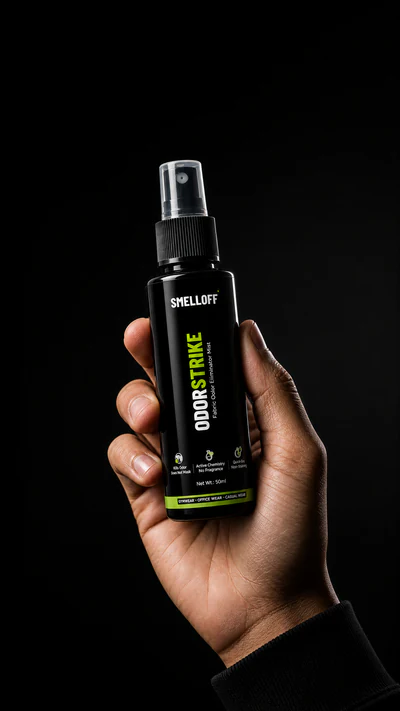
ODORSTRIKE — Fabric Odor Mist
50ml pocket spray. HPβCD traps the odor molecule, Zinc PCA neutralises it. Built for the garments you cannot wash. Up to 8 hours of odor protection on fabric under normal office/commute conditions, dries in 15–30 seconds, no oils, and it dries clear with no stiff residue. Fabric only, never skin.
Read Next
No Washing Machine? Keeping Clothes Wearable in a Hostel or PG