
How to Get Mothball and Almirah Smell Out of Clothes

The saree comes out for the function and announces where it has been for eleven months. Storage smell is three different problems wearing one name, and only one of them is solved by washing.
How do you get mothball smell out of clothes fast?
Take every mothball out of the cupboard first, then hang the garment fully unfolded in a ventilated room away from direct sunlight for several hours. Spot-test a hidden seam, then mist the seams, lining, collar and dense folded areas with a water-based fabric odor mist and let it dry. Treating clothes while mothballs are still in the almirah does not work.
In this guide6 sections
Every Indian household has a version of this. The winter woolens come down in November. The silk saree comes out for a wedding. The sherwani gets unpacked the night before. And all of them carry the same flat chemical smell of the cupboard they have been living in.
Washing is the obvious response, and on the garments most likely to be affected — wool, silk, zari, structured pieces — it is also the response most likely to do damage. There is a better sequence, and it starts with understanding that "almirah smell" is not one thing.
Why does mothball smell survive washing?
Because naphthalene arrives as a vapour, and it has had months to get everywhere. That is a fundamentally different delivery mechanism from anything else your clothes pick up.
Naphthalene — the classic white mothball — sublimes. It passes directly from solid to vapour without ever becoming liquid, which is exactly why a mothball slowly shrinks and disappears while sitting on a shelf doing nothing. The ATSDR describes it plainly as a white solid that evaporates easily, sold as mothballs, moth flakes and tar camphor.
The consequence for your clothes is that there is no barrier. A vapour does not need to be splashed onto a garment or rubbed in; it fills the closed volume of the almirah and reaches every fold, every seam allowance, the inside of every sleeve. A garment folded in a stack is not protected — the inner folds are simply the last place it reaches and the last place it will leave from.
Then there is solubility. Naphthalene is poorly soluble in water, so a domestic wash cycle removes considerably less of it than people expect, and the garments involved are usually the ones that should not be washed repeatedly anyway. Wash a wool shawl three times to chase a smell and you will have a smell and a damaged shawl.
What is actually in an "almirah smell"?
Three separate things, produced three different ways. People treat it as one problem, which is why partial fixes are so common.
One: the moth repellent. Naphthalene or camphor vapour, as above. This is the sharp, chemical, unmistakable part.
Two: oxidised skin oils. Whatever sebum was left in the fabric when it was put away has spent a season slowly oxidising, and oxidised lipids smell stale and faintly rancid. This is why a garment stored clean smells noticeably better after a year than one stored "clean enough", and it is a good argument for washing things properly before storage rather than after.
Three: dampness. A cupboard closed through a monsoon holds humid air against textiles for weeks, and the microbes that grow on damp fabric produce their own musty compounds — the same family behind the smell of a damp room. The monsoon guide covers that mechanism in detail.
Only the third of those is genuinely addressed by a normal wash. The first is barely water-soluble and the second needs warm water and real detergent, not a cold quick cycle. Which is a fair description of why washing a stored garment so often leaves it smelling better but not right.
| Approach | What it does | What it costs |
|---|---|---|
| Leave it hanging in the same almirah | Nothing. The source is still in there | Days, wasted |
| Direct sunlight for hours | Airs it, and fades it | Colour on darks and silks |
| Scented fabric softener | Adds a heavy perfume over a chemical base | Two smells, and residue on the fibre |
| Cold quick wash | Little. Naphthalene is barely water-soluble | Wear on wool and silk |
| Unfold and air in shade with airflow | Carries off a real share of the vapour | Several hours, free |
| Fabric odor mist on seams and lining | Traps and neutralises what airing leaves | 15–30 sec |
Why are sunlight and scented softener the wrong answers?
One damages the garment and the other adds a second smell. Both are near-universal advice and both are worse than shade plus airflow.
The useful part of "hang it in the sun" is the hanging, not the sun. Moving air carries vapour away from the fabric surface, and that is what actually clears storage odor. Direct sunlight contributes very little to that and does contribute to fading — dark cottons lose depth, dyed silks shift, and both silk and wool are protein fibres that are weakened by repeated UV exposure. A shaded balcony or a room with a fan running gives you the benefit and skips the cost.
Scented softener is worse in a different way. It does not remove naphthalene; it lays a heavy perfume on top of it, and the combination of a chemical base note with a strong floral over it is more noticeable than the original, not less. It also deposits a cationic film on the fibre, which is the last thing a silk or a fine wool needs.
How do you actually clear it?
Remove the source, unfold and air in shade, then treat the seams and lining. In that order, because each step makes the next one work better.
Take the mothballs out first. All of them — balls, flakes, sachets, the ones at the back that have been there since before you moved in. Naphthalene keeps subliming for as long as it is in the cupboard, so treating a garment while the source is still inside is a fast way to spend product on a problem that is being continuously replaced.
Unfold the garment completely and hang it. The unfolding matters as much as the airflow. A folded saree or a stacked shawl has most of its surface pressed against itself, and the vapour concentrated in those inner folds cannot leave until they are opened out. Use a wide or padded hanger, give it space on both sides, and leave it for several hours in a ventilated room out of direct sun.
Then treat what airing leaves. The areas that hold the most are the ones with the most fabric in contact with fabric: seams, hems, linings, the inside of the collar, and any dense or heavily embroidered panel.
ODORSTRIKE works on this class of problem for a specific reason. HPβCD, a modified sugar ring, forms inclusion complexes with odor molecules — the ring has a hydrophobic interior cavity that suits small non-polar molecules, and it holds the molecule inside rather than letting it reach your nose. Naphthalene is exactly that kind of molecule, which is why this mechanism suits storage odor particularly well. Zinc PCA neutralises what remains, triethyl citrate lowers the local pH on the fibre, and zinc gluconate reduces how quickly the odor comes back. It carries in a fast-drying water base with no oils, no dyes and no glycerine, so nothing is left on a silk or a fine wool, and it dries in 15–30 seconds with up to 8 hours of odor protection on fabric under normal office/commute conditions. The mechanism is explained fully in the cyclodextrin guide.
Technique: hold it 15 to 20 centimetres away, keep the hand moving, two or three light passes, and stop well before the fabric looks damp. On a saree or a sherwani, work the lining and the seams rather than the face of the cloth.
Spot-test on a hidden area first. Spray fabric only, never skin, hair or body. On a saree that means an inside hem or a pallu edge you can check; on a jacket, the lining under the arm. One light spray, let it dry completely, and check it in daylight before you go near a visible panel.
Festive wear is where this caution matters most, because plain water is what marks silk, zari and velvet — the risk is the water, not the odor actives, and it applies to every spray sold. The festive wear guide deals with sherwanis, silk kurtas and sarees specifically, and the staining guide tests a water-based mist on five materials.
What about thrifted and second-hand clothes?
Same storage odor, plus somebody else's residual body oils. The second half is what people usually fail to remove.
Wash whatever can be washed, and wash it properly: a full warm cycle with enough detergent, not a cold quick wash. Oxidised skin lipids do not dissolve in cold water, and a thrifted shirt that still smells faintly of a stranger after washing has almost always been washed cold and short. Then dry it fast and completely, because a slow indoor dry adds a musty note of its own on top.
For the pieces that cannot go in a machine — wool coats, silk, structured jackets, anything embroidered — air them unfolded for a day and treat the lining and seams. That is the realistic path, and it is also the one that does not risk the garment.
How do you store clothes so it does not come back?
Dry, breathable, and occasionally opened. Three things, none of which cost anything.
Put garments away completely clean and completely dry. Residual sebum is what oxidises into stale odor over a season, and residual moisture is what makes a closed cupboard musty. Anything that goes in slightly damp determines what the whole shelf smells like by March.
Use breathable cotton covers, not plastic. The plastic sleeve a dry cleaner returns a garment in is packaging for the trip home, not storage — it traps moisture against the fabric, and a piece sealed in one through a Hyderabad monsoon comes out musty no matter how clean it went in.
And open the almirah occasionally. A cupboard that is opened once a week exchanges its air; one that stays shut for eleven months does not, and everything inside it ends up smelling of the cupboard rather than of itself.
A fabric odor mist does not remove stains, does not clean a soiled garment and does not replace washing or dry cleaning. It resets a clean garment that has picked up a smell. It is for fabric only, never skin, hair or body, and on delicate or embroidered pieces it goes on after a spot test.
Sources
Agency for Toxic Substances and Disease Registry. ToxFAQs: Naphthalene, 1-Methylnaphthalene, 2-Methylnaphthalene. wwwn.cdc.gov
World Health Organization. WHO Guidelines for Indoor Air Quality: Dampness and Mould. who.int
Odor Absorption Performance of Cotton Fabrics Functionalized with Beta-Cyclodextrin. Fibers and Polymers, 2025. link.springer.com
Frequently Asked Questions
How do you get mothball smell out of clothes fast?
Take every mothball out of the cupboard first, then hang the garment fully unfolded in a ventilated room away from direct sunlight for several hours. Spot-test a hidden seam, then mist the seams, lining, collar and dense folded areas with a water-based fabric odor mist and let it dry. Treating a garment while mothballs are still in the almirah does not work, because the source keeps replacing what you cleared.
Why does mothball smell survive washing?
Naphthalene sublimes, meaning it passes straight from solid to vapour without melting, so a closed almirah is filled with vapour that reaches every fold and seam over months of contact. It is also poorly soluble in water, so a domestic wash cycle removes far less of it than people expect — and the woolens and silks it usually affects are the garments least suited to repeated washing anyway.
What exactly is the stale smell of an old cupboard?
It is normally three things at once. Naphthalene or camphor vapour from moth repellents, oxidised skin oils left in the fabric from the last time the garment was worn, and dampness from a cupboard that was closed through a humid season. The three are produced differently and only the third one is really fixed by washing, which is why a wash often leaves the smell only partly improved.
Should you hang clothes in the sun to remove storage smell?
Shade with moving air, not direct sun. Airflow does the work of carrying vapour away, and strong sunlight adds nothing to that while fading dark cottons and silks and weakening protein fibres like wool and silk over repeated exposure. A shaded balcony or a room with a fan gets you the benefit without the cost.
How do you get the smell out of thrifted or second-hand clothes?
Wash whatever can be washed, on a full warm cycle rather than a cold quick one, and dry it fast and fully. For pieces that cannot go in a machine — wool, silk, structured jackets, anything embroidered — air them unfolded for a day and treat the lining and seams with a fabric odor mist. Thrifted garments usually carry storage odor plus somebody else's residual body oils, and the second part is what a cold quick-wash leaves behind.
Is it safe to spray a fabric mist on a silk saree or a heavy lehenga?
Only after a spot test, and lightly. Silk, zari, velvet and heavy embroidery water-mark from plain water, so the risk is the water rather than the odor actives and it applies to every spray on the market. Test an inside hem or seam allowance, let it dry completely, check it in daylight, and work on the lining and seams rather than the face of the cloth.
How to get naphthalene smell out of clothes?
Air the garment in moving air for several hours, then mist residual odor with a water-based fabric odor mist. Naphthalene (mothballs) lives in the fibre; a perfume cover will not last. Wash if the smell is heavy or the cloth is soiled.
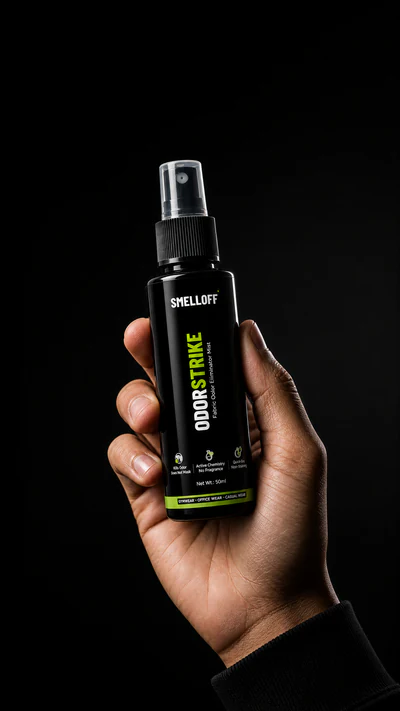
ODORSTRIKE — Fabric Odor Mist
50ml pocket spray. HPβCD traps the odor molecule, Zinc PCA neutralises it. Built for the garments you cannot wash. up to 8 hours of odor protection on fabric under normal office/commute conditions, dry in 15–30 seconds, no oils and no stiff residue. Fabric only, never skin.
Read Next
Wedding and Festive Wear: Odor Without Washing