
Does Vinegar, Baking Soda or Softener Remove Clothes Odor?
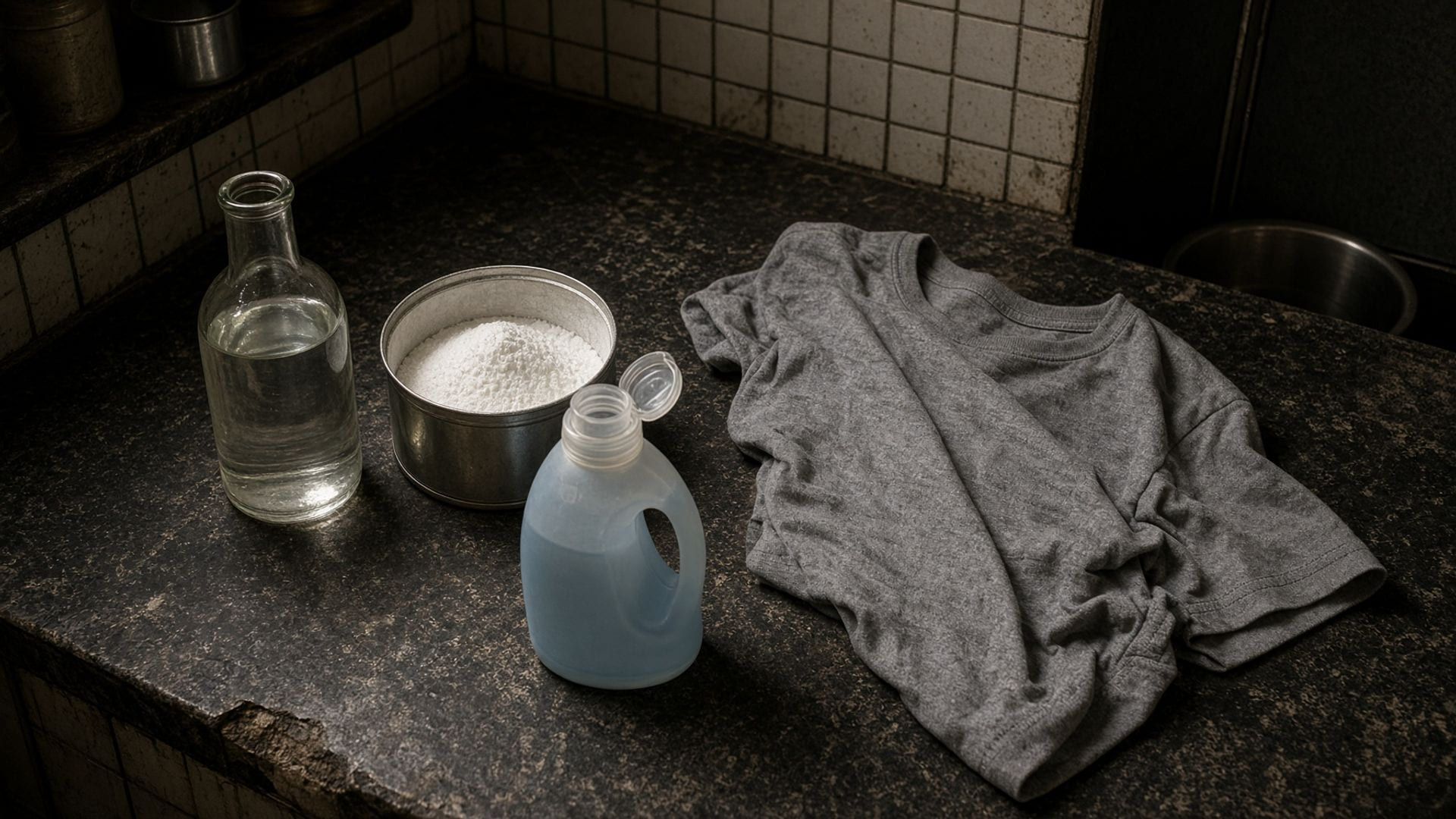
Vinegar is an acid rinse. Baking soda is a mild alkali. Softener is a film. None of them is a sweat-odor killer.
White vinegar is an acid rinse. Baking soda is a mild alkali with a little abrasion. Fabric softener is a cationic film that makes cotton feel slick. Each has a real laundry job. None of them is a sweat-odor killer. Mix vinegar and baking soda in the drum and you get salt water and a fizz. Mix vinegar and bleach and you can make chlorine gas. Softener residue holds the next day's soil. Use them for what they are. Wash the sebum properly. Do not expect a kitchen bottle to do a detergent's work on a collar.
In this guide12 sections
- Three additives. Three jobs. Zero killers.
- What vinegar actually does in the laundry
- What baking soda actually does
- Why mixing vinegar and baking soda is a volcano, not a wash
- Do not mix vinegar and bleach
- What fabric softener actually does
- Softener films in residue
- The job table
- Why none of them eliminates sweat odor on a collar or a pit
- Hard water, front-loaders, monsoon — the Indian failure modes
- If you still want to use them, use them for their jobs
- What to use when the job is actually sweat odor
Indian laundry cupboards have a trinity: a bottle of white vinegar, a packet of baking soda, a pink or blue softener that smells like a showroom. The search is always the same. Does this one eliminate sweat smell. No. Next. Does this one. No. The honest version is more useful. Each additive has a job. Used for that job, it is not a scam. Used as a universal odor solution, it is how a poly-cotton formal gets a film, a fizz, and the same pits on Thursday.
Three additives. Three jobs. Zero killers.
Sweat odor on a worn shirt is not one molecule. Fresh axillary smell is full of short-chain acids. After a mild wash, Munk's 2000 work showed those acids mostly leave. What stays are aldehydes and other lipid-oxidation products from sebum. On polyester, hydrophobic odorants survive the wash better than on cotton (Munk 2001). Bacteria that survive a 30°C colour cycle can make more odor while the shirt dries slowly on a rod. A kitchen acid, a kitchen alkali, and a fabric film do not all speak to that stack.
White vinegar
Acid rinse
- Cuts alkaline detergent leftover
- Not a degreaser or a sebum treatment
- Never mix with bleach: chlorine gas
Baking soda
Mild alkali
- Some buffering, some abrasion as a paste
- Will not emulsify neck oil
- Unkind to wool, silk, some dyes
Fabric softener
Cationic film
- Slick feel, anti-static, perfume
- The perfume is a cover
- Films build up with hard water
Mixed together, vinegar and baking soda cancel each other out. The fizz is not cleaning.
So stop asking which bottle 'eliminates odor'. Ask what job you are hiring. Residue rinse. Mild alkali. Hand-feel. Those are jobs. Sebum in a fused collar is a surfactant job. A pit seam is a pre-treat and a rinse job. A sour drum is a machine-clean job. Get the hiring right.
What vinegar actually does in the laundry
Household white vinegar is dilute acetic acid, typically around 4–5%. In a rinse it can lower the pH of leftover wash liquor, cut some alkaline detergent residue, and help with mineral film from hard water. Clothes can feel less stiff after a vinegar rinse because you have removed the crunchy leftover, not because you have softened the fibre the way a cationic softener does.

Acid can also take some ammonia-type notes into a less volatile salt. That is a real, narrow odor job: alkaline, pee-adjacent, leftover-detergent stale. It is not the job of a sebum ring. Acetic acid at laundry dilution is not a reliable disinfectant and not a degreaser. It will not lift the lipid that McQueen-type wear studies keep finding in the axilla of a shirt. It will not pull Micrococcus out of a polyester pit.
Use it, if you use it, in the rinse. Softener compartment, or a down-the-side pour once the wash liquor is gone. Half a cup in a top-loader is the folk dose; a front-loader wants less, because there is less water. Smell your tap. If you are on hard water — Hyderabad, Chennai, much of the north — a periodic acid rinse can be a residue tool. It is still not why the collar is yellow.
Vinegar is a rinse, not a deodorant for cloth
If the search was 'does vinegar remove sweat smell from clothes', the honest sentence is: it can help with alkaline residue and some stale, ammonia-ish notes. It does not remove sebum odorants that survived a wash, and it does not replace detergent on a collar band. People who 'swear by it' are often describing softer hand-feel after a residue cut. That is a different win.
What baking soda actually does
Sodium bicarbonate is a mild alkali. In water it buffers, raises pH a little, and can help with some acid-smelling soils and with the crunch of hard water when used as a wash-water booster. There is a little mechanical help if you paste it on a spot — abrasion, not magic. It is not a surfactant. It does not emulsify neck oil. It does not nest hydrophobic aldehydes the way a properly built detergent or a leave-on trap would.
A sprinkle in the drum with detergent is a modest alkali boost. A paste on a musty towel, left to sit, then washed, is a reasonable folk move for a sour cotton that has been slow-dried. A cup of soda as a substitute for detergent on a worn office shirt is how you get grey pits and a crunchy band. Alkali without surfactant does not wash a lipid.
High pH is also unkind to wool, silk, and some dyes. If the shirt is a coloured formal, soda is not a free extra. If the shirt is a white cotton, soda plus detergent is at least not a war. It is still not a pit protocol.
Why mixing vinegar and baking soda is a volcano, not a wash
Acid plus carbonate is a school experiment. You get carbon dioxide, water, and a sodium salt. The fizz looks like work. The work is the two actives cancelling each other. What you pour down the drum is a weaker acid, a weaker alkali, some bubbles, and less of the job either bottle was hired to do.
If you want soda in the wash and vinegar in the rinse, that is chemically coherent — they never meet at full strength. If a reel told you to dump both in at once 'for extra power', the reel is entertaining children. The shirt is still dirty.
Do not mix vinegar and bleach
This is not a vibe. Acetic acid plus sodium hypochlorite can release chlorine gas. Closed Indian bathrooms, a front-loader, a 'I'll just add a splash of both' moment: bad. Bleach is for whites and for a machine-clean, used as directed, never as a cocktail with acids — not vinegar, not a citric rinse, not a toilet cleaner you also keep on the same shelf.
If you bleach a white cotton load, skip the vinegar rinse on that cycle. If you vinegar-rinse a colour load, do not 'boost' it with bleach. If you are cleaning the machine, pick one chemistry per run and rinse.
Two mixes, two failures
Vinegar + baking soda in the same step: you spent both bottles to make salt water. Vinegar + bleach: you can make chlorine. Neither mix is a sweat-odor hack. The first is useless. The second is unsafe.
What fabric softener actually does
Liquid fabric softener is, mostly, cationic surfactant — quaternary ammonium compounds — plus perfume and a carrier. The quat is positively charged. Cotton in wash water is negatively charged. The quat lays down on the fibre as a lubricating film. Towels feel fluffy. A formal feels slick. Static drops. That is a real job. People like it. The bottle is not lying about hand-feel.
The same film is why softener is a poor odor strategy. You have coated the cloth. The next day's sebum and sweat sit on a waxy layer instead of on a rinsed fibre. Hydrophobic odorants have a friendlier surface. Towels lose absorbency. Sports knits and poly-cotton office shirts start to smell 'already worn' faster. The perfume in the softener covers the first hour, then you are smelling perfume plus pits. That mash is how a lot of Indian wardrobes actually smell, and it gets blamed on the body.
Softener does not remove odor. It adds a scent and a film. If your search was 'does fabric softener remove odor', the answer is no. If your towels have gone sour despite weekly washing, the film plus slow indoor drying is a prime suspect. Strip the film — hot wash on cotton towels if the label allows, skip softener for a month, dry in moving air — before you buy a fourth bottle of the same idea.
Softener films in residue
Hard water makes this worse. Calcium and magnesium already leave mineral on cloth and in the machine. Cationic softener plus mineral plus leftover detergent is a stack. Front-loaders with short rinses, common in Indian apartments, do not always get it off. The gasket stays slimy. The inner collar of a white shirt goes grey-yellow and feels waxy. You add more softener because the shirt feels rough — the roughness was the last film plus mineral. You are feeding the loop.
Sports weaves and any shirt you need to wet (a monsoon commute, a long walk) suffer first. A fused collar suffers second: the band was already a sandwich, now it is a sandwich with lube in it. Detergent cannot get a clean shot at the sebum. Munk's leftover aldehydes have a place to sit.
The job table
Hire them correctly or leave them on the shelf.
| Additive | Real job | What it is not | How it fails |
|---|---|---|---|
| White vinegar | Acid rinse: cuts alkaline detergent leftover, some hard-water film, some ammonia-ish stale | Not a degreaser. Not a disinfectant at laundry dose. Not a sebum treatment. | In the wash with soda: cancelled. With bleach: chlorine. On a yellow collar: no. |
| Baking soda | Mild alkali, some buffering, some abrasion as a paste | Not a surfactant. Will not emulsify neck oil or pit lipid. | As a detergent replacement: grey soil stays. High pH: unkind to wool, silk, some dyes. |
| Fabric softener | Cationic film. Slick hand-feel on cotton. Anti-static. Perfume. | Not an odor remover. The perfume is a cover, not a mechanism. | Build-up on towels, knits, poly-cotton. Next day's soil sits on the film. Gasket slime. |
Why none of them eliminates sweat odor on a collar or a pit
A collar is sebum and keratin in a fused band. A pit is heat, lipid, and a stitched channel. McQueen (2007) showed odor intensity after wear tracking fibre, not a simple bacterial headcount. Callewaert (2014) showed a textile microbiome that is not a copy of the armpit — micrococci enriched on synthetics, staphylococci on both, corynebacteria not enriched on the cloth. Hammer's radiolabel work showed polyester dumping isovaleric acid into the air while wool held it. The soil is lipid, the habitat is fibre-and-seam, the leftover after a polite wash is often aldehyde, not the acid vinegar would like to meet.
Vinegar might help the leftover detergent that makes a shirt smell 'washed-stale'. Soda might help a sour, acidic note on a cotton towel. Softener will perfume the first hour. The pit seam still needs surfactant contact, time, a rinse, and a dry. That is laundry. The trinity is not laundry. It is seasoning.
Hard water, front-loaders, monsoon — the Indian failure modes
Hard water means more mineral for vinegar to be useful against, and more mineral for softener to glue down. If your tap scales a kettle, a vinegar rinse on towels once in a while is on-job. Weekly softener on the same towels is how they go crunchy-sour.
Front-loaders in closed bathrooms never dry. Gattlen and colleagues sampled washing-machine biofilms across three continents: the recommended detergent dose did not fully clear slime and cell debris. Adding softener to that ecology is extra food and extra film in the gasket. Adding vinegar occasionally as a rinse is closer to a descaler. Adding vinegar every wash 'to disinfect the drum' is a folk hope. Clean the gasket with the machine empty, run a hot maintenance cycle as the maker allows, leave the door open. That is the drum job. It is not a splash of kitchen acid on a packed Sunday load.
Monsoon drying is Munk 2001 in a 2BHK: slow dry, microbial odor dominates. Vinegar in the rinse will not outrun a shirt that hangs wet overnight with the sleeves in. Dry the seams. Space the hangers. Softener perfume on a still-damp pit is a temple-and-sweat mash by morning. A lot of Indian households outsource the dose: a cap of detergent, a cap of softener, cold, packed. Vinegar joins as a third cap because of a WhatsApp forward. The collar still comes back. Change the protocol, not the folklore — less load, pre-treat the band and pits, skip softener on work shirts, acid-rinse only if the water is hard and the clothes feel residual. The bottles were never the bottleneck.
If you still want to use them, use them for their jobs
A week of hiring the trinity correctly
- Pick the actual problem — Stiff, crunchy, white residue: mineral and detergent leftover — vinegar in the rinse, or less detergent, or both. Sour slow-dried cotton: wash, space, air; soda paste is optional, not the hero. Scratchy cotton that is actually clean: a little softener, rarely, and not on pits-heavy shirts. Yellow collar or pit stink: detergent contact on the zone. None of the trinity.
- Never in the same step — Soda, if you use it, with the wash. Vinegar, if you use it, in the rinse. Softener, if you use it, in the rinse — and not in the same rinse as vinegar, they fight for the fibre. Bleach never with vinegar. One chemistry per compartment.
- Skip softener on the shirts this page cares about — Office formals, anything with a fused collar, anything you sweat in. You want the fibre rinseable next time. Softener on bath towels is a preference; know that you are trading absorbency. Softener on a 65/35 formal is how the pit starts loud on wear two.
- Dose smaller than the label's optimism — Indian front-loaders use little water. A full cap of softener is a film. A mug of vinegar is more acid than the rinse can use. Start at half folk-wisdom, then feel the cloth.
- Re-test the shirt, not the ritual — After a week, smell the inner band at 10cm. If it is better, you changed the wash and the dry, not 'the vinegar worked'. If it is the same, stop adding bottles. Pre-treat the zone, wash with space, dry the seam.
What to use when the job is actually sweat odor
On a worn shirt: detergent on the inner collar and both pit seams, time, a wash with room in the drum, a dry that includes the channel. On a dry, unstained shirt you must wear today: a fabric mist is a leave-on, not a rinse, and it still does not replace the wash. On a machine that smells: empty hot cycle, gasket wipe, door open. The trinity can sit this one out, or play the small parts above.
Do not buy a fourth 'natural odor killer' that is the same acetic acid with a better label. Do not mix a paste of soda and vinegar 'to boost'. Do not pour softener on a gym knit because it smells and you want it to smell of something else.
- Use vinegar, if at all, as a rinse against alkaline leftover and hard-water film.
- Use baking soda, if at all, in the wash as a mild alkali — never as detergent.
- Keep softener off work shirts, pit zones, and anything you need absorbent.
- Pre-treat sebum with surfactant. That is the collar-and-pit job.
- Leave the machine door open. Clean the gasket. One chemistry per cycle.
- Do not mix vinegar and baking soda in the same step. You are making salt water.
- Do not mix vinegar and bleach. Chlorine is not a laundry hack.
- Do not treat fabric softener as an odor remover. It is a film plus perfume.
- Do not vinegar-soak a yellow collar and expect the ring to leave.
- Do not add a third cap of anything to a packed cold load and call it a system.
Vinegar, soda and softener are wash-and-rinse additives. ODORSTRIKE is a leave-on fabric mist for a dry garment you are about to wear. Different job. 50ml, formula v3.1, made in Hyderabad. ₹229 prepaid. Cash on Delivery available. Light, subtle scent — not unscented, not a perfume. Dries in 15–30 seconds, 30–60 in humidity. Up to 8 hours on fabric under normal office conditions is a working window, not a guarantee. It does not dissolve detergent film, does not soften cotton, does not replace a wash, and is not for skin. If the shirt needs vinegar, it needs a rinse. If it needs ODORSTRIKE, it needs to be dry and already washed.
50ml fabric-only mist. Formula v3.1. Prepaid UPI ₹229. Cash on Delivery available. Light, subtle scent. Not a wash. Not for skin.
- Munk S, Münch P, Stahnke L, Adler-Nissen J, Schieberle P. Primary odorants of laundry soiled with sweat/sebum: influence of lipase on the odor profile. Journal of Surfactants and Detergents. 2000;3:505–515. — After a mild 30°C colour wash, the organic acids that dominate fresh axillary sweat were effectively removed. Remaining primary odorants were aldehydes, esters and ketones from sebum oxidation. An acid rinse is aimed at the wrong leftover if the complaint is a washed-but-still-sweaty collar. Source
- Munk S, Johansen C, Stahnke LH, Adler-Nissen J. Microbial survival and odor in laundry. Journal of Surfactants and Detergents. 2001;4:385–394. — Bacteria survived 30–40°C colour washes without bleach. Hydrophobic odorants stuck to polyester more than cotton. Microbial odor dominated under slow drying — the monsoon-rod condition vinegar will not outrun. Source
- Gattlen J, Amberg C, Zinn M, Mauclaire L. Biofilms isolated from washing machines from three continents and their tolerance to a standard detergent. Biofouling. 2010;26(8):873–882. — Biofilms from 11 machines, four countries. Recommended detergent concentration did not fully remove cell debris and slime. A splash of vinegar in a packed load is not a gasket protocol. Softener film in that ecology is extra residue. Source
- Callewaert C et al. Microbial odor profile of polyester and cotton clothes after a fitness session. Applied and Environmental Microbiology. 2014;80(21):6611–6619. — Textile odor after wear is a fibre-and-microbe story (micrococci on synthetics, staphylococci on both), not something a rinse acid or a quat film is designed to reverse. Source
- Hammer TR, Berner-Dannenmann N, Hoefer D. Quantitative and sensory evaluation of malodour retention of fibre types by use of artificial skin, sweat and radiolabelled isovaleric acid. Flavour and Fragrance Journal. 2013;28(3):238–244. — Polyester released radiolabelled isovaleric acid into the air far faster than cotton or wool. Fibre physics, not a kitchen additive, decides how loud that molecule is at your nose. Source
Frequently Asked Questions
Does vinegar remove sweat smell from clothes?
Not as a universal killer. It can help alkaline leftover and some ammonia-ish stale in a rinse. The acids of fresh sweat mostly leave in a normal wash anyway (Munk 2000). What you still smell on a collar is often sebum-oxidation residue and a pit seam the wash missed. Vinegar does not lift that.
Does baking soda remove odor from laundry?
It is a mild alkali. It can buffer some acid notes and help as a paste on sour cotton. It is not a surfactant and will not wash neck oil out of a fused collar. Do not use it as detergent. Do not mix it with vinegar in the drum.
Does fabric softener remove odor?
No. It deposits a cationic film and a perfume. Hand-feel is the job. The film holds the next day's soil and can make towels and poly-cotton shirts smell used sooner. If towels are sour, skip softener for a month and dry with space.
Can I mix vinegar and baking soda in the wash?
Not in the same step. They neutralise each other: carbon dioxide, water, a salt. Soda in the wash and vinegar in the rinse is coherent. A combined dump is a volcano for children, not a protocol for pits.
Why shouldn't I mix vinegar and bleach?
Acid plus hypochlorite can release chlorine gas. Closed bathroom, front-loader, splash of both: do not. If you bleach whites, skip vinegar on that cycle. If you acid-rinse colours, skip bleach.
Why do my towels smell after using softener?
The film cuts absorbency and holds soil. Slow indoor drying then lets microbial odor dominate (Munk 2001). Hard water glues the stack down. Wash hotter if the label allows, skip softener, dry with air around each piece.
What should I use instead for sweat odor on a shirt?
Detergent on the inner collar band and both pit seams, a wash with space in the drum, a dry that includes the channel. A fabric mist is for a dry, unstained shirt you must wear today, and it still does not replace the wash. Kitchen bottles are rinses and films. Hire them for that, or leave them.
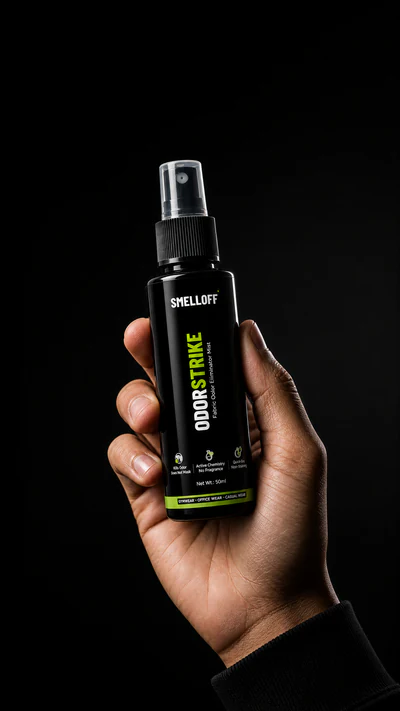
ODORSTRIKE — Fabric Odor Mist
50ml · ₹229 · Cash on Delivery available · For clothing fabric only
Buy now — ₹229 View product details