
Why Clothes Smell Stale in an AC Room
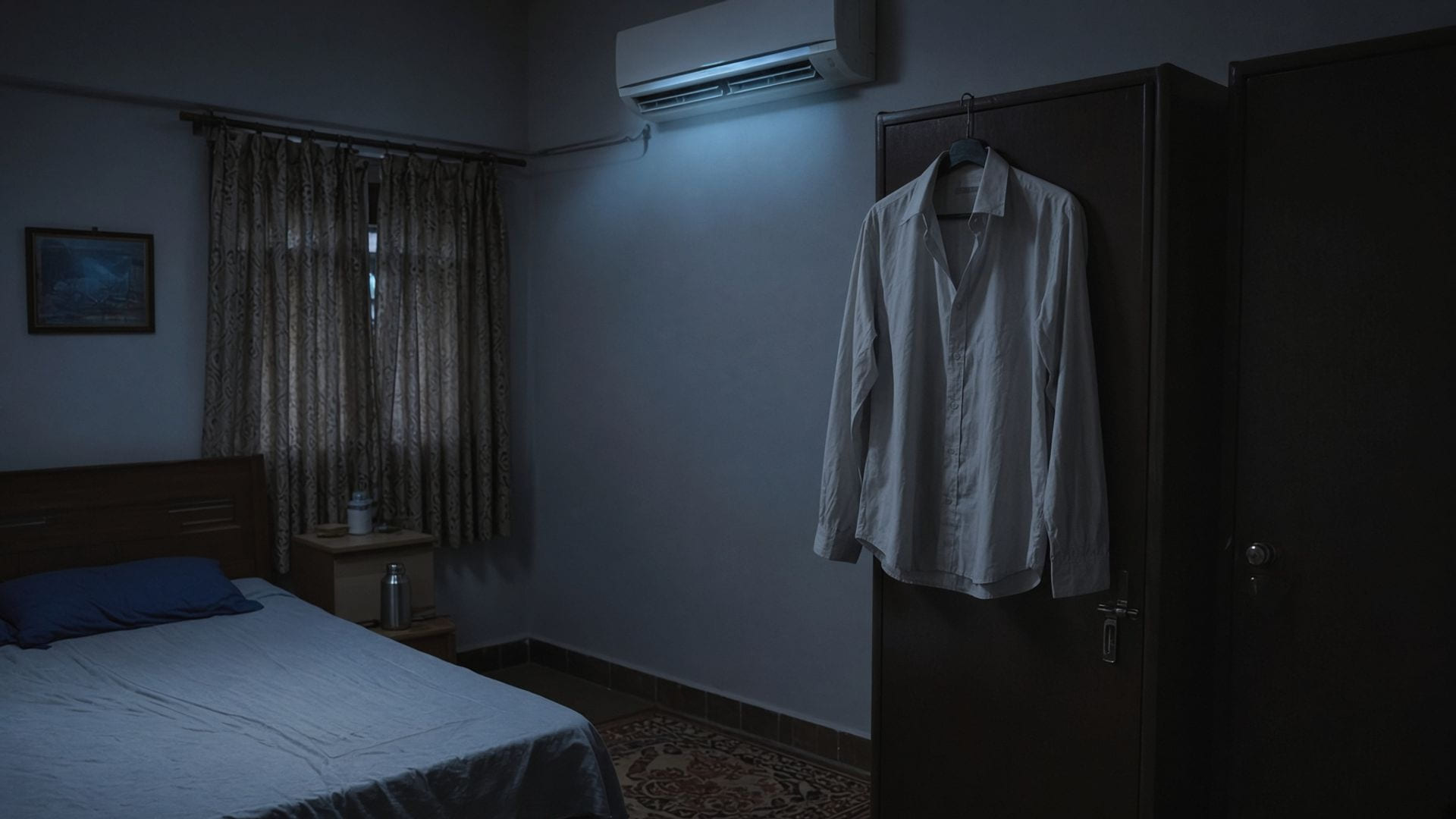
An AC room recirculates the same cabin. Hung clothes pick up that room note. An under-washed shirt adds its own.
An AC room recirculates the same air over a filter that was never designed to clean odor. Hung clothes pick up that room note, and any under-washed shirt adds its own fibre note on top. Cool is not clean. A fabric mist treats cloth, not the cabin.
In this guide10 sections
You hung the shirt in the bedroom because the bedroom has AC. By morning it smells like the room: a little sweet, a little stale, a little like cold plastic and last night's curtain. The shirt did not go to the gym. It sat in a closed, cooled box while the same air went around in a circle.
Indians run this experiment every summer. Door shut, split AC on sleep, 18°C, filter last washed at some forgotten Diwali. The temperature drops. The air does not become new. Clothes are large, quiet surfaces. They take on whatever the cabin is looping.
Closed cool air is not clean air
An air conditioner is a heat pump with a fan. In most Indian bedrooms and office cabins it is set to recirculate. That is the point in April: you paid to cool this air, you do not want to cool the corridor. The same cubic metres pass the coil, pass the filter, pass the bed, pass the shirt on the chair, and come back. Temperature falls. The volatile load does not get a holiday.
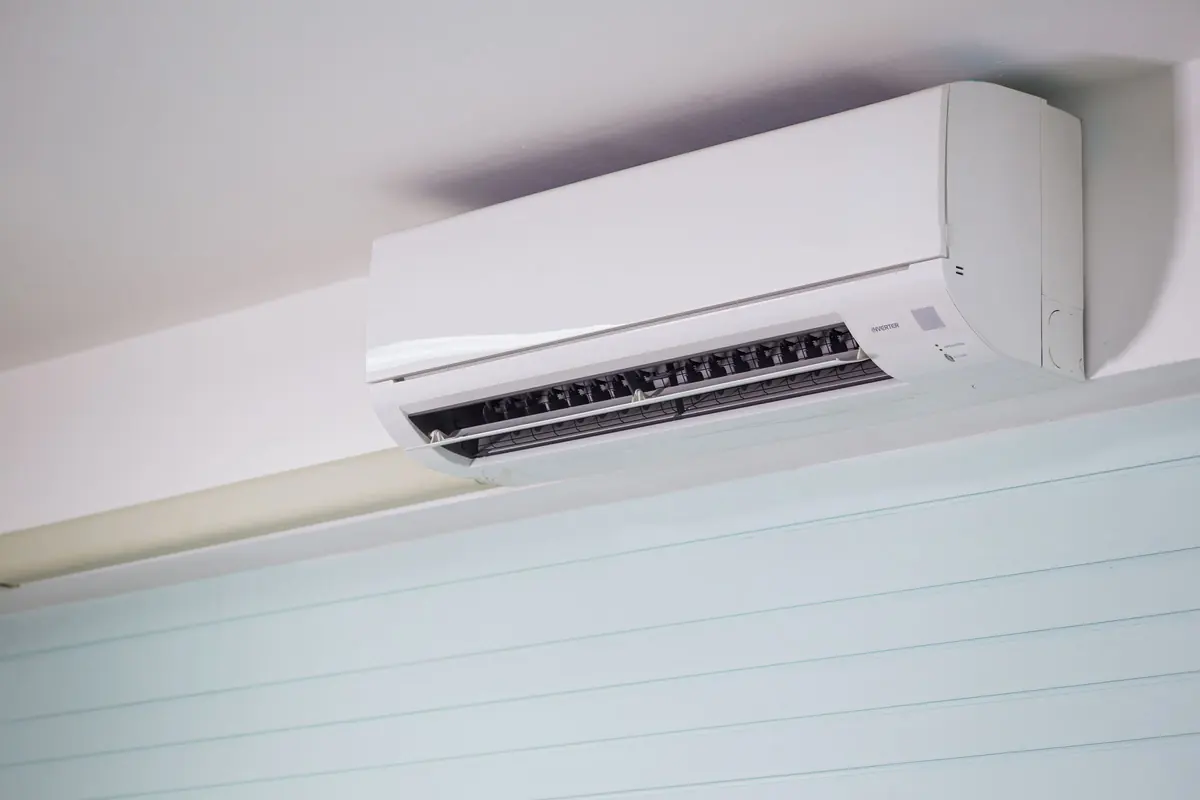
If the room was a bit lived-in when you closed it — yesterday's dinner, a damp towel, a person sleeping eight hours, a polyester shirt that has already been worn twice — those notes have nowhere to go except onto surfaces. Fabric is a very good surface.
Cooling is not ventilation
Recirculation saves electricity. It also means the room is a closed loop. A filter that catches dust is not a fresh-air exchange. Do not confuse the two when you sniff the shirt.
The recirculated cabin
Think of a small bedroom with a 1.5-ton split, or a two-person office cabin, or a PG room where the window AC is the only opening that is ever used. Low air change. High fabric load: bedsheet, curtains, three shirts on the back of the door. Indoor textiles are known sinks for VOCs. They adsorb. Later they emit. In a closed loop, the hung shirt is both a passenger and a secondary source.
Sleep mode makes it worse in a boring way. The fan slows. Mixing drops. A layer of still, cool, slightly humid air sits on the cloth. Nothing dramatic. Just enough that a shirt which would have aired near a window now marinates.
What the filter actually does
The filter in a split AC is a dust screen. Hair, lint, some particles. It is not activated carbon. It does not strip odor molecules from air. A dirty filter is worse than a clean one: loaded dust becomes a small odor source of its own. Lab work on ventilation filters has been saying this for years — used filters emit carboxylic acids, aldehydes, terpenes. Your bedroom unit is a cheaper, hotter, less-serviced version of that.
Washing the filter is useful. It is not a fabric treatment. A clean filter still recirculates. It will not pull last Tuesday out of a polyester weave. People wipe the filter, sniff the shirt, and feel cheated. They asked the wrong object to do the job.
Filters load. Then they emit.
Hyttinen's group found dusty HVAC filters adsorb VOCs and later release them; humidity raises desorption. Indoor fabrics, separately, have large surface area and act as VOC reservoirs. An AC bedroom stacks both: a loaded filter in a loop, and a lot of cloth hanging in that loop.
Room note versus fibre note
This is the distinction the page exists for. Room note is what the cabin is doing to any cloth that sits there: recycled air, coil, curtain, a faint sweet-stale. Fibre note is what the garment already held — an under-washed shirt, especially a synthetic that has been worn more times than it has been washed, adding its own residue to the still air. You can have one, the other, or both. Treating the wrong one is how you waste a Sunday.
Room note
The cabin
- Recycled air, coil, curtain
- A faint sweet-stale on every cloth
- Fades in another room
Fibre note
The shirt
- Sits at the underarms and collar
- Stays when you move the shirt
- Wash it, or treat the fabric
A clothing mist is a contact treatment for fibre. It does not deodorise a room.
| What you smell | Mostly room note | Mostly fibre note | Both |
|---|---|---|---|
| Where it sits | Whole hung garment, including parts that never touched skin | Pits, collar, yoke — contact zones | Contact zones plus a stale film on the chest and back |
| If you air it near an open window | Often fades in an hour | Stays. Residue is in the yarn | The cabin part fades; the pit does not |
| If you hang a freshly washed cotton next to it | The clean cotton picks up a little of the same stale | The clean cotton stays cleaner | Clean cotton takes the room; the dirty shirt keeps the pit |
| Wrong response | Spraying the shirt and leaving the room closed | Washing the AC filter and expecting the pit to reset | One product for two jobs |
The shirt on the chair
Office people hang the day's shirt on the back of the chair in the AC cabin 'to air it'. There is no air. There is a closed loop and a person who just wore the shirt. Overnight the cloth equalises with the room and with its own leftover sweat. Morning sniff: stale, a bit sweet, a bit of you. That is not mysterious. That is a reservoir sitting in a box.
The hostel version is a wire hanger on the almirah door, two feet from the window AC, above a pile of more shirts. The wardrobe version is worse: still air, no coil even, just cloth on cloth. The AC room is not a cupboard, but if you never crack a window it starts to behave like one that happens to be cold.
Under-washed cloth in still air
A shirt that has been worn twice and washed as if it were worn once is a fibre note waiting for a quiet room. Synthetics are especially good at holding onto what a short, cool wash left behind. This is not a ranking of fibres — that page exists and is not this one. It is a laundry habit meeting a closed cabin. The AC did not create the residue. It gave it a still, cool gallery in which to be obvious.
Cotton can carry a room note without much fibre note. A synthetic that is overdue for a real wash can carry both, and will smell like the room plus last Wednesday. If you only ever sniff in the AC bedroom, you will blame the AC for a wash you skipped.
The 18-degree PG room
One window AC, door towel-sealed against the corridor heat, three people, wet towels, office shirts on a single rail. The machine is doing exactly what you asked. It is not an air cleaner. In that box, every extra wear without a wash is a louder morning.
Why the stale note reads sweet
People say 'sweet' and mean it as a complaint. Closed indoor air collects aldehydes, acids, a bit of fragrance leftover from detergent and room spray, a bit of human. Cooled, it is not the sharp sweat of a bus stop. It is duller, slightly confectionery, like a hotel corridor or a car that has been AC-only for a week. The shirt copies that because the shirt is sitting in it.
This is also why perfume in an AC bedroom is a bad experiment. Top notes have nowhere to go. They loop. By morning the cloth has a stale-plus-perfume mash that nobody wanted.
What to do with the hung shirt
Separate the room from the fibre before you buy anything. Open the room. Then sniff the shirt in a different room, or near a window. The protocol is boring on purpose.
AC-stale shirt, without fooling yourself
- Crack the loop — Window or door, even twenty minutes. Fan if you have one. You are diluting the cabin, not cooling it. Do this before you judge the cloth.
- Move the shirt into real air — Balcony, corridor with a draft, a room that is not the sealed box. Hang it so pits and collar see space. If the stale fades and the pit is quiet, it was room note.
- Sniff contact zones separately — Collar band, pits, back yoke. If those still speak after the chest has gone quiet, that is fibre note. Under-washed. Air will not finish it.
- Treat fibre on dry cloth, or wash — A fabric mist on a dry shirt can take residual odor on the cloth. It will not deodorise the bedroom. If the pit is yellow or the shirt has been loud for days, wash. Still air is not a detergent.
- Wash or rinse the AC filter on a calendar, not on a mood.
- Hang tomorrow's shirt where air actually moves, even if that is not the coldest corner.
- Separate room note from fibre note with a ten-minute window test.
- Wash the shirt that has been 'aired' in the cabin for three nights. That was storage, not laundry.
- Do not spray a fabric mist into the room and call the cabin treated.
- Do not use deodorant or perfume on a hung shirt to cover stale air.
- Do not assume a cold room dries a damp shirt. Cool plus still is slow drying.
- Do not leave wet towels in the same loop as work shirts.
A mist does not deodorise a room
This is the line people skip. A clothing mist is a contact treatment for fibre. It needs to wet the cloth, work on what is on that cloth, and dry. Spraying it at the AC, at the curtain, at the air in the middle of the room, is how you scent a cabin for twelve minutes and then sit in the same loop. Room odor is a ventilation and source problem. Open the window. Wash the filter. Get the wet towel out. Do not ask a 50ml fabric product to be an HVAC system.
Wrong object, right-looking activity
Misting the shirt and leaving it in the closed AC bedroom is a half-job. You treated fibre, then put it back in the source. If the stale is the cabin, the shirt will pick it up again by morning.
When the room itself needs work
If every clean garment that spends a night in that bedroom comes out smelling like the bedroom, stop treating shirts. Wash the filter. Dust the coil if you can reach it or get a technician. Pull curtains into a wash. Stop drying laundry in the same sealed room. A short fresh-air dump in the morning costs you a little cooled air and returns you a room that is not a marinade.
Humidity physics — water making residue louder — is the sibling page. Musty monsoon laundry is the other sibling. This page is the closed cabin. Keep them straight and the Sunday routine gets shorter.
If the stale is on the cloth after the room has been opened — fibre note, dry shirt — ODORSTRIKE 50ml v3.1 is a fabric-only mist for that residue. Made in Hyderabad. ₹229 prepaid. Cash on Delivery available. Light fragrance that fades; not unscented, not a room spray, not a perfume. Dries in 15–30 seconds. Up to 8 hours on fabric in ordinary use, not a guarantee. Does not deodorise an AC cabin. Does not replace washing an under-washed shirt. Not for skin.
50ml fabric-only mist. Formula v3.1. Prepaid UPI ₹229. Cash on Delivery available. Light, subtle scent. Not a wash. Not for skin.
- Licina, D., Morrison, G. C., Bekö, G., Weschler, C. J. & Nazaroff, W. W. (2019). Clothing-Mediated Exposures to Chemicals and Particles. Environmental Science & Technology, 53(10), 5559–5575. — Clothing is a reservoir for chemicals and particles acquired during wear, care and storage. Indoor textiles take up airborne compounds and later re-emit them — a hung shirt in a closed room is not a neutral object. Source
- Huang, L. et al. (2024). Advancing characterization of VOC diffusion in indoor fabrics: A dual-porosity modeling approach. Building and Environment. — Indoor fabrics strongly adsorb VOCs because of high loading and surface area. Desorption then acts as a secondary source, prolonging indoor pollution — exactly the hung-shirt-in-a-cabin problem. Source
- Hyttinen, M., Pasanen, P. & Kalliokoski, P. (2001). Adsorption and desorption of selected VOCs in dust collected on air filters. Atmospheric Environment, 35(33), 5709–5716. — Dust on air filters stores VOCs and later releases them. Raising humidity increased desorption. Used filters become odor sources — the opposite of their job if they are left loaded. Source
- Hyttinen, M., Pasanen, P., Björkroth, M. & Kalliokoski, P. (2007). Odors and volatile organic compounds released from ventilation filters. Atmospheric Environment, 41(19), 4029–4039. — Used supply-air filters were odor sources; the prefilter dominated until humidity shifted emission to the fine filter. Recirculated air past a dirty filter is not odor-free air. Source
Frequently Asked Questions
Why do clothes smell stale in an AC room?
Because the room is usually a closed recirculating loop. Cool air still carries VOCs, a dirty filter can emit its own odor, and fabric hanging in that loop takes the room note on. Any under-washed shirt adds a fibre note on top.
Does the AC filter remove clothing smell?
No. It catches dust. It does not strip odor molecules. A dirty filter can even become a source. Cleaning it is maintenance for the machine, not a treatment for the shirt.
Why does a clean shirt smell like the bedroom by morning?
Room note. The garment was a blank surface in a closed cabin. Air it in a different space. If it then goes quiet, the room is the job, not the wash.
Can I spray fabric mist in the AC room to freshen it?
You can. You should not expect it to work as a room deodoriser. It is a contact product for cloth. Spraying the air scents the loop briefly. Open a window. Treat the shirt separately if the fibre still smells.
Is this the same as monsoon musty or humidity-loud odor?
No. Musty after slow indoor drying is mould chemistry. Humidity-loud is water raising volatility and bacterial time on a worn shirt. AC-stale is recirculated cabin air plus whatever the fibre already held.
Should I hang shirts in the AC bedroom overnight?
Only if that room actually exchanges air. A sealed 18°C box is storage, not airing. A rail near a slightly open window beats the coldest corner of a closed cabin.
Why is the smell sweet rather than sweaty?
Closed indoor air collects a dull mix — aldehydes, leftover fragrance, human, coil. Cooled, it reads stale-sweet rather than bus-stop sweat. Contact zones that still smell of pits are fibre note, not the cabin.
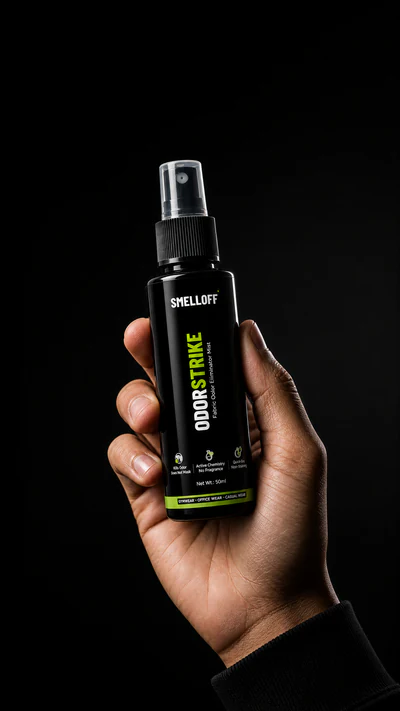
ODORSTRIKE — Fabric Odor Mist
50ml · ₹229 · Cash on Delivery available · For clothing fabric only
Buy now — ₹229 View product details