
No Washing Machine? Keep Clothes Fresh in a Hostel or PG

Laundry goes out once a week. Clothes get worn every day. Nothing dries properly in a shared room in July. Here is how to run a wardrobe inside those three constraints without your cupboard smelling like a cupboard.
How do you keep clothes fresh without a washing machine?
Hang every garment the moment you take it off, sort re-wearable items from ones that must be washed, treat the collar, underarms and cuffs of the re-wear pile with a water-based fabric odor mist, and give everything real airflow overnight. About ninety seconds, and it is what makes one laundry run cover seven days.
In this guide6 sections
The hostel and PG version of the laundry problem is not really about cleaning. It is about scheduling. You have a weekly service and a daily wardrobe, and the arithmetic does not work unless some clothes get worn more than once.
Everyone already re-wears. The question is whether you do it deliberately, with a routine that keeps the garments wearable, or accidentally, by pulling something back out of the pile and hoping. The difference between those two is about ninety seconds a night.
Why do hostel clothes smell even when they are clean?
Because of how long they took to dry, not how they were washed. This is the single most misdiagnosed thing in shared-room laundry, and once you see it you cannot unsee it.
A garment that comes out of a bucket or a wash and then stays damp for hours is a warm wet surface with nothing competing for it. Microbial growth on damp textiles produces the compounds behind that specific flat, cellar-like musty smell — the same family of compounds behind the smell of a damp room, which is why the two smell related. The World Health Organization's guidelines on indoor dampness and mould treat persistent dampness as the underlying condition to fix, and a slow-drying garment is a small version of the same problem.
A hostel room is close to the worst case for drying speed. Limited airflow, a line strung indoors, garments crowded together so they shade each other, high ambient humidity for months at a stretch, and often no direct sun. Under those conditions a thick cotton shirt can take most of a day, and the smell is set into the fibre long before it reaches your cupboard.
Which means the fix is not more washing. Washing a garment that smells because it dried slowly, and then drying it slowly again, reproduces the problem exactly. The monsoon damp-clothes guide goes through that cycle in detail and it applies year-round in a room with poor airflow.
What happens in the days between laundry runs?
Sweat gets deposited, and then bacteria slowly turn it into something you can smell. The delay is why a shirt can seem fine at night and not fine in the morning.
Fresh sweat is close to odorless. What produces smell is skin bacteria metabolising the lipids and proteins in sebum and apocrine sweat, releasing volatile compounds as they do — the American Society for Microbiology lays out the mechanism clearly. That process needs time, warmth and moisture, and a garment thrown onto a chair at night supplies all three generously.
This is the actual reason a pile of worn clothes in the corner of a room becomes the smell of the room. It is not that the clothes are dirty. It is that folded-over damp fabric holds warmth and moisture against itself for hours, which is the ideal condition for the thing you do not want happening.
| What you do at night | What happens by morning | Cost |
|---|---|---|
| Chair or pile | Warm, damp, enclosed. Worst case for odor | Free, and it is the problem |
| Straight into the cupboard | Moisture transfers to everything else in there | Free, and it spreads |
| Body spray over it | Two smells instead of one | Wasteful |
| Hang with airflow | Dries out, bacteria stall, smell stops developing | 15–30 seconds |
| Hang + treat three zones | Wearable again the next morning | About 90 seconds |
| Wash it | The reset — when the garment has actually earned it | A bucket, and a day to dry |
Which clothes genuinely re-wear?
Whatever sat over another layer re-wears. Whatever was against your skin absorbing sweat does not. That one rule settles almost every case.
Re-wear comfortably: shirts and kurtas worn over a vest or t-shirt, jeans and trousers, hoodies and sweatshirts, jackets and overshirts. These touch skin at a small number of points — the neck, the wrists, the underarms — and those points are treatable.
Do not stretch: t-shirts worn directly against skin, socks, innerwear, and anything worn through genuine sweat, whether that was a cricket match or an hour on a bus in May. Trying to get a second day out of those is precisely what makes a room smell, and no product changes that. Jeans are the interesting middle case with a lot of folklore attached, and the denim guide takes it apart properly, including why the freezer trick does not work.
Fibre matters here too. A polyester or poly-blend shirt will start smelling sooner than a cotton one worn identically, because polyester grips the skin lipids that odor is produced from. If you are buying clothes for a hostel wardrobe, that is a genuinely useful thing to know — the full comparison is in the fabric guide.
What is the nightly routine?
Hang, sort, treat three zones, leave it airflow. Ninety seconds, done at the point where you would otherwise drop everything on a chair.
Hang it immediately. The moment a garment comes off, it goes on a hanger or a hook, opened out. This alone does more than anything else on the list, because it ends the warm-damp-enclosed condition that the whole problem depends on.
Sort as you go. Re-wear on the rail, wash into the bag. Making that decision at night rather than in the morning is what stops you pulling something dubious out at 8am.
Treat three zones on the re-wear pile. The inside collar, the underarm area, and the cuffs. On a shirt or kurta those three carry nearly all of it, and they are all on the inside.
ODORSTRIKE exists for this exact gap — a clean garment, a week to get through, and no machine. HPβCD, a modified sugar ring, forms inclusion complexes with odor molecules, holding the molecule inside the ring rather than letting it reach your nose. Zinc PCA neutralises what remains, triethyl citrate lowers the local pH on the fibre, and zinc gluconate reduces how quickly the odor comes back. It carries in a fast-drying water base with no oils, no dyes and no glycerine, so there is nothing left on the fabric, and it dries in 15–30 seconds with up to 8 hours of odor protection on fabric under normal office/commute conditions. The bottle is 50ml, which is the point — it lives in a bag, not on a shelf.
Hold it 15 to 20 centimetres away, keep the hand moving, two or three light passes per zone, stop before the fabric looks damp. The usage guide has the full method.
Leave it airflow. Space on both sides, near a window or a fan, not crammed into a full cupboard. A garment that is dry by morning does not develop a smell of its own overnight.
Spot-test on a hidden area first. Spray fabric only, never skin, hair or body. On a shirt that means the inside of the tail; on a kurta, an inside seam allowance. One light spray, let it dry completely, check it in daylight before treating anywhere visible.
How do you dry clothes indoors without the musty result?
Spacing and moving air, in that order. Both are free and both are usually ignored.
Wring or spin out as much water as you physically can before anything goes up. The drying clock starts from however wet the garment is when it is hung, so the difference between a hard wring and a lazy one is hours at the far end.
Hang with gaps. Two shirts touching on a line dry as one thick shirt. Turn heavy items like jeans inside out so the thickest seams and pockets face outward into the air rather than being sandwiched inside.
Then move the air. A ceiling fan on a low setting over a drying line does more than an open window on a still day. Still humid air next to a wet garment quickly reaches equilibrium and stops taking moisture; moving air keeps replacing it. If there is a dry hour of sun on the balcony, use it — but do not leave dark clothes out in strong sun for hours, because that fades them.
What this does not do
It does not replace washing, and nobody should tell you otherwise. The routine buys you the gap between laundry runs. It does not remove the need for one.
A fabric odor mist does not remove dirt, does not remove stains and does not clean a soiled garment. Anything worn against skin through real sweat still goes in the wash. A collar with visible build-up needs detergent, not a spray. And if a garment has already gone properly musty from being stored damp, the honest answer is to wash it and dry it fast, then keep it fresh afterwards.
What it does do is make a wardrobe of eight shirts behave like a wardrobe of twelve, which in a room with one weekly laundry pickup is the whole game.
A fabric odor mist does not remove stains, does not clean a soiled garment and does not replace washing. It resets a clean garment that has picked up a smell. It is for fabric only, never skin, hair or body.
Sources
World Health Organization. WHO Guidelines for Indoor Air Quality: Dampness and Mould. who.int
American Society for Microbiology. The Microbial Origins of Body Odor. ASM.org, 2021. asm.org
Callewaert, C. et al. Microbial Odor Profile of Polyester and Cotton Clothes after a Fitness Session. Applied and Environmental Microbiology, 2014. journals.asm.org
Frequently Asked Questions
How do you keep clothes fresh without a washing machine?
Hang every garment the moment you take it off, sort re-wearable items from ones that must be washed, treat the collar, underarms and cuffs of the re-wear pile with a water-based fabric odor mist, and give everything real airflow overnight. The routine takes about ninety seconds and it is what makes a weekly laundry run cover seven days of wear.
Why do clothes in a hostel smell even when they are clean?
Usually because of how long they took to dry, not how they were washed. A garment that stays damp for several hours in a humid room grows the microbes that produce musty odor compounds, and that smell is baked in before the clothes ever reach the cupboard. A shared room with limited airflow and a line strung indoors is close to the worst case for drying speed.
Which clothes can you re-wear and which cannot?
Shirts, kurtas, jeans, hoodies and any jacket worn over another layer re-wear comfortably. T-shirts worn directly against skin, socks, innerwear and anything worn through real sweat do not, and trying to stretch those is what makes a room smell. The rule is simple: whatever was against your skin absorbing sweat gets washed, whatever sat over it does not.
How do you dry clothes indoors without the musty smell?
Spacing and airflow beat everything else. Hang garments with a gap between them rather than crowded on one line, put them where air moves — near an open window, in front of a fan — and turn the fan on rather than relying on still air. Wring or spin as much water out as you can first, because the drying clock starts from however wet the garment is when it goes up.
Does a fabric odor spray replace washing clothes?
No, and it should not be sold as if it does. It resets a clean garment that has picked up a smell so you can wear it again before laundry day. It does not remove dirt, does not remove stains and does not clean a soiled garment. Anything worn against skin through sweat still needs a wash, and that is the honest line.
What is the fastest way to make a shirt wearable again in the morning?
Hang it in moving air for ten minutes, then mist the inside collar, the underarm area and the cuffs and let it dry 15–30 seconds. That covers the three zones that actually carry the smell on a shirt. If the collar has visible build-up or the shirt is marked, no spray will help and it needs washing.
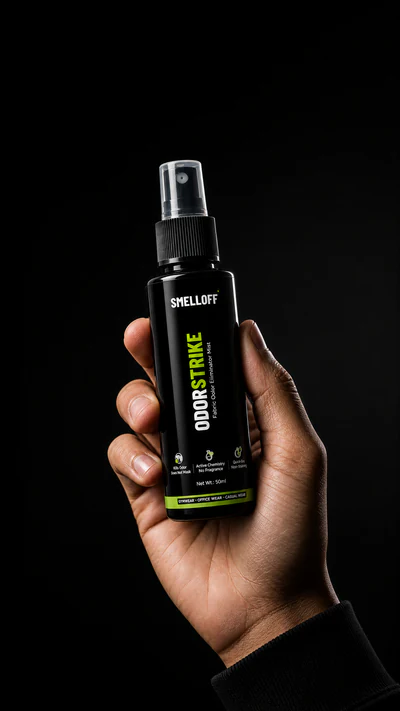
ODORSTRIKE — Fabric Odor Mist
50ml pocket spray. HPβCD traps the odor molecule, Zinc PCA neutralises it. Built for the garments you cannot wash. up to 8 hours of odor protection on fabric under normal office/commute conditions, dry in 15–30 seconds, no oils and no stiff residue. Fabric only, never skin.
Read Next
Keep Office Trousers and Formals Fresh Between Washes