
Keep Office Trousers Fresh Without Washing Them Daily
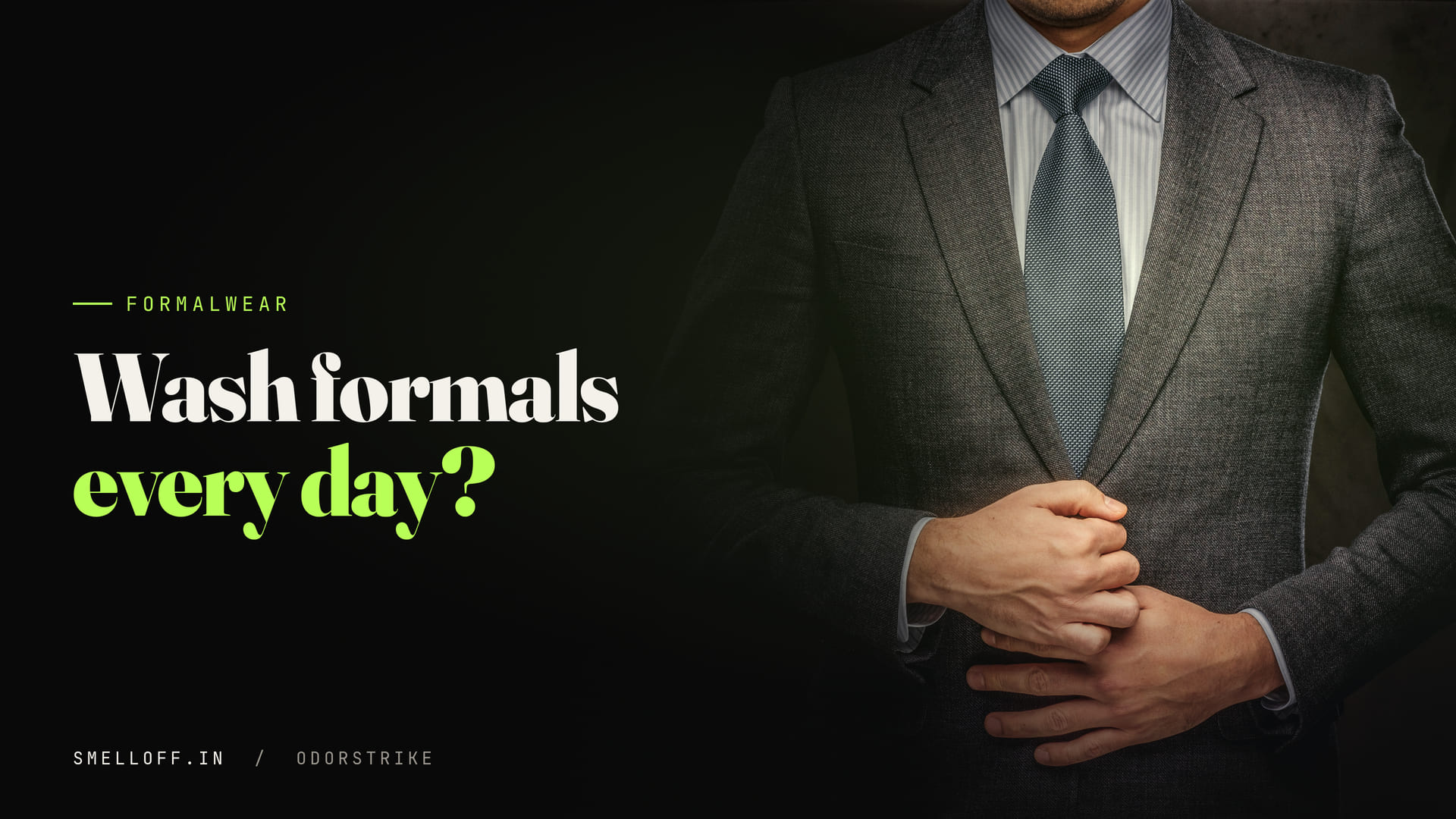
A forty-minute commute in May undoes a morning of preparation. Formals are the hardest garments in a wardrobe to keep fresh and the worst ones to wash daily, which is an awkward combination for anyone who wears them five days a week.
How do you keep office trousers fresh without washing them daily?
Change out of them as soon as you get home, hang them from the cuffs with airflow, then mist the inside waistband, the upper inner thigh seams, the inside collar and the cuffs with a water-based fabric odor mist and let them dry. Those four friction zones carry nearly all of it, and all four are on the inside.
In this guide6 sections
Formalwear is designed for a climate it is rarely worn in. Structured waistbands, lined panels, closed weaves and a full-length trouser leg are all sensible in fifteen degrees and none of them are sensible on a bus in Hyderabad in May.
The result is a garment that starts to smell well before it looks like it needs anything, worn by someone who has four more days of the week to get through. Washing it every night solves the smell and slowly destroys the trouser.
Why do formal trousers smell before they look dirty?
Because the deposit is concentrated, not spread. Sweat does not land evenly across a pair of trousers, and once you know where it does land the problem becomes small.
Fresh sweat is close to odorless. What produces smell is skin bacteria metabolising the lipids and proteins in sebum and apocrine sweat and releasing volatile compounds as a by-product — the American Society for Microbiology sets this out clearly. That process needs warmth, moisture and time, so the parts of a garment that stay warm and damp longest are the parts that end up smelling.
On formalwear those parts are predictable. The waistband is pressed firmly against the body for nine hours, is usually doubled and interfaced, and sits at the point where a shirt is tucked in — so it is the least ventilated part of the outfit. The upper inner thigh seams sit in a warm enclosed area with constant friction from walking, and on lined or heavier trousers they are slow to dry out. The collar takes what comes off the neck and hairline. The cuffs get wrist contact all day and are also doubled.
Cloth choice compounds it. Most office trousers in India are a poly-cotton or poly-viscose blend, chosen because they hold a crease and resist wrinkling. Polyester is oleophilic — it grips the skin lipids that odor is produced from, and a cold wash does not readily dissolve them. That is why a poly-blend trouser smells sooner than an all-cotton one worn identically, and the fabric comparison works through the whole range.
Which zones actually hold it?
Four, and all of them are on the inside. Which is convenient, because it means treatment never touches the face of the cloth.
- The inside waistband. The single highest-value zone on a trouser and the one almost nobody treats.
- The upper inner thigh seams. Warm, enclosed, high friction, slow to dry.
- The inside collar. On the shirt, and on a blazer if you are wearing one.
- The cuffs. Doubled fabric in constant skin contact.
Notice what is not on that list. The seat, the knees, the front of the shirt, the outer legs — all the parts of the outfit people actually look at, and none of them are where the smell lives. Treating a garment all over is wasted product and unnecessary moisture on cloth that did not need it.
If you wear a jacket over this, that garment has its own version of the same story and the lining is the layer that matters — the blazer guide covers it.
| Approach | What it does | Cost to the garment |
|---|---|---|
| Wash them every night | Works, and it is the expensive answer | Fades, frays, breaks down the waistband |
| Dry clean weekly | Works, on wool. Slow and costly | Flattens the nap, stiffens interlining |
| Body deodorant on the fabric | Wrong product. Made for skin, not cloth | Can leave residue on dark suiting |
| Hanging in a steamy bathroom | Good for creases. Adds moisture where you least want it | Slows drying in the lined zones |
| Change and hang with airflow | Ends the warm-damp condition the odor needs | None, and free |
| Fabric odor mist on four zones | Traps and neutralises what is already there | None. Under a minute |
What does washing formals daily actually cost?
Colour, edges, structure and crease, roughly in that order. None of it is dramatic on any single wash, which is exactly why it goes unnoticed until the trouser looks tired.
Colour goes first and most visibly. Dark formal trousers are the least forgiving garment in a wardrobe for fading, because a slightly faded black trouser next to a properly black jacket reads immediately as worn out.
Edges go next. Hems, pocket openings and the fly area take mechanical stress in every cycle, and fraying at a hem is the point at which a trouser stops being presentable regardless of the rest of it.
Structure is the quiet one. The waistband is held by interfacing, and repeated washing gradually breaks that down — a waistband that has lost its interfacing rolls and buckles and cannot be fixed. And the crease flattens with every wash, which means every wash also implies a press, and pressing has its own cumulative cost in shine along the edges.
For wool suiting the calculation is different again and stricter: solvent, agitation and pressing all take something off the cloth each time, which is why tailors suggest dry cleaning a suit a small number of times a year and handling the rest by brushing, airing and spot treatment.
What is the end-of-commute routine?
Change, hang, treat four zones, let it dry. Two minutes, done at the door rather than at 7am the next morning.
Change immediately. This is the highest-value minute in the routine and it is free. Warm damp fabric — whether on the body or folded over a chair — is where the odor is actively being produced, and that process runs for hours. Ending it early is worth more than anything you spray afterwards.
Hang properly. Trousers from the cuffs on a clamp hanger so the crease falls straight under its own weight; shirts open on a wide hanger. Give both space on either side and put them where air moves. A garment crammed into a full wardrobe still damp from a commute is being stored under the exact conditions that cause the problem.
Treat the four zones. Inside waistband, upper inner thigh seams, inside collar, cuffs.
ODORSTRIKE was built for garments in exactly this position — clean, expensive to launder, needed again on Thursday. HPβCD, a modified sugar ring, forms inclusion complexes with odor molecules, holding the molecule inside the ring rather than letting it reach your nose. Zinc PCA neutralises what remains, triethyl citrate lowers the local pH on the fibre, and zinc gluconate reduces how quickly the odor comes back. It carries in a fast-drying water base with no oils, no dyes and no glycerine, so there is nothing to leave a mark on dark suiting, and it dries in 15–30 seconds with up to 8 hours of odor protection on fabric under normal office/commute conditions. The 50ml bottle fits a laptop bag, which is the point — the useful moment is often the middle of the day, not the end of it.
Hold it 15 to 20 centimetres away, keep the hand moving, two or three light passes per zone, and stop before the fabric looks damp. The usage guide has the full method, and the deodorant comparison explains why a body product is the wrong tool for cloth.
Spot-test on a hidden area first. Spray fabric only, never skin, hair or body. On trousers that means inside a pocket bag or the seam allowance under the waistband. One light spray, let it dry completely, and check it in daylight before you treat anywhere visible.
How often should formals actually be washed?
Trousers every four to six wears. Shirts every single time. The split is about which layer is against your skin.
The shirt is doing the absorbing. It sits directly on the body across the whole torso and it goes in the wash after every wear, no exceptions and no routine that changes that. The trousers are a different case: the contact area is much smaller, the fabric is heavier, and four to six wears is realistic for a poly-blend office trouser in Indian heat with the routine above. Wool suiting goes further still and is generally dry cleaned a handful of times a year.
Uniforms follow the shirt rule where they sit against skin and the trouser rule where they do not. A service uniform tunic worn over a vest behaves like outerwear; one worn directly against skin does not.
Does this work on a shirt collar?
For the smell, yes. For the grey line, no, and the distinction is worth being clear about because people expect both from one product.
The odor at a collar responds well to treatment, because it is the same lipid-and-bacteria story as everywhere else. The visible grey or yellow line that builds along a collar edge is something different: skin oils combined with dust and worked into the weave by friction. That is soil. It needs detergent and pre-treatment, and no odor product touches it.
Same for a stain. Removing soil and neutralising a smell are different chemistry solving different problems, and using a mist on a mark wastes the product and the window in which the mark was still easy to lift.
A fabric odor mist does not remove stains, does not clean a soiled garment and does not replace washing or dry cleaning. It resets a clean garment that has picked up a smell. It is for fabric only, never skin, hair or body.
Sources
American Society for Microbiology. The Microbial Origins of Body Odor. ASM.org, 2021. asm.org
Callewaert, C. et al. Microbial Odor Profile of Polyester and Cotton Clothes after a Fitness Session. Applied and Environmental Microbiology, 2014. journals.asm.org
Odor Absorption Performance of Cotton Fabrics Functionalized with Beta-Cyclodextrin. Fibers and Polymers, 2025. link.springer.com
Frequently Asked Questions
How do you keep office trousers fresh without washing them daily?
Change out of them as soon as you get home, hang them from the cuffs on a clamp hanger with airflow, then mist the inside waistband, the upper inner thigh seams, the inside collar and the cuffs with a water-based fabric odor mist and let them dry. Those four friction zones carry nearly all of it, and all four are on the inside of the garment.
Why do formal trousers smell before they look dirty?
Because sweat and skin lipids are deposited at a small number of high-contact points rather than evenly across the cloth. The waistband is pressed against the body all day, the upper inner thigh seams sit in a warm enclosed area with constant friction, and both are lined or doubled, so they hold moisture longer than a single layer of suiting. Fresh sweat is close to odorless — what smells is what skin bacteria produce from the lipids in it, and that takes hours.
How often should you wash formal trousers?
Every four to six wears for cotton or poly-blend office trousers in Indian heat, and less often for wool suiting, which is generally dry cleaned a small number of times a year. The shirt worn with them is a different matter and goes in every single time, because it is the layer against your skin doing the absorbing.
Does washing formals every day damage them?
It shortens their life noticeably. Repeated washing and pressing fades colour, frays the hem and pocket edges, breaks down the waistband interfacing that holds the shape, and gradually flattens the crease so it needs re-pressing every time. On wool suiting the cost is higher again, because solvent and pressing take down the nap and stiffen the interlining.
Does the same routine work on a shirt collar?
For smell, yes — the inside collar and the cuffs are the two zones to treat, and a mist handles the odor there well. For the grey or yellow line that builds up along a collar, no. That is soil, a mix of skin oils and dust worked into the weave, and it needs detergent and pre-treatment. Smell and soil are different problems and only one of them responds to an odor product.
Is a fabric mist better than steaming or hanging trousers in the bathroom?
For odor, yes, and steam can make things slightly worse. Steam relaxes creases well, which is why the bathroom trick is popular, but it also drives moisture into waistband interfacing and lined areas that are slow to dry — and damp enclosed fabric is exactly the condition that produces the smell in the first place. Use steam for creases and a dry-fast mist for odor.
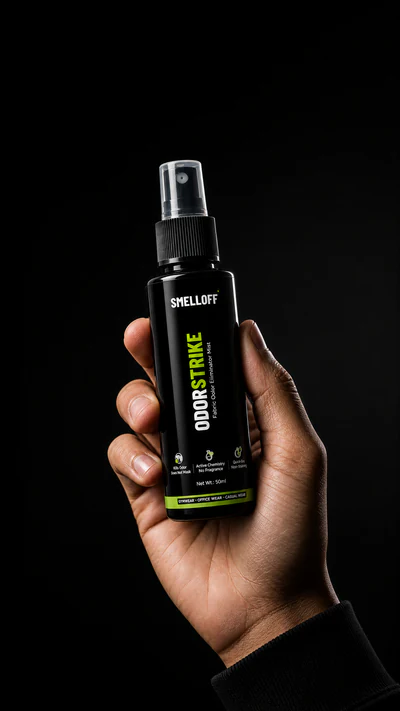
ODORSTRIKE — Fabric Odor Mist
50ml pocket spray. HPβCD traps the odor molecule, Zinc PCA neutralises it. Built for the garments you cannot wash. up to 8 hours of odor protection on fabric under normal office/commute conditions, dry in 15–30 seconds, no oils and no stiff residue. Fabric only, never skin.
Read Next
Remove Smoke and Food Smell From a Blazer Without Dry Cleaning