
Remove Smoke and Food Smell From a Blazer

You cannot put a structured jacket in a machine, and the dry cleaner takes three days and does not love your wool either. What actually works between those two options.
How do you remove smoke smell from a blazer without dry cleaning?
Air the jacket open on a wide hanger in moving air for a few hours, brush the shoulders and back downwards to lift settled particulate, then treat the back lining, underarm area and inside collar with a water-based fabric odor mist. Spot-test a hidden area first. That sequence handles most restaurant and evening smells.
In this guide5 sections
A blazer is the garment least equipped to deal with the situations it gets taken to. It goes to weddings, restaurants, bars and long evenings, absorbs everything in the room, and then has no way of being cleaned that does not cost money and time or slowly wear it out.
The instinct is to send it to the dry cleaner every time. That is the expensive answer and, done often enough, the damaging one. Most of what a jacket picks up in an evening does not need solvent.
Why does the lining hold the smell?
The lining is the layer nearest your body and it is usually a synthetic. That combination makes it the part of the jacket that collects the most and releases the least.
The outer shell of a good blazer is wool, sometimes with linen or a small synthetic content. Wool is a relatively low-odor fibre: it moves moisture as vapour rather than holding it at the surface, and it tends to hold odor compounds inside the fibre rather than giving them off. That is why a wool jacket worn several times does not smell the way a polyester shirt does after one wear.
The lining is a different material entirely. Most jackets are lined in viscose or polyester, chosen because they are smooth and let the jacket slide over a shirt. Polyester is oleophilic, meaning it attracts and holds oily substances, so it takes on the sebum and lipids your body deposits through a shirt across an evening. Odor compounds concentrate in exactly that oily fraction. The physics behind this is the same story as synthetic activewear, laid out fully in the fabric comparison.
Smoke and cooking smells arrive by a second route. Cigarette smoke and tandoor smoke both carry volatile compounds and very fine particulate, and both settle onto and into textiles. The residues that persist on surfaces and fabric long after the smoke has cleared are well documented in the public health literature on tobacco smoke, and a jacket hanging over a chair in a restaurant is an efficient collector. Cooking smells behave similarly: aerosolised oil from a kitchen carries scent compounds that land on fabric and stay.
So the jacket ends up with two problems in one layer. Body odor compounds bound into the lining from the inside, and smoke or food residues settled from the outside, most of which end up in the same absorbent places.
What does frequent dry cleaning do to wool?
Solvent, agitation and pressing all take something off the garment each time. Once or twice a season is maintenance. Once a month is attrition.
Traditional dry cleaning uses perchloroethylene, and newer shops use hydrocarbon or silicone-based alternatives. All of them are doing the same job: dissolving oily soil without water, because water would felt and shrink the wool. The solvent itself is not gentle on the fibre, and it strips some of wool's natural lanolin along with the soil.
Pressing does more visible damage than the cleaning. Heat and pressure flatten the nap of the cloth, which is the thing that gives good wool its depth and drape. A jacket that has been pressed twenty times looks shiny at the lapel edges and the seat of the matching trousers, and that shine does not come back.
Structure is the third cost. A tailored jacket has canvas, interlining and shoulder construction holding its shape. Repeated cleaning and pressing gradually stiffens some of that and slackens the rest. Tailors will generally tell you a suit should see the cleaner a handful of times a year at most, and that brushing, airing and targeted treatment should handle the rest.
| Approach | What it does | Time and cost |
|---|---|---|
| Dry cleaning | Removes stains and deep soil. Necessary sometimes, hard on wool if frequent | 2–4 days. See note below on price |
| Steaming | Relaxes creases and drives off some surface volatiles. Adds moisture | 10 min, at home |
| Airing on a wide hanger | Removes a real share of light smoke and food smell. Costs nothing | 3–8 hrs |
| Brushing | Lifts settled particulate out of the surface of the weave | 2 min |
| Fabric odor mist on the lining | Traps and neutralises the compounds in the layer that holds them | Under a minute |
How do you air a jacket properly?
Open, spaced, and in moving air. Most people hang a jacket in a wardrobe and call that airing, which is the one place it cannot work.
Use a wide wooden or padded hanger that matches the shoulder width. A thin wire hanger deforms the shoulder over a few hours and that damage is permanent. Unbutton the jacket and let the front hang open so air reaches the lining, which is the layer that actually needs it.
Hang it where air moves. A balcony in shade, a room with a fan, a doorway. Not in direct sun, which fades wool and can set some stains. Not in a closed wardrobe, where the jacket sits in its own air and nothing leaves.
Give it a few hours, ideally overnight. Airing removes a meaningful share of a light smoke or food smell on its own, because a good part of what you are smelling is volatile and simply leaves given somewhere to go. What it will not remove is anything bound into the lining, which is where the treatment comes in.
Brush before you treat. A clothes brush worked downwards over the shoulders, lapels and back lifts settled particulate out of the surface of the weave. On a jacket that spent an evening near a tandoor or a smoking area, that step alone makes a difference you can smell.
Which three zones do you actually treat?
The back lining, the underarm area of the lining, and the inside collar. Those carry the overwhelming majority of it, and none of them are on the outside of the jacket.
Open the jacket fully and work on the inside. The back panel of the lining sits against your shirt across the widest area and picks up the most. The underarm is the highest-concentration zone on any garment. The inside collar takes what comes off your neck and hairline and is the part closest to another person's nose.
ODORSTRIKE is designed for exactly this kind of garment, which is to say one you cannot wash. HPβCD, a modified sugar ring, forms inclusion complexes with odor molecules, holding the molecule inside the ring rather than letting it reach your nose. Zinc PCA neutralises what remains, triethyl citrate lowers the local pH on the fibre, and zinc gluconate reduces how quickly the odor comes back. It carries in a fast-drying water base with no oils, no dyes and no glycerine, so there is nothing left behind on a light lining, and it dries in 15–30 seconds with up to 8 hours of odor protection on fabric.
Technique on a jacket matters more than on a t-shirt, because the consequences of getting it wrong are more expensive. Hold the bottle 15 to 20 centimetres away, keep the hand moving through the pass, use two or three light passes and stop well before the fabric looks damp. Then leave the jacket hanging open until it is completely dry before it goes back in the wardrobe. The general method is in the usage guide.
Spot-test on a hidden area first. Spray fabric linings only — avoid saturating foam, padding or leather. On a jacket that means an inside seam allowance or the lining under the arm. Apply one light spray, let it dry completely, and check it in daylight before you treat anything visible.
That caution is not about the actives. On silk, zari, velvet and heavy embroidery, plain water is what marks, and that is true of every spray sold. Festive wear is where the stakes are highest, and the festive wear guide deals with sherwanis, silk kurtas and sarees specifically. If you want to know how a water-based mist behaves on different materials, the staining guide goes through five of them.
When is dry cleaning still the right answer?
Stains, structure, and one proper reset at the end of a season. The routine above is maintenance, not a replacement.
Anything that landed on the jacket goes to a cleaner. Oil, gravy, wine, chai. An odor product does nothing to a stain, because removing a stain and neutralising a smell are different chemistry solving different problems. Trying to treat a stain with a mist wastes both the product and the window in which the stain was still easy to lift.
Structural work is the second. A jacket that needs relining, reshaping or a repair goes to a tailor or a cleaner who does that work, and it gets cleaned as part of it.
The third is the seasonal reset. A jacket worn regularly through a winter or a wedding season accumulates more than surface treatment reaches, and one proper clean before it goes into storage is worth doing. Store it after that on a wide hanger, in a breathable cotton cover rather than the plastic sleeve the cleaner returns it in. Plastic traps moisture, and a jacket stored in a sealed sleeve through a Hyderabad monsoon comes out musty for reasons that have nothing to do with the evening it last went out.
A fabric odor mist does not remove stains, does not clean a soiled jacket and does not replace dry cleaning. It resets a clean garment that has picked up a smell. It is for fabric only, never skin, and on delicate or embroidered pieces it goes on the lining after a spot test, not on the face of the cloth.
Sources
American Society for Microbiology. The Microbial Origins of Body Odor. ASM.org, 2021. asm.org
United States Environmental Protection Agency. Perchloroethylene and dry cleaning. epa.gov
Odor Absorption Performance of Cotton Fabrics Functionalized with Beta-Cyclodextrin. Fibers and Polymers, 2025. link.springer.com
Frequently Asked Questions
How do you get smoke smell out of a suit jacket without dry cleaning?
Air it first, brush it, then treat the lining. Hang the jacket open on a wide hanger in moving air for a few hours, brush the shoulders and back downwards to lift settled particulate, then mist the back lining, underarm area and inside collar with a water-based fabric odor mist. Spot-test a hidden area before you treat anything visible.
Why does a blazer hold smell in the lining rather than the outer fabric?
The lining is the layer against your shirt and closest to your body, so it collects the sweat and sebum that odor compounds are produced from. It is also usually viscose or polyester, both of which hold oily residue more readily than the wool outer. Smoke and cooking smells then settle into that same layer, which is why the inside of a jacket smells stronger than the outside.
Does frequent dry cleaning damage a wool blazer?
Over time it takes a toll. The solvent, the mechanical agitation and especially the pressing gradually flatten the nap of the wool, stiffen the interlining and stress the shoulder construction that gives a jacket its shape. Most tailors suggest dry cleaning a jacket a small number of times a year and dealing with everything else by brushing, airing and spot treatment.
Can you spray a fabric odor mist on silk or embroidered festive wear?
Only after a spot test. Silk, zari, velvet and heavy embroidery water-mark from plain water, and the risk is the water rather than the odor actives, so it applies to every spray on the market. Test a hidden seam or an inside hem, let it dry completely, and check it in daylight before you go anywhere near a visible panel.
When should you still take a blazer to the dry cleaner?
For stains, for structural work such as a relining or a reshaped shoulder, and for one proper reset at the end of a season. An odor mist handles the smell a jacket picks up from a restaurant or a long evening. It does not remove a food stain, does not clean soiled fabric and does not restore a garment that has been stored badly.
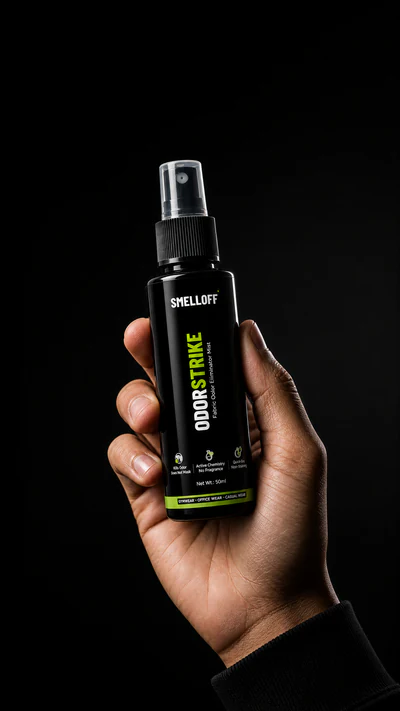
ODORSTRIKE — Fabric Odor Mist
50ml pocket spray. HPβCD traps the odor molecule, Zinc PCA neutralises it. Built for the garments you cannot wash. Up to 8 hours of odor protection on fabric under normal office/commute conditions, dries in 15–30 seconds, no oils, and it dries clear with no stiff residue. Fabric only, never skin.
Read Next
Wedding and Festive Wear: Odor Without Washing