
How to Get Diwali Cracker Smoke Smell Out of Clothes
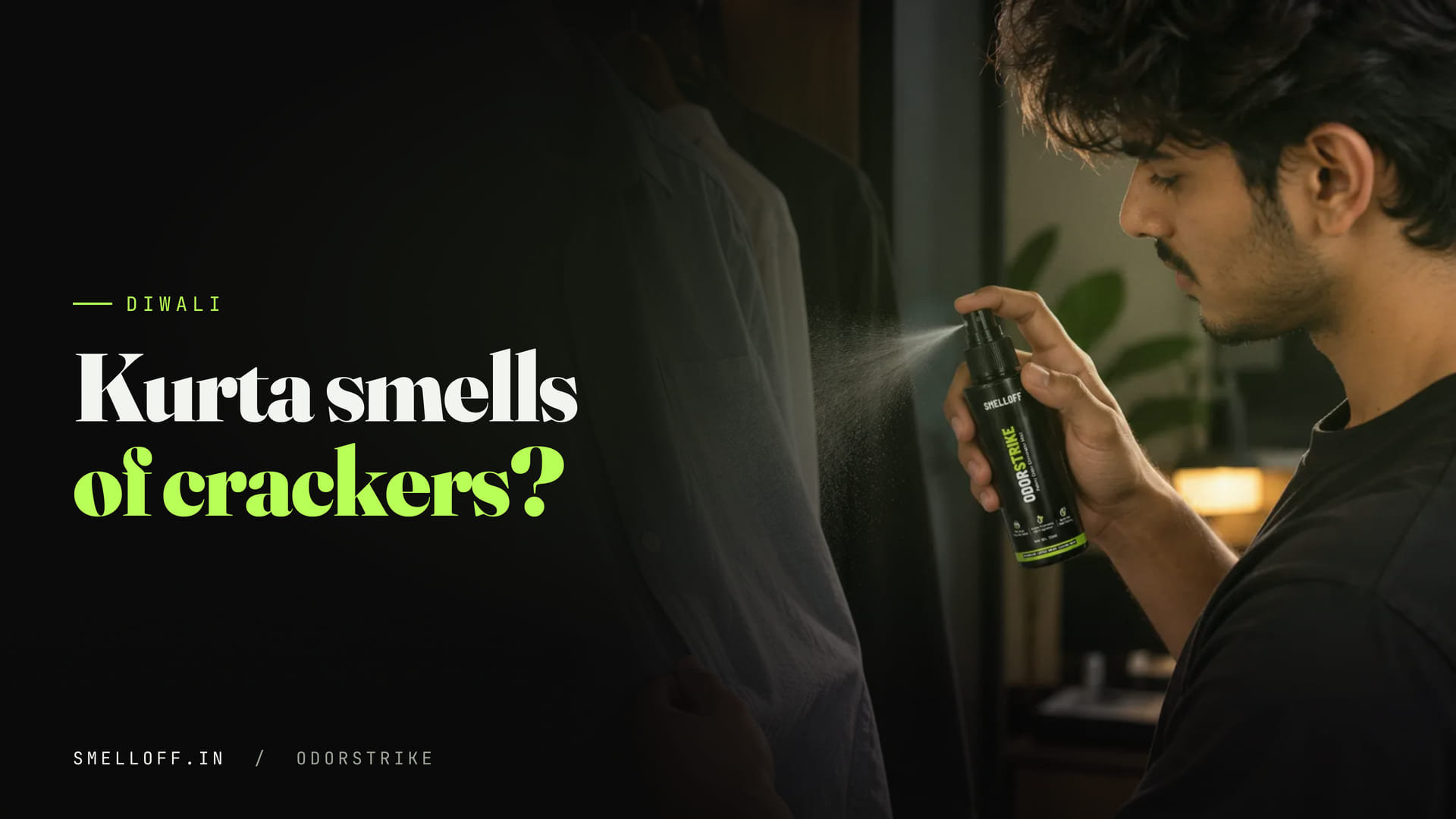
One evening of phuljhadis and anars, and the kurta you wore smells like a matchbox the next morning. Why firecracker smoke behaves differently from cigarette or kitchen smoke, and how to clear it from festive clothes you cannot throw in the machine.
How do you get cracker smoke smell out of clothes?
Take the outfit off as soon as you are indoors, hang it open in moving air for at least an hour, brush off any visible ash, then mist the front, sleeves and shoulders with a fabric odor spray from 15–20 cm and let it dry. Patch-test silk and zari first. Burn marks and soot stains need a wash or a dry cleaner.
In this guide7 sections
- Why does firecracker smoke smell stick to clothes?
- Which parts of an outfit hold the most smoke?
- What should you do the same night?
- How do you clear the smell the next morning?
- Can you use a fabric spray on a silk kurta or a saree?
- When does a festive outfit need washing instead?
- How do you keep festive clothes from smelling in the first place?
Diwali is the one night of the year most Indian households knowingly stand in smoke for hours. The sweets get eaten, the diyas burn down, and the next morning the silk kurta or the new shirt hanging on the chair smells unmistakably of struck matches. It is not dirty. It was worn for one evening. But it is not wearable to the Bhai Dooj lunch either.
Firecracker smoke is a different problem from the smells most of our guides deal with, and treating it like sweat or kitchen smell is why the usual fixes half work.
Why does firecracker smoke smell stick to clothes?
Because it arrives as fine particles carrying sulphur compounds, and fabric is a very good particle filter. The smell is not floating around the garment. It is sitting on the fibres.
The Central Pollution Control Board lists the permitted components of Indian firecrackers as mainly barium nitrate, potassium nitrate, sulphur, charcoal and strontium. Burning that mix releases sulphur dioxide, carbon monoxide and a dense cloud of particulate matter carrying metal salts. In CPCB's Delhi measurements on Diwali, sulphur dioxide in a residential area rose from 6.28 µg/m³ on a normal day to 28.30 µg/m³, and respirable particles from 107 to 312.51 µg/m³ — roughly three times the usual particle load in the same street.
Those particles are what you smell on the kurta. A woven cotton or silk surface catches them the way a dust filter does, and the sulphur-based compounds riding on them are the reason the smell reads as "matchbox" rather than "bonfire". Unlike cooking smoke, there is very little oil involved, so the deposit is drier and more of it can be shaken or brushed off. That is good news: it means airing does more here than it does for a tadka smell.
Which parts of an outfit hold the most smoke?
The parts that faced the cracker and the parts you held close to it. Smoke does not settle evenly, so treating the whole garment wastes effort and risks water marks on festive fabric.
- The front panel and chest. You stand facing the anar or the chakri, so the front of a kurta or shirt takes the plume head-on.
- Sleeves and cuffs. The hand lighting the phuljhadi is the closest part of you to the source, and loose kurta sleeves trail through the smoke.
- Dupatta, stole or shawl. A draped layer has the most surface area and catches the most particles. It is usually the worst-smelling piece the next day.
- Hair-level collar and neckline. Smoke rises, and the neckline sits right in the rising plume.
What should you do the same night?
Get the clothes off, out of the smoky room and open to the air before you sleep. Every hour a smoky garment spends folded on a chair or stuffed in a laundry bag is an hour the smell has to settle deeper into the fibres.
- Change as soon as you are back inside. Houses fill with smoke on Diwali night too; hanging the outfit in the same room keeps it collecting.
- Shake it out outdoors or at a window. A few firm shakes remove loose ash and particles. Do it away from the area where diyas are still lit.
- Hang it open on a wide hanger. Unfold the dupatta fully. Turn heavy kurtas inside out so the lining airs too.
- Leave it in moving air overnight. A fan or a cross-breeze matters more than sunlight, which can fade silk and dyed festive fabric.
Do not spray any fabric spray, perfume or deodorant near a lit diya, candle or cracker, and never on clothes you are still wearing near a flame. Treat garments indoors, away from fire, after they are off your body.
How do you clear the smell the next morning?
Brush, air, then treat the four zones with a fabric odor mist and let it dry fully. By morning the loose particles are gone and what remains is the smell bound into the weave, which is where a mist does its work.
Use a soft clothes brush or a clean, dry microfibre cloth on the front and sleeves, brushing downward with the grain. Then mist the four zones above from 15–20 cm, keeping the bottle moving: 2–3 sprays per zone on a kurta, 4–5 across a full shirt. Let the fabric dry for 15–30 seconds before you touch it, longer on heavy cotton or in humid weather.
ODORSTRIKE works on this by holding the odor molecules rather than adding a stronger smell on top. HPβCD, a ring-shaped sugar molecule, traps odor molecules inside its ring; Zinc PCA neutralises them. That matters on Diwali clothes because perfume sprayed over cracker smoke gives you sulphur and perfume together, which is the smell everyone remembers from the morning after.
| What you try | What it does to cracker smoke | Verdict |
|---|---|---|
| Perfume or body spray on top | Adds a second smell; the sulphur note stays underneath | Skip |
| Airing overnight in moving air | Removes loose particles and a good share of the smell | Always do it |
| Sun-drying silk or zari | Clears smell but can fade dye and dull zari | Avoid on festive fabric |
| Brushing the front and sleeves | Lifts ash and particles before they work in | Do it next morning |
| Fabric odor mist on the four zones | Traps and neutralises the smell left in the weave | After airing |
| Machine wash | Clears everything on washable cotton; risky for silk and zari | Only if the label allows |
Can you use a fabric spray on a silk kurta or a saree?
Only after a patch test, and the reason is water, not the actives. Silk, zari and heavy embroidery can water-mark from any water-based mist, including plain water from a plant sprayer.
Spray once on an inside seam or the inside of the hem, let it dry completely and check it in daylight. If there is no ring or change in sheen, treat the zones lightly from the full 15–20 cm, with fewer sprays than you would use on cotton. If the label says dry clean only, do not spray it at all; take it to a dry cleaner. Our festive wear guide covers sherwanis, lehengas and sarees in detail.
When does a festive outfit need washing instead?
When something landed on it: soot, a spark burn, a ghee drip or a sweet stain. A spray clears smell. It does not lift soot, and nothing fixes a spark hole.
Soot marks are carbon and need a proper wash or a dry cleaner's spotting. Small black specks from phuljhadi sparks are often tiny burns; check for them before you spend effort on the smell. And if you sweated heavily through a long evening of dancing and crackers, wash the cotton pieces normally. Freshening is for clothes that are clean apart from what they picked up from the air.
How do you keep festive clothes from smelling in the first place?
Wear a cheap outer layer for the cracker hour and keep the good fabric away from the smoke. It sounds obvious, and it is the single habit that saves the most dry-cleaning money every November.
- Do the puja in the silk kurta, then switch to a cotton kurta or an old shirt for crackers.
- Leave the dupatta or stole indoors while lighting crackers; it is the piece that collects the most smoke.
- Stand upwind of the cracker. Two steps to the side of the plume halve what reaches you.
- Hang festive clothes in the wardrobe only once they smell clean. Smoky clothes pass the smell to everything around them in a closed almirah, which is how one evening turns into a wardrobe that smells stale.
A fabric odor spray does not remove soot, ash marks or stains, and it does not replace washing. It is for fabric only, never skin, hair or body. Spot-test silk, zari and embroidery, and skip dry-clean-only pieces.
Sources
Central Pollution Control Board. Health Impact Assessment of Fire Crackers. CPCB, 2017. cpcb.nic.in
Odor Absorption Performance of Cotton Fabrics Functionalized with Beta-Cyclodextrin. Fibers and Polymers, 2025. link.springer.com
Frequently Asked Questions
Why do my clothes smell like sulphur after Diwali?
Indian firecrackers are mainly potassium nitrate, barium nitrate, sulphur, charcoal and strontium, according to the Central Pollution Control Board. Burning them releases sulphur dioxide and fine particles, and woven fabric catches those particles like a filter. The matchbox smell is those sulphur compounds sitting on the fibres.
Does hanging clothes outside remove cracker smoke smell?
Mostly, yes. Cracker smoke is a dry particle deposit with little oil in it, so a night in moving air plus a firm shake removes much of it. What remains in the weave the next morning can be treated with a fabric odor mist on the front, sleeves, dupatta and neckline.
Can I spray a fabric spray on a silk saree after Diwali?
Patch-test first on an inside seam or hem, let it dry and check it in daylight. Silk and zari can water-mark from any water-based mist. If the label says dry clean only, do not spray it.
Is it safe to use a fabric spray near diyas?
Do not spray any fabric spray, perfume or deodorant near a lit diya, candle or cracker. Take the garment off and treat it indoors, away from any flame.
Will a fabric spray remove soot marks from my kurta?
No. Soot is carbon and needs washing or a dry cleaner. A fabric odor spray clears smell from clothes that are otherwise clean; it does not remove stains, ash or burn marks.
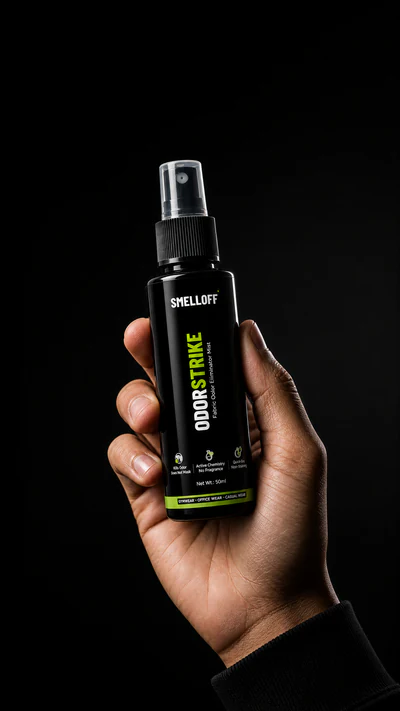
ODORSTRIKE — Fabric Odor Mist
50ml pocket spray for clothes. HPβCD traps odor molecules in the fabric and Zinc PCA neutralises them, instead of covering them with perfume. Dries in 15–30 seconds, up to 8 hours of odor protection on fabric under normal office/commute conditions. Fabric only, never skin.