
Get Curry and Cooking Smell Out of Clothes in 10 Minutes

You cooked one thing and now you are wearing it. Why kitchen smell behaves differently from every other smell your clothes pick up, and what actually clears it in the ten minutes before you leave the house.
How do you get cooking smell out of clothes without washing?
Move the garment out of the kitchen, air it in moving air for about twenty minutes, then mist the front panel, the forearms and the shoulders with a water-based fabric odor mist and let it dry. Those are the zones that face the pan. If oil actually splashed on it, that is a stain and it needs a wash instead.
In this guide6 sections
There is a specific kind of annoyance in realising, halfway to somewhere, that you smell like the thing you made for lunch. It is not a hygiene failure. You showered, the shirt was clean, you cooked for twenty minutes. And yet the smell is on you in a way that a walk in fresh air does not fix.
The reason is that cooking smell does not reach your clothes the way most smells do. Understanding that one difference changes what you do about it, and saves you from re-washing clothes that are not dirty.
Why does cooking smell cling to clothes?
Because it lands on you as oil, not as air. That is the whole difference, and everything else follows from it.
When oil gets hot in an open pan it does not simply release a scent into the room. It throws a fine aerosol — microscopic droplets of heated oil, thrown clear of the pan and carried on the convection currents rising off the hob. Those droplets carry the aroma compounds with them, and they settle on every surface in the room that is cooler than the air, which includes the walls, the cupboard doors, and you.
So what ends up on a kurta after a tadka is not a smell hanging around it. It is a very thin oily film, deposited across the fibre, holding the scent compounds physically in place. That film is why the smell has staying power that an ordinary room smell does not.
The chemistry inside those droplets is well characterised. Heating fats drives thermal oxidation, which produces aldehydes, ketones, alcohols and acids — a mix of compounds with very different volatilities. The light ones leave on their own within the hour. The heavier ones do not, and they are the ones still on your collar the next morning.
Fibre choice then decides how bad it gets. Polyester is oleophilic, meaning it actively attracts and grips oily substances, so a synthetic kurta or a poly-blend shirt holds a cooking aerosol far more tenaciously than pure cotton does. The full fibre-by-fibre picture is in the fabric comparison, and it is the reason the same evening in the kitchen leaves one shirt fine and another unwearable.
Which cooking methods put the most on your clothes?
Anything involving hot oil in an open pan, by a wide margin. The gap between frying and boiling is not marginal — it is close to an order of magnitude.
A 2024 study in Indoor Air measured peak volatile organic compound concentrations across cooking methods in a controlled setting. Pan-frying came out highest at roughly 260 ppb, with deep-frying at 230 ppb and stir-frying at 110 ppb. Boiling registered 30 ppb and air-frying 20 ppb.
That ranking maps neatly onto lived experience. Nobody comes out of the kitchen smelling of boiled rice. A tadka — mustard seeds and curry leaves hitting hot oil, deliberately at the top of the temperature range, deliberately uncovered — sits at the extreme end of the frying category and does in forty seconds what a simmering pot will not do in an hour.
| What you did about it | What it removes | Time |
|---|---|---|
| Nothing, walked out | The lightest fraction, slowly. The film stays | Hours |
| Body deodorant or perfume over it | Nothing. Adds a second smell on top of the first | Instant, and worse |
| Airing in moving air | A real share of the volatile fraction. Costs nothing | 20+ min |
| Steaming or ironing | Some volatiles, but adds moisture to an oily film | 10 min |
| Fabric odor mist on the three zones | Traps and neutralises what airing leaves behind | 15–30 sec |
| Full wash | Everything, including the oil. The correct answer if it splashed | A cycle plus drying |
Does airing clothes actually work?
It works, then it stops working. Airing is worth doing and it is not enough on its own, and knowing where the line falls saves you from leaving a shirt on the balcony overnight for nothing.
Give a garment real moving air — a balcony, an open window with a cross-draught, a fan — and the lightest compounds leave within about twenty minutes. That is a genuine improvement and it costs nothing but time.
What airing cannot do is lift the heavier compounds out of the oily film they are bound into. They are not volatile enough to walk off the fibre by themselves. This is why the pattern is so familiar: a shirt aired all night smells much better than it did, and still smells faintly of dinner at the cuffs and collar when you put your face near it.
Two things that do not work, both of which people try. Spraying body deodorant or perfume over cooking smell adds a second smell rather than removing the first, and the combination is usually worse than either alone — the difference between a fabric mist and a body product is set out in the deodorant comparison. And steaming pushes moisture into a fabric that is already carrying an oil deposit, which does the volatiles some good and the film none.
How do you reset a shirt in ten minutes?
Out of the kitchen, twenty minutes of air, then treat three zones. The zones matter because the deposit is not even across the garment.
First, get it out of the room. A garment hanging in a kitchen keeps collecting for as long as the pan is hot. If you are cooking in something you intend to wear out, change before you start — that single habit removes most of the problem.
Then air it properly, as above. Open, spaced, in moving air, not folded over a chair.
Then treat the three zones that took the deposit. The front panel from the chest down, because it faces the pan directly. The forearms and cuffs, because your hands were over the hob and your sleeves were closest to the rising plume. The shoulders and upper back, because convection carries the aerosol up and it settles on the highest horizontal surfaces in the room, and when you are standing at a hob that is you.
ODORSTRIKE is built for this category of problem — a clean garment that has picked up something it cannot be washed out of on a weekday evening. HPβCD, a modified sugar ring, forms inclusion complexes with odor molecules, holding the molecule inside the ring rather than letting it reach your nose. Zinc PCA neutralises what remains, triethyl citrate lowers the local pH on the fibre, and zinc gluconate reduces how quickly the odor comes back. It carries in a fast-drying water base with no oils, no dyes and no glycerine, so nothing is added to a fabric that already has an oil film on it, and it dries in 15–30 seconds with up to 8 hours of odor protection on fabric under normal office/commute conditions.
Technique: hold it 15 to 20 centimetres away, keep the hand moving through the pass, two or three light passes per zone, and stop well before the fabric looks damp. The general method is in the usage guide.
Spot-test on a hidden area first. Spray fabric only. On a kurta that means an inside seam allowance or a hem; on a shirt, the inside of the tail. Apply one light spray, let it dry completely, and check it in daylight before you treat anything visible.
That caution matters most on festive and delicate pieces, where plain water is what marks the cloth and the odor actives are beside the point. It is true of every spray sold. The festive wear guide covers silk kurtas, sarees and sherwanis specifically, and the staining guide works through how a water-based mist behaves on five different materials.
What about the smell that survives a wash?
That is usually a drying problem wearing a cooking-smell disguise. Heavy oil deposits do need detergent and warm water, and a cold quick-wash on a synthetic will not shift them.
Oil does not dissolve in cold water. A 30-degree quick cycle on a polyester shirt with a real cooking deposit will remove some of it and leave the rest, and the smell reappears as soon as your body heat warms the fibre. If a garment has genuinely been fried on, wash it warm, on a full cycle, with enough detergent to emulsify what is there.
The other half of the problem is what happens after the wash. A garment that takes eight hours to dry indoors develops its own smell, unrelated to the kitchen, and people often read that as the cooking smell coming back. It is not. The monsoon guide deals with that one properly.
When does it need washing rather than treating?
When something landed on the cloth rather than around it. A splash, a greasy patch, a mark you can see — that is soil, and soil goes in the machine.
Removing a stain and neutralising a smell are different jobs solved by different chemistry. An odor mist does nothing to a stain, and using one on a fresh oil mark wastes both the product and the window in which the mark was still easy to lift. Treat the smell on clothes that are otherwise clean; wash the ones that are not.
A fabric odor mist does not remove stains, does not clean a soiled garment and does not replace washing. It resets a clean garment that has picked up a smell. It is for fabric only, never skin, hair or body, and on delicate or embroidered pieces it goes on after a spot test.
Sources
Tang, X. et al. Impact of Cooking Methods on Indoor Air Quality: A Comparative Study of Particulate Matter (PM) and Volatile Organic Compound (VOC) Emissions. Indoor Air, 2024. onlinelibrary.wiley.com
American Society for Microbiology. The Microbial Origins of Body Odor. ASM.org, 2021. asm.org
Odor Absorption Performance of Cotton Fabrics Functionalized with Beta-Cyclodextrin. Fibers and Polymers, 2025. link.springer.com
Frequently Asked Questions
How do you get cooking smell out of clothes without washing them?
Get the garment out of the kitchen, air it in moving air for about twenty minutes, then mist the front panel, the forearms and the shoulders with a water-based fabric odor mist and let it dry. Those three zones are the ones that face the pan or catch what rises off it. If oil actually splashed onto the cloth, that is a stain and it needs a wash instead.
Why does cooking smell stick to clothes so much more than other smells?
Because it does not arrive as loose air. Heating oil throws a fine aerosol of oil droplets into the room, and those droplets carry the scent compounds with them and land on whatever is nearby. What settles on your kurta is a thin oily film holding the smell in place, which is why it survives hours of airing when an ordinary room smell would have gone.
Which cooking methods put the most smell on your clothes?
Anything with hot oil in an open pan. A 2024 study in Indoor Air measured peak volatile organic compound concentrations by method and found pan-frying highest at around 260 ppb, deep-frying close behind at 230 ppb and stir-frying at 110 ppb, against 30 ppb for boiling and 20 ppb for air-frying. A tadka is the highest-intensity moment in that whole range, which matches what everyone already knows from standing next to one.
Does airing clothes on the balcony remove kitchen smell?
It removes part of it and then stops. Airing carries off the lightest, most volatile fraction, which is the part that was going to leave anyway. The heavier compounds held in the oily film on the fibre are not volatile enough to walk off on their own, so a shirt aired overnight often still smells faintly of last night's dinner at the collar and cuffs.
Can you spray a fabric mist on a silk saree or an embroidered kurta?
Only after a spot test. Silk, zari, velvet and heavy embroidery water-mark from plain water, so the risk is the water rather than the odor actives and it applies to every spray on the market. Test a hidden seam or an inside hem, let it dry completely, and check it in daylight before you treat anything visible.
When does a garment with cooking smell actually need washing?
When oil has landed on it rather than around it. A visible splash, a greasy patch or a stain is soil, and removing soil and neutralising a smell are different jobs. A fabric odor mist does not remove stains and does not clean a soiled garment. Wash it, and treat the smell only on clothes that are otherwise clean.
How to get curry smell out of clothes without washing?
Get the garment out of the kitchen, air it in moving air for about twenty minutes, then mist the front panel, the forearms and the shoulders with a water-based fabric odor mist and let it dry. Those three zones face the pan. If oil splashed onto the cloth, that is a stain and it needs a wash instead.
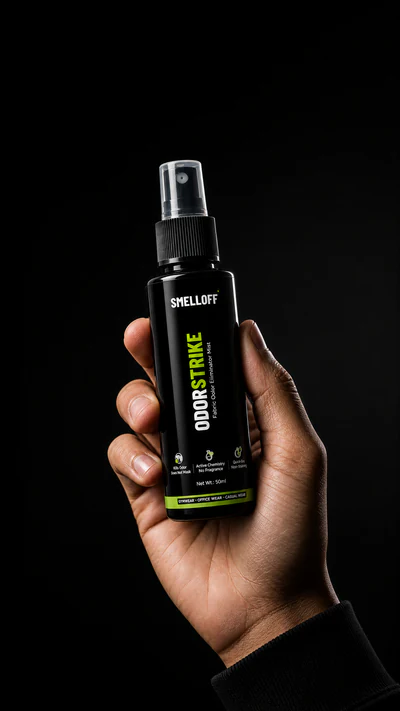
ODORSTRIKE — Fabric Odor Mist
50ml pocket spray. HPβCD traps the odor molecule, Zinc PCA neutralises it. Built for the garments you cannot wash. up to 8 hours of odor protection on fabric under normal office/commute conditions, dry in 15–30 seconds, no oils and no stiff residue. Fabric only, never skin.
Read Next
Get Cigarette and Party Smoke Smell Out of Clothes