
Why Traffic Fumes Cling to Clothes on Your Commute

The commute coats the outer face of the shirt with particles and fuel volatiles. It is not sweat and it is not kitchen tadka.
Traffic fumes cling because the commute coats the outer face of the shirt with particles and fuel volatiles — diesel soot, dust, two-wheeler exhaust. It is not sweat and it is not kitchen tadka. Airing lifts some of the volatiles. Dust and oily exhaust sit until you wash or treat the cloth that actually faced the road.
In this guide10 sections
You did not cook. You did not gym. You sat on a two-wheeler behind a bus, or in an auto that spent twelve minutes at a signal inhaling the jeep in front, and now the shirt smells like the flyover. People call it sweat because it arrived on a hot body. Smell the chest, not the pit. That is the road.
Indian city air is a coating booth you walk through. Diesel, dust, petrol two-wheelers, the occasional CNG sweetness. The chemistry is not kitchen oil. The stubbornness is similar: something landed on the outer face of the cloth and did not leave when you sat down at the desk.
You did not sweat this smell
Sweat odor is an inside job. Skin, pit, collar band, the underside of the forearm where it meets the desk. Traffic is an outside job. Front panel, outer sleeves, the face of the bag, the side of a kurta that pointed at the road. If you can smell the ORR on a shirt you have not yet lifted to your nose from the armpit, you are not in a hygiene argument. You are in a deposition argument.
This matters because the wrong diagnosis gets the wrong product. Deodorant on a chest that smells of exhaust is a mash. Perfume on diesel is a mash with better packaging. The soil is on the commute side of the cloth.
Sniff the outside first
Pit note is you. Outer-chest note after a ride is the city. Treat them as two soils on one garment or you will wash the wrong story.
Particles plus volatiles
Exhaust is not one thing. There is a particle fraction: soot, dust, the grey film you can sometimes see on a white collar after a week of bike commuting. There is a vapour fraction: unburnt fuel notes, aldehydes, the sharp petrol of a two-wheeler at idle, the heavier diesel of a bus pulling away. Clothing is good at both. Particles deposit on the outer face, more so when the cloth is rough or the air is moving. Vapours sorb into the fibre and the finish.

Road-tunnel work showed organic vapours sorbing onto diesel soot and tunnel aerosols. Clothing studies showed fabrics picking up ambient odorants from air — smoke, hot-pot, the room they sat in. You are wearing a collector through a plume. The plume is the 8:40 signal.
Cloth is a sampler
Licina, Morrison, Bekö, Weschler and Nazaroff reviewed clothing as a mediator of chemical and particle exposure: garments acquire, hold and later shed what the air offered. Cao's manikin work found particle deposition onto clothing rises with fabric roughness and air speed. A bike commute is roughness plus air speed plus a dirty plume. Of course it clings.
Outer face of the commute shirt
The useful map is front versus back, outside versus inside. On a two-wheeler the chest, the outer arms, and anything not covered by a jacket take the hit. In an auto you are sitting in a metal box with no door, facing traffic at knee and chest height; the front of the shirt and the bag on your lap are the filters. On a bus you stand in the aisle wash of everyone else's exhaust plus the open window. The inner face, against skin, is a different soil — sweat, sebum — unless the cloth is thin enough that the two meet.
- Chest and front panelFaces the plume on a two-wheeler.
- Outer sleevesOuter arms take road air the whole ride.
- Collar edgeDust and grey film show here first.
- CuffsHands on the handlebar, cuffs in the stream.
Sweat is an inside job; traffic is an outside one. Air the outer face first.
Jackets lie. A riding jacket keeps the plume off the shirt and then becomes the garment that smells of the commute. Treat the jacket's outer shell as the commute face. Do not mist the lining and call the job done if the stink is on the outside.
Auto, bike, bus
The Indian commute is not a car with recirc on. Recirc in a sedan is its own stale-cabin problem. This page is the people who eat the plume.
- Two-wheeler: highest air speed relative to the body, chest and arms as leading edges, helmet hair as a bonus sampler. Petrol note dominant when you idle. Diesel when you draft a bus.
- Auto: open sides, long waits, the engine under the seat plus everyone in front of you. Dust and exhaust both. A white shirt tells on you by noon.
- Bus and shared cab: lower air speed, longer dwell, windows that may or may not exist. You pick up the cabin and the road. Standing near the door is a particle bath.
Forty minutes at the signal is a coating
Hyderabad ORR, Bangalore Outer Ring, Delhi Ring Road, the last kilometre into Andheri. You are not 'in traffic' as a mood. You are holding still in a plume while fabric does what fabric does: collect.
This is not cooking smell
Kitchen odor is oil-soluble tadka chemistry — heated oil droplets carrying spice volatiles onto the front of whatever you wore to cook. Traffic is soot, dust, and fuel volatiles from engines. Both land on an outer face. Both annoy people who then wash the garment as if it were a pit stain. The overlap stops there. If you fried onions, that is the cooking page. If you rode through a diesel cloud, stay here. Do not write one protocol for both and pretend the chemistry agreed.
Incense is a third outer-face problem — resin smoke, particles in the weave, temple-and-cotton. Also not this. Three Indian source odors, three jobs. Mixing them is how you get a blog that helps nobody at 8.55am.
Three notes on one commute
| Note | Mostly what | Where it sits | What airing does |
|---|---|---|---|
| Sharp petrol / two-wheeler idle | Fuel volatiles | Outer chest, sleeves, bag | A lot, in moving air, in under an hour |
| Heavy diesel / bus pull-away | Soot plus heavier organics | Outer face, sometimes visible grey | Some of the vapour. Little of the particle film |
| Dust, dry, roadside | Mineral dust, tyre and road particles | Collar edge, cuffs, white cloth | Almost nothing. That is dirt. Brush, then wash |
| Pit sour after the same ride | You. Sweat acids | Inner face, contact zones | Not a fume problem. Different clock |
What airing actually removes
Moving air takes unbound volatiles. Hang the shirt outside the cabin, unbuttoned, chest to the breeze, not in a closed AC bedroom. Twenty to forty minutes does real work on the petrol note. It does less on diesel film. It does nothing on dust. If you air a shirt on the back of an office chair in a sealed cabin, you are transferring commute volatiles into the room loop. That is the AC-stale page's problem, started by this one.
Sun helps a bit with some organics and with drying if you also sweated. It is not a soot detergent. Do not bake a damp, fume-loaded synthetic on a railing at 2pm and expect chemistry to applaud.
Home protocol after the ride
You walk in. You want to sit. The shirt wants to be a source for the sofa. Take it off.
Commute shirt, outer face first
- Get it off the body and into moving air — Not the bedroom with the door shut. Balcony, window, fan. Outer face free, not folded in on itself. If you wear a jacket, the jacket hangs too — it did the collecting.
- Brush or shake the dust — Dry dust is dirt. A mist will glue it into the weave. Shake outside. A clothes brush on collar and cuffs if the cloth is pale. Then decide.
- Sniff outer chest versus pit — If the chest is the story and the pit is quiet, you are in fume territory. If both speak, you have two soils. Do not treat only one.
- Mist dry outer cloth, or wash — On a dry shirt with a leftover exhaust note and no visible film, a fabric mist on the outer face — chest, sleeves, front panel — is the between-wash job. Grey, gritty, or a diesel film you can see: wash. A mist does not remove dirt.
- Treat the outer face as the commute side. Jacket shell included.
- Air in moving air before you decide the note is permanent.
- Wash pale shirts that are picking up a visible roadside film.
- Keep the commute shirt off the bed and the sofa until it has aired.
- Do not perfume a diesel chest. You will smell like a signal and a wedding.
- Do not spray deodorant on the outer panel. That product is for skin.
- Do not bag a fume shirt in a backpack for the evening. You are packing the plume.
- Do not run a kitchen-smoke protocol on engine exhaust and call it the same oil.
When the shirt needs a wash, not a mist
Visible grey. Grit in the collar. A film that darkens white. A note that is still diesel after an hour in a breeze. That is soil. Fabric odor mist is for odorants on otherwise wearable cloth. It does not lift soot. It does not replace washing. A week's bike commute on one white office shirt is how you discover this the expensive way.
Synthetics hold oily exhaust notes with some enthusiasm. That is not a reason to write a fibre ranking here. It is a reason to wash the riding shirt more often than your vanity schedule, and to treat the outer face between washes only when the cloth is still a shirt, not a filter cartridge.
Dirt is dirt
Particles that have become a grey film are laundry. Volatiles left on a clean-looking outer face are a mist-or-air job. If you cannot tell, wash. A 50ml bottle is not a street-cleaning contract.
Honest limits
You will not out-formulate a city's fleet. You can stop wearing the plume into the office, stop mixing it with perfume, and stop calling it sweat. Helmets, jackets, bags — they collect too. The shirt is just the thing you sniff when you sit down.
Once the shirt is dry and the dust is off — leftover exhaust note on the outer face, not a grey film — ODORSTRIKE 50ml v3.1 is a fabric-only mist for that cloth. Spray the commute side: chest, sleeves, front panel. Made in Hyderabad. ₹229 prepaid. Cash on Delivery available. Light fragrance that fades; not unscented, not a perfume, not a room spray. Dries in 15–30 seconds. Up to 8 hours on fabric in ordinary office or commute use, not a guarantee. Does not replace washing a soiled shirt. Not for skin.
50ml fabric-only mist. Formula v3.1. Prepaid UPI ₹229. Cash on Delivery available. Light, subtle scent. Not a wash. Not for skin.
- Licina, D., Morrison, G. C., Bekö, G., Weschler, C. J. & Nazaroff, W. W. (2019). Clothing-Mediated Exposures to Chemicals and Particles. Environmental Science & Technology, 53(10), 5559–5575. — Clothing acquires chemicals and abiotic particles from environmental sources during wear. The garment is a collector — acquisition, retention, later transmission — which is the commute-shirt problem stated in environmental-science language. Source
- Cao, J. et al. (2023). Deposition of inhalable particles onto human clothing: A manikin-based chamber study. Building and Environment, 246, 110954. — Particle deposition onto clothing rose with fabric roughness and with air speed, and increased with supermicron particle size. A moving commuter in dusty, sooty air is on the wrong side of all three. Source
- Roth, C. M., Goss, K.-U. & Schwarzenbach, R. P. (2005). Sorption of a Diverse Set of Organic Vapors to Diesel Soot and Road Tunnel Aerosols. Environmental Science & Technology, 39(17), 6632–6641. — In traffic-dominated air, organic vapours sorb strongly to diesel soot (elemental carbon) and to road-tunnel aerosols. Exhaust is not only a smell in the air; it is a sorbent-laden aerosol that cloth can wear. Source
- Huang, W., Liang, S., Zhang, H., Ding, X. & Wang, J. (2023). Tobacco and Hot Pot Odor Adsorbed by Cotton, Wool, and Polyester Fabrics. Clothing and Textiles Research Journal. — Common apparel fibres adsorb and later desorb ambient odorants from air. Adsorption depends on the compound and the fibre; airing helps some volatiles more than others. Engine exhaust is a harsher analogue of the same outer-face pickup. Source
Frequently Asked Questions
Why do my clothes smell like traffic after the commute?
Because the outer face of the garment collected particles and fuel volatiles from the plume you sat in. Diesel, dust and two-wheeler exhaust stick to cloth. It is a coating, not a sudden personal-odor failure.
How is this different from cooking smell on clothes?
Cooking is heated oil droplets carrying kitchen volatiles. Traffic is soot, dust and engine volatiles. Both hit an outer face. The chemistry and the wash line are different. Kitchen tadka has its own page.
Can I air the shirt instead of washing it?
Airing in moving air removes a useful amount of the petrol-vapour note. It does little to diesel film and nothing to dust. If the cloth looks grey or still smells of bus after an hour in a breeze, wash.
Where should I spray a fabric mist for commute smell?
On dry cloth, on the outer face: chest, sleeves, front panel, the jacket shell if that did the collecting. Not as a room spray. Not on skin. Not as a substitute for brushing dust off first.
Why does the smell sit on my shirt but not in my hair as much?
Hair sees some of it. Woven cloth is a better collector — more surface, more time in the plume, a front panel aimed at traffic. The shirt is the sampler you then wear into a meeting.
Is the pit smell after a bike ride the same thing?
Usually not. Pit is sweat on the inner face. Exhaust is the outer face. A hot ride gives you both. Sniff both. Treat both. One product aimed at the armpit will not clear a diesel chest.
Will this go away in the office AC?
Some volatiles will leave into the cabin and then loop, which is how a commute shirt seeds an AC-stale room. The particle film will not evaporate in the cold. Air the shirt, or take it off. Do not use the cabin as a fume cupboard.
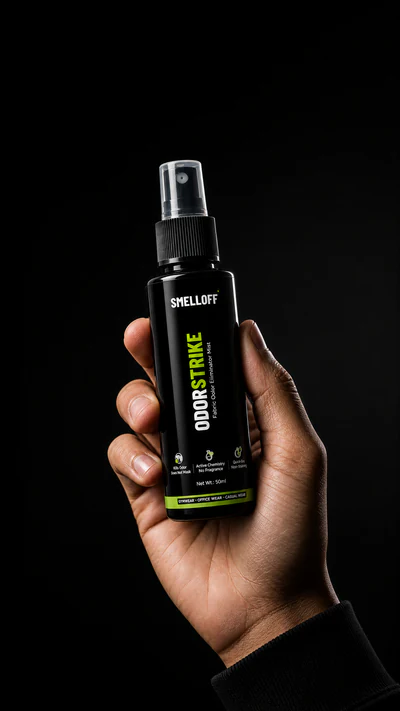
ODORSTRIKE — Fabric Odor Mist
50ml · ₹229 · Cash on Delivery available · For clothing fabric only
Buy now — ₹229 View product details