
How to Remove Incense and Agarbatti Smell From Clothes
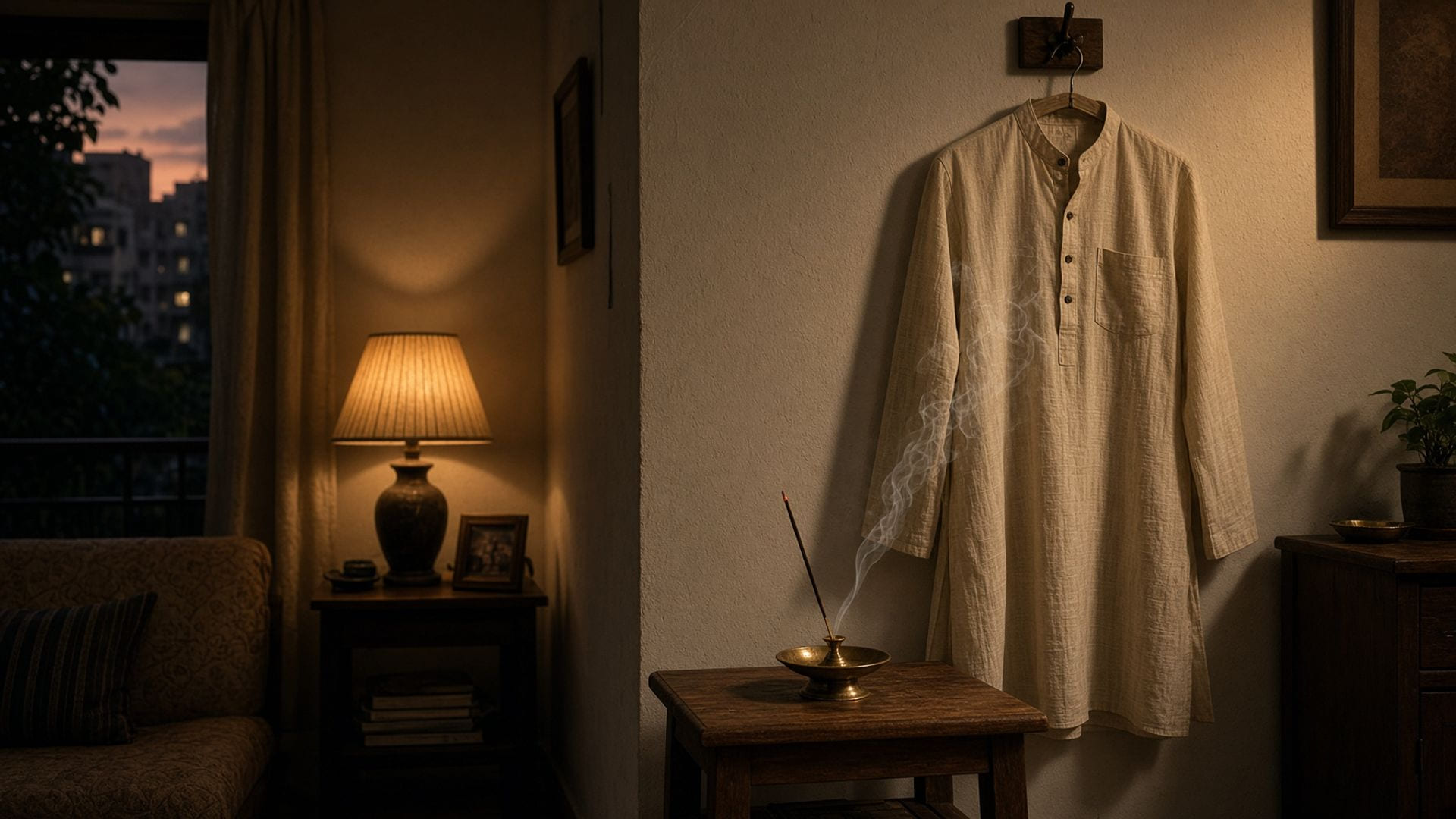
Agarbatti and dhoop leave particles and resin volatiles in cloth. That is not sweat and it is not cooking oil.
Agarbatti and dhoop leave resin smoke and fine particles in the weave. Air the garment in moving air so the light volatiles leave. Sun helps cotton; silk often cannot take it. Wash what can be washed. A fabric mist is honest on a clean, dry cloth that still smells of the puja room. Cologne on top of smoke is how you get a temple-and-perfume mash that follows you into the lift.
In this guide11 sections
- How do you get agarbatti smell out of clothes?
- Why incense is not a room odor you can wait out
- Resin smoke is not kitchen smoke
- What actually lands on cotton and silk
- Agarbatti, dhoop, and the enclosed room
- Airing: what it takes, what it leaves
- Sun: useful on cotton, rude to silk
- When a wash is the honest answer
- Temple-and-perfume mash
- When a fabric mist is honest
- Kurtas, stoles, and the next puja
You left the aarti. The room has moved on. Your kurta has not. Incense is sold as atmosphere. On cloth it is a deposit. Waiting for the house to air is not a fabric strategy.
How do you get agarbatti smell out of clothes?
Get the garment out of the smoky room. Hang it in moving air — balcony, fan, a window that is actually exchanging — for thirty to sixty minutes. That takes the light end. If it is cotton or a washable blend and the smell is still loud, wash it. If it is silk, zari, or a garment you will not wet, and the cloth is otherwise clean, air it fully dry, then treat residual odor on fabric rather than spraying a cologne over the smoke. Do not do this in the puja room. The cloth will keep collecting while you 'treat' it.
- Leave the roomGet the garment out of the smoky room.
- Air it30–60 minutes in moving air takes the light end.
- Sun for cottonShade for silk; sun is rough on silk and dyes.
- Mist what is leftOn clean, dry cloth: shoulders, drape, collar.
- Wash if thickHeavy smoke on a washable garment: wash it.
Agarbatti is a fabric odor
The room smell fades because the air changes. The shirt smell stays because particles and heavier smoke compounds lodged in the weave. You are not waiting out a mood. You are unloading a coating.
Why incense is not a room odor you can wait out
Agarbatti and dhoop smoulder. Incomplete combustion of wood powder, resins, oils and, in cheap sticks, whatever else was cheap, throws a mix of gases and particles. The particles are small — mass median diameters in chamber studies sit around a quarter of a micrometre — which is a polite way of saying they do not bounce off a kurta. They sit in the yarn.
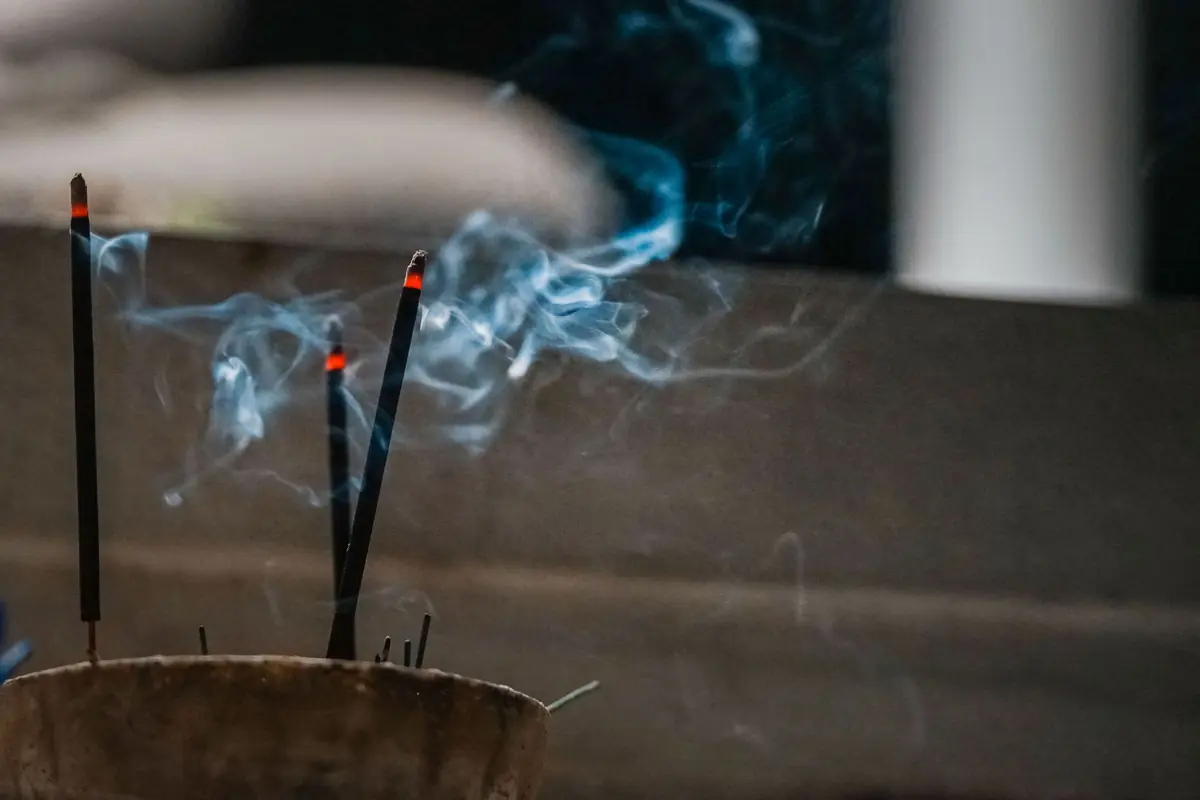
On that particle surface travel the stubborn notes: polycyclic aromatic hydrocarbons, other semi-volatiles, the brown-carbon organics that make incense smoke smell sweet-resinous rather than like a clean wood fire. The lightest volatiles leave on their own. The particulate and the heavier fraction are why a stole still smells of last night's dhoop in this morning's Uber.
Smoke is a particle problem first
Smouldering incense is a documented indoor particle source. A large share of the particle-bound PAHs come off in the finest fraction. Fabric is a filter you happened to wear. Airing moves the gas. It does not vacuum the filter.
Resin smoke is not kitchen smoke
Cooking smell on clothes is mostly an oil-and-spice story: hot fat throws an aerosol, the droplets park on the fibre, the spices ride along. That page already exists. Do not run a tadka protocol on a puja kurta.
Incense is dry smoulder. Resin, wood, charcoal, fragrance oils. The deposit is soot-adjacent particulate and smoke organics, not a fried-oil film. You will not see a greasy splash. You will smell sandalwood in a boardroom. The jobs overlap at one point only — moving air first — and then they split. Kitchen cloth that took oil needs a wash as soil. Temple cloth that took smoke needs air, then a judgement: wash, sun, or a fabric treatment on clean dry cloth.
What actually lands on cotton and silk
Cotton is a willing sponge for ambient odor. Work on smoke-type exposures with cotton, wool and polyester shows natural fibres taking up and later releasing a wider set of the airborne compounds. That matches what anyone with a white cotton kurta and a closed puja room already knows. The cloth was not 'near' the smoke. It was in the path of it.
Silk is a protein fibre with its own appetite for scent, and a lower tolerance for the usual rescue moves. Hard sun fades it. Water spots it. A soak is a dry-clean conversation. A heavy zari pallu is not a t-shirt. Treat silk as if the cloth were expensive, because it is, even when the relative insisted it was 'just a kurta'.
- Cotton / linen / most office shirts: air, then wash if the smell survived the air.
- Poly blends: air; they may hold less of the ambient note than cotton and still need a wash if the room was thick.
- Silk, chiffon, heavy embroidery, zari: air in shade, no harsh sun, no hopeful soaking. Spot-test anything you spray.
- Wool shawls: air, brush, shade. Heat and agitation are how you felt a problem into the cloth.
Agarbatti, dhoop, and the enclosed room
A single stick in a draughty hall is a different load from a closed bedroom puja with three sticks and a dhoop cone. Dhoop is denser. More resin, more smoke, less of the polite ribbon people photograph. Temples stack the problem: volume, enclosure, time. A silk saree at a morning aarti is a sampling device. Home use is milder and still enough to follow you to work if you dressed in the same room.
Dress after the smoke, in another room
If you have to be somewhere after puja, do not wear the going-out garment while the sticks are lit. Keep it behind a closed door. Light, finish, air the room, then dress. This is prevention disguised as sequence, and it beats every rescue on this page.
Airing: what it takes, what it leaves
Airing is mandatory and incomplete. Hang the garment open — not folded over a chair-back in the same smoky hall. Moving air for half an hour to an hour pulls off the volatile fraction, the part that was going to leave anyway. What remains is the cloth-bound remainder: heavier organics, particle-held notes, the 'I can still tell' layer at collar and dupatta.
Overnight on a still indoor hook in the puja room is not airing. That is storage in the source. Balcony with actual breeze is airing. A fan across a hanger in a different room is airing. If after a genuine air the smell is faint, you may be done. If it is still obviously temple, keep going down this page. Do not start the perfume.
Sun: useful on cotton, rude to silk
Sun adds two things air alone may not: heat, which drives off more volatiles, and UV, which is rough on some organic residues and also on dyes. Cotton kurtas, cotton stoles, everyday shirts — a limited spell of shade-to-sun after airing is a fair Indian instinct. Do not bake. A harsh noon on a coloured cotton is how you trade smoke for fade.
Silk, lightly dyed festive wear, and anything with zari: shade only. Heat plus UV plus a fibre that already objects to water is how heirloom cloth becomes a lesson. If the silk still smells after a long shade-air, the honest options are a specialist clean or a very careful fabric treatment after a hidden-seam test — not the terrace at 1pm.
When a wash is the honest answer
If the garment is washable and the smoke was thick, wash it. Particles that lodged are soil of a kind, even when you cannot see soot. A normal cycle on cotton, hang with spacing and air, and you have done the adult thing. A fabric mist does not replace that wash. It does not lift dirt, oils, or a sooty film you can wipe off a collar.
If you can see grey on a white collar, or the dupatta feels dusty with smoke, that is not residual odor. That is a clean. Dry-clean silk when the garment's life matters more than today's calendar. Hoping a spray will unsoot a pallu is how pallus get stained and still smell.
| What you have | What it is | Honest next step |
|---|---|---|
| Light home-puja on a cotton shirt, just out of the room | Mostly volatiles plus a little particle load | Moving air 30–60 min, then sniff |
| Still obvious after a real air, washable garment | Heavier smoke organics in the weave | Wash, then dry with air and spacing |
| Visible grey or dusty film | Soot-adjacent soil | Wash or dry-clean. Not a mist job |
| Silk / zari / festive, residual smell, cloth otherwise clean | Scent in a fibre you cannot casually wet | Shade-air, then spot-tested fabric treatment if needed |
| Cologne sprayed on the still-smoky kurta | Two heavy notes, one garment | Stop. Air. Do not add a third |
| Dressed in the puja room during aarti | Continuous collection | Prevention next time: other room, then dress |
Temple-and-perfume mash
The usual panic, in a car, is to drown the kurta in the cologne that lives in the dashboard. Alcohol flashes off. The perfume's top notes leave. The resin smoke does not. You now wear sandalwood-and-dhoop plus whatever woody-citrus you considered a personality. It does not read as 'fresh'. It reads as a temple that sells perfume.
Skin fragrance on a clean pulse point is a different object. Fragrance oils on a smoke-saturated weave are a cover. Cover is not removal. If you already did this, you cannot unspray it in the lift. Air the garment when you can. Do not add a third scent on top of the mash. Next time, air first, then decide whether the cloth needs a wash, a mist, or nothing.
When a fabric mist is honest
A fabric odor mist is for residual smell on cloth that is already clean and dry. Not for soot. Not for a garment you should wash. Not for skin. After airing, if a cotton or blend still carries the puja room and you need the garment today, a water-based mist that traps odor molecules on the fibre is a between-wash tool. It dries in 15–30 seconds in ordinary indoor air, longer in a humid hall. It will not unscent a sooty dupatta, and it does not replace the wash you owe a washable kurta that spent an hour over a dhoop bowl.
Hold the bottle off the cloth, keep the hand moving, light passes on the zones that faced the smoke — front panel, shoulders, the inner drape of a stole — and stop before the fabric looks wet. Silk and heavy zari: hidden-seam test first, full dry, daylight check. If it water-marks, you have your answer, and the answer is a cleaner, not more product.
Mist is not unscented magic, and it is not a wash
A light, subtle scent is still a fragrance. It is not unscented. Used on residual smoke it should not fight the resin for hours. Used as a cover-scent, it becomes another mash. Fabric only. Not leather, not suede, not a dry-clean-only guess.
From aarti to wearable, without the mash
- Leave the smoky room — The garment keeps collecting for as long as it hangs in the plume. Other room, other hook. If you can, this step started before you got dressed.
- Hang it open in moving air — Thirty to sixty minutes. Balcony breeze or a fan. Not the puja room. Not a folded pile on the bed.
- Judge the remainder — Faint: you may be done. Still obviously incense, and washable: wash. Still obvious, and silk or festive: shade-air longer, then a spot test before anything wet touches a show panel.
- Sun only what can take it — Cotton, limited spell, not a bleach session on the terrace. Silk stays in shade.
- Treat residual odor only on clean, dry cloth — If you use a fabric mist, light passes on the smoke-facing zones, 15–20 cm off the fabric, stop before it looks wet. 15–30 seconds to dry in ordinary air. This does not replace a wash, and it is not cologne.
- Do not perfume the leftover — If you can still name the dhoop, do not add a designer name on top. Air, wash, or treat. Cover is how the lift gets a story.
- Dress for going out after puja, in another room.
- Air in moving air for at least half an hour.
- Wash cotton and blends when the smell survives the air.
- Shade-air silk. Spot-test before any spray.
- Treat only residual odor on clean, dry fabric.
- Keep the going-out stole in a closed cupboard during aarti.
- Wait in the same smoky room and call it airing.
- Spray cologne or body deodorant on a smoke-saturated kurta.
- Bake silk or zari in noon sun.
- Mist a sooty or dusty garment instead of washing it.
- Use a fabric product on skin, hair, or the puja room's curtains.
- Fold the garment into a car seat and hope the AC strips smoke.
Kurtas, stoles, and the next puja
A stole is a horizontal shelf. Smoke rises, cools, settles. Shoulders and the inner drape collect more than a trouser leg. If you only air the shirt and wear yesterday's dupatta, you will diagnose 'the smell came back' in twenty minutes. Treat the shelf.
Prevention remains cheaper than rescue. Closed door between the sticks and the outfit. Finish the aarti. Air the room. Then dress. The garment that never entered the plume does not need this article.
After a real air, residual agarbatti or dhoop on an otherwise clean, dry garment is a fabric-odor job, not a perfume job. ODORSTRIKE 50ml v3.1 is a fabric-only mist from Hyderabad: HPβCD to trap what is on the fibre, Zinc PCA to quiet it, a light, subtle scent — not unscented, not a cologne. It dries in 15–30 seconds (longer in a humid hall), with up to 8 hours on fabric under ordinary wear, which is not a guarantee. ₹229 prepaid. Cash on Delivery available. It does not replace washing a sooty or washable-and-still-loud kurta, does not lift dirt, and wants a patch test on silk and heavy zari. Hold 15–20 cm off the cloth. Do not use it as a temple cover-scent.
50ml fabric-only mist. Formula v3.1. Prepaid UPI ₹229. Cash on Delivery available. Light, subtle scent. Not a wash. Not for skin.
- Yang C-R, Lin T-C, Chang F-H. — Particle size distribution and PAH concentrations of incense smoke in a combustion chamber (Environmental Pollution, 2007) — Incense smoke aerosol had a mass median aerodynamic diameter around 262 ± 49 nm. Solid-phase PAHs dominated the toxic equivalency relative to the gas phase — the smell you wear is riding particles, not only 'air'. Source
- Yang C-R. et al. — Characteristics of PAH emissions of particles of various sizes from smoldering incense (Bulletin of Environmental Contamination and Toxicology, 2012) — Most particle-bound PAH emission from smouldering incense was in the finest fraction (PM0.25 / PM2.5 ratio above 0.92 in the study). Fine smoke is what fabric can hold. Source
- Huang W. et al. — Tobacco and Hot Pot Odor Adsorbed by Cotton, Wool, and Polyester Fabrics (AATCC Journal of Research, 2023) — Textiles adsorb ambient smoke-type odors and later release them; cotton released a wide set of the compounds. Natural fibres are not innocent bystanders in a smoky room. Source
- Singh D.P. et al. — Uncharted sources of particle-bound PAHs from South Asia: religious/ritual burning practices (Atmospheric Pollution Research, 2015) — Ritual smouldering in South Asian settings is a measured source of particle-bound PAHs. Incense and related burns are not 'just fragrance in the air'. Source
- Chakrabarty R.K. et al. — Black and brown carbon fractal aggregates from combustion of two fuels widely used in Asian rituals (Journal of Quantitative Spectroscopy and Radiative Transfer, 2013) — Incense smoke aerosols are weakly bound aggregates; brown carbon is a primary constituent — consistent with the sweet-resin note that cloth keeps after the room has cleared. Source
Frequently Asked Questions
How do I remove agarbatti smell from clothes?
Leave the smoky room, air the garment in moving air for thirty to sixty minutes, then wash if it is washable and still loud. Silk and festive wear get shade-air and, only if the cloth is clean and dry, a spot-tested fabric treatment. Do not cover the smoke with cologne.
Does airing on the balcony get dhoop out of a kurta?
It gets the light, volatile part out. That is worth doing. The particle-held remainder often stays, which is why a kurta can still smell of last night after a conscientious hook on the grill. If airing leaves an obvious note, wash or treat — do not just wait longer in the same airless corner.
Can I put perfume on clothes to hide incense smell?
You can. You will wear both. Alcohol goes; resin smoke stays; the mix is a temple-and-perfume mash. Air first. If the cloth still needs help, wash it or use a fabric odor mist on clean dry fabric, not a skin fragrance.
Is incense smell on clothes the same as cooking smell?
No. Cooking is largely oil-and-spice aerosol. Incense is resin smoke and fine particles from smouldering plant material. Both cling. They are not the same job, and the kitchen page is the wrong protocol for a puja saree.
Can I sun a silk saree to remove dhoop smell?
Do not. Silk takes shade-air, not a noon terrace. UV and heat fade dyes and are a poor bargain for a garment you cannot casually rewash. If silk still smells after a long air, think specialist clean or a hidden-seam-tested mist, not the sun.
Will a fabric spray replace washing a smoky cotton kurta?
No. If the kurta is washable and the smoke was thick, wash it. A mist is for residual odor on cloth that is already clean and dry. It does not remove soot, dust, or the need for a wash.
How do I stop clothes picking up puja smell next time?
Do not wear the going-out outfit while the sticks are lit. Keep it in another room, door closed. Finish, air the puja room, then dress. A stole left on a chair next to the holder is a volunteer.
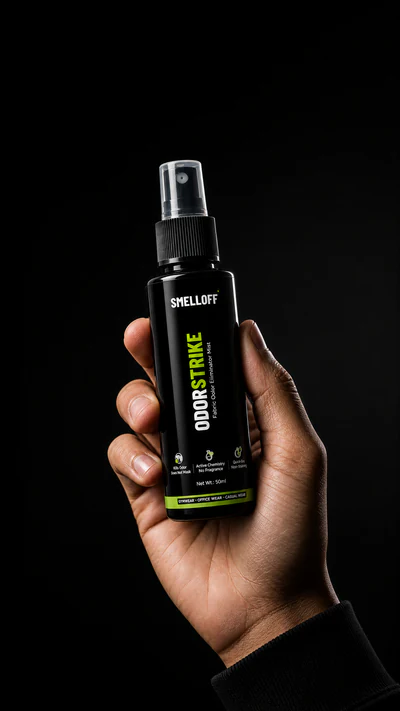
ODORSTRIKE — Fabric Odor Mist
50ml · ₹229 · Cash on Delivery available · For clothing fabric only
Buy now — ₹229 View product details