
How to Get Cigarette Smoke Smell Out of Clothes Tonight

You did not smoke. You stood near people who did, for four hours. Now the shirt smells, the jacket smells, and so does everything that was hanging next to them. Why smoke behaves this way, and what actually gets it out.
How do you get cigarette smoke smell out of clothes?
Hang the garment away from your other clothes, brush it downwards over the shoulders and back, air it in moving air for a few hours or overnight, then mist the shoulders, chest and collar with a water-based fabric odor mist and let it dry. Smoke settles from above, so the upward-facing surfaces take the heaviest deposit.
In this guide6 sections
Smoke is the most persistent thing an ordinary evening puts on your clothes. Cooking smell fades in a day. Sweat is dealt with by a wash. Smoke sits in a jacket for a week, gets into the wardrobe it was hung in, and turns up again on a shirt you have not worn since.
There is a reason for that, and it is not that smoke is somehow stronger. It is that smoke is not really a smell at all — it is a deposit that produces a smell continuously.
Why does smoke smell survive on clothes for days?
Because it leaves residue behind, and the residue keeps releasing. Ordinary smells dissipate. Smoke installs itself.
Tobacco smoke is a mix of very fine particulate and a large family of semi-volatile compounds. Both settle onto surfaces — walls, furniture, hair, and any textile in the room — and both then persist. The particulate lodges physically in the weave. The semi-volatile compounds absorb into the fibre and re-release slowly into the air over hours and days.
That continuous re-release is the whole explanation for the experience. The shirt is not holding a fixed amount of smell that gradually escapes; it is acting as a low, steady source. Which is also why moving it into a wardrobe spreads the problem — the compounds coming off it are absorbed by everything hanging nearby.
This persistent residue is studied under the name thirdhand smoke, and it turns out not to be chemically inert. A 2010 study in PNAS showed that nicotine deposited on indoor surfaces reacts with ambient nitrous acid to form tobacco-specific nitrosamines, and reported more than a tenfold increase in surface-bound nitrosamines on a model cellulose material after three hours of exposure. The researchers also measured substantial levels on surfaces inside a smoker's vehicle.
Worth stating plainly, because it is easy to over-read: that is a good argument for clearing the residue from a garment rather than spraying perfume over it. It is not a reason to be alarmed about one evening in a bar. The relevant point for a wardrobe is simply that this stuff is real, it is physically there, and masking it does not remove it.
Which fabrics hold smoke the worst?
Anything with a raised surface, a lining, or a lot of texture. Surface area is what decides it.
A smooth cotton shirt gives smoke relatively little to hold onto and airs out fastest. Wool, fleece, corduroy, knitwear and anything brushed hold far more, because a raised or scaled surface has many times the effective area of a flat weave. Jackets are the worst case in most wardrobes, and not because of the outer fabric — the blazer guide works through why the lining is the layer that actually holds a smoky evening.
Synthetics have a second problem on top of that. Polyester is oleophilic, so where smoke residue is carried in an oily fraction, a poly shirt grips it more tightly than cotton does. The full fibre-by-fibre picture is in the fabric comparison.
| Approach | What it does | Time |
|---|---|---|
| Straight into the wardrobe | Spreads the residue to everything hanging next to it | Instant, and it makes things worse |
| Perfume or body spray over it | Adds a second smell. The smoke is still there underneath | Instant, and it does not work |
| Brushing the surface | Lifts settled particulate out of the weave | 2 min |
| Airing in moving air | Clears the volatile fraction. Genuinely effective, just slow | A few hours to overnight |
| Fabric odor mist on the settled zones | Traps and neutralises what airing leaves behind | 15–30 sec |
| Wash or dry clean | The full reset. Right answer for a heavy exposure | A cycle, or days |
Does hanging clothes outside actually work?
Yes, and slowly, and it is still the first thing to do. Airing is doing real work — it is just doing it on one half of the problem.
Give the garment moving air and space on both sides, and the volatile fraction leaves steadily over a few hours. Overnight on a balcony makes a substantial difference to a shirt. What airing struggles with is the settled particulate and the compounds absorbed into the fibre, which have no strong reason to leave on their own.
Brushing before you air is the underrated step. A clothes brush worked downwards over the shoulders, chest and back lifts surface particulate out of the weave — and on a wool jacket after a long evening, that alone changes what the garment smells like.
Two things to avoid. Do not put it in the wardrobe first "until the weekend", because that is how the residue reaches five other garments. And do not spray perfume or body deodorant over it: you end up with smoke and perfume, which is worse than smoke, and the deodorant comparison explains why those products are solving a different problem entirely.
How do you reset a garment the same night?
Isolate, brush, air, then treat the zones smoke settles on. Those zones are predictable, because smoke arrives from above.
Smoke rises and then disperses downwards through a room, which means the horizontal and upward-facing surfaces collect most of it. On a person standing in a bar, that is the shoulders and upper back first, then the chest and front panel, then the collar area, which also catches what comes off your hair. Sleeves and the lower back take noticeably less.
ODORSTRIKE is built for the garment that cannot go straight into a wash — a jacket, a shirt you want again tomorrow, the thing you are wearing when you realise. HPβCD, a modified sugar ring, forms inclusion complexes with odor molecules, holding the molecule inside the ring rather than letting it reach your nose. Zinc PCA neutralises what remains, triethyl citrate lowers the local pH on the fibre, and zinc gluconate reduces how quickly the odor comes back. It carries in a fast-drying water base with no oils, no dyes and no glycerine, so nothing is added to fabric that already has a deposit on it, and it dries in 15–30 seconds with up to 8 hours of odor protection on fabric under normal office/commute conditions.
Hold it 15 to 20 centimetres away, keep the hand moving through the pass, two or three light passes per zone, and stop before the fabric looks damp. On a jacket, work on the lining rather than the face of the cloth. The usage guide covers the general method.
Spot-test on a hidden area first. Spray fabric only, never skin, hair or body. On a shirt that means the inside of the tail; on a jacket, an inside seam allowance or the lining under the arm. One light spray, let it dry completely, check it in daylight before treating anywhere visible.
Silk, satin, zari and heavy embroidery are the cases to be most careful with, because plain water is what marks them and that applies to every spray sold, not just this one. The staining guide works through how a water-based mist behaves on five materials, and the festive wear guide covers sherwanis and sarees specifically — which matters, because Indian weddings are exactly where an evening of smoke meets the least washable clothes anyone owns.
What about hair and skin?
Not this, and not any fabric product. ODORSTRIKE is for fabric only, never skin, hair or body, and that limit is not negotiable.
Hair does hold smoke well — it has a scaled surface and a natural oil layer, which is a good description of an efficient collector. The answer there is a shower, not a spray. Deal with the clothes as clothes and the rest of it the usual way.
When does it need a wash or a dry clean?
After a heavy exposure, or when the garment has been sitting in it for weeks. The routine above is for an evening, not for a chronic case.
A shirt worn for four hours in a smoky room resets well. A jacket that has been worn to the same place every week for two months has accumulated more than surface treatment reaches, and that one needs a proper clean. Anything with a visible mark or an actual burn goes to a cleaner regardless — an odor product does nothing to a stain, and the two are different chemistry solving different problems.
A fabric odor mist does not remove stains, does not clean a soiled garment and does not replace washing or dry cleaning. It resets a clean garment that has picked up a smell. It is for fabric only, never skin, hair or body, and on delicate or embroidered pieces it goes on after a spot test.
Sources
Sleiman, M. et al. Formation of carcinogens indoors by surface-mediated reactions of nicotine with nitrous acid, leading to potential thirdhand smoke hazards. PNAS, 2010. pnas.org
Centers for Disease Control and Prevention. Smoking and Tobacco Use — environmental scan. cdc.gov
Odor Absorption Performance of Cotton Fabrics Functionalized with Beta-Cyclodextrin. Fibers and Polymers, 2025. link.springer.com
Frequently Asked Questions
How do you get cigarette smoke smell out of clothes without washing?
Hang the garment away from your other clothes, brush it downwards over the shoulders and back to lift settled particulate, air it in moving air for a few hours or overnight, then mist the shoulders, chest and collar with a water-based fabric odor mist and let it dry. Smoke settles from above, so the upward-facing surfaces take the heaviest deposit and are the ones to treat.
Why does smoke smell last so long on clothes?
Because smoke leaves residue, not just a smell. Tobacco smoke carries both very fine particulate and semi-volatile compounds, and both settle onto and into textiles, where they stay and slowly re-release into the air. Researchers call the persistent residue thirdhand smoke, and it is why a jacket can still smell of an evening out three days later without being anywhere near a cigarette since.
Does hanging clothes outside remove smoke smell?
It removes a real share of it, given enough time and moving air. Airing carries off the volatile fraction, which is the part that would leave on its own. What it does not clear quickly is the residue that has settled into the fibre, which is why an aired jacket smells much better and still smells faintly of smoke when you put your face against the shoulder.
Is the smoke smell on your clothes harmful?
The residue itself has been studied and it is not inert. A 2010 study in PNAS showed that nicotine deposited on indoor surfaces reacts with ambient nitrous acid to form tobacco-specific nitrosamines, and reported more than a tenfold increase in surface-bound nitrosamines on a model material after three hours of exposure. That is a reason to clear the residue rather than mask it, and not a reason to panic about one evening out.
Can you spray a fabric odor mist on a jacket or a silk shirt?
On a jacket, yes, and on the lining rather than the outer face. On silk, satin or anything embroidered, only after a spot test — plain water is what marks those fabrics, so the risk applies to every spray on the market. Test a hidden seam, let it dry completely, and check it in daylight before you treat anything visible.
What about smoke smell in hair and on skin?
A fabric odor mist is for fabric only and must never be used on skin, hair or body. Hair holds smoke readily because of its surface texture, and the answer there is washing it, not spraying anything. Deal with the clothes as clothes and the rest in the shower.
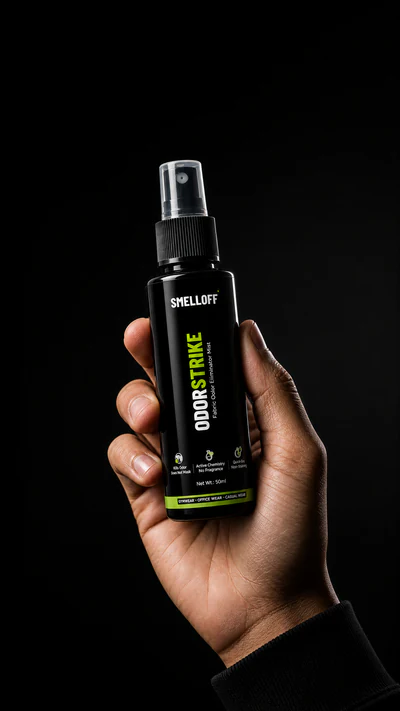
ODORSTRIKE — Fabric Odor Mist
50ml pocket spray. HPβCD traps the odor molecule, Zinc PCA neutralises it. Built for the garments you cannot wash. up to 8 hours of odor protection on fabric under normal office/commute conditions, dry in 15–30 seconds, no oils and no stiff residue. Fabric only, never skin.
Read Next
Get Mothball and Almirah Smell Out of Clothes