
Wash it, mist it, or just wear it
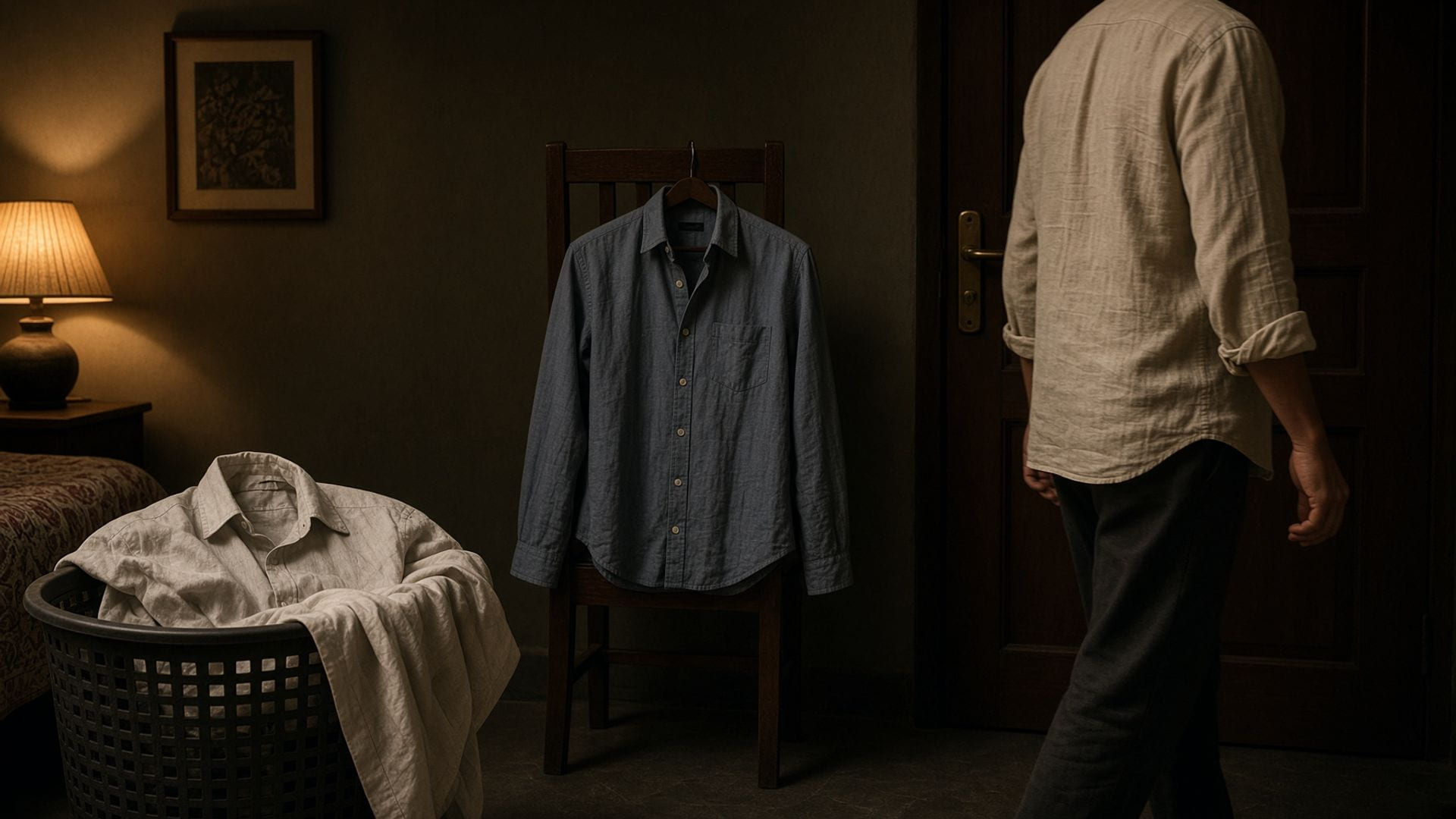
A shirt decision tree for the morning, the 4-minute meeting panic, and the 12-hour workday.
Wear it if it is dry, unstained, and quiet at 10cm on a hanger. Mist it if the cloth is clean-looking and only speaks once it is on a warm body, and you have minutes, not a laundry window. Wash it if the collar is yellow, the pits smell at arm's length, the shirt is damp, or you already misted it yesterday. The 4-minute meeting protocol is a dry-fabric sprint, not a wash. The long workday is a clock: morning triage, midday honesty, evening wash. Perfume on a sour shirt is a false exit.
In this guide9 sections
You are holding a shirt. The question is always the same: does this go on a body, on a hanger with a spray, or in the machine. The answer changes with the clock. Morning at 8:10 is not 3:56 before a client walk-in. Neither is 9pm after a 12-hour day. Same garment. Three protocols.
Most people skip the decision and pick a ritual. They wash everything, and the machine is full of shirts that were only tired. Or they wear everything twice, and the collar writes a review by lunch. Or they spray perfume on a pit seam and call it strategy. None of those is a decision tree. This page is.
Three clocks, one shirt
Clock one is the morning: you have ten minutes, a rod of hanging shirts, and a commute. Clock two is the panic: a meeting in four minutes, this is the shirt you have, the pits have an opinion. Clock three is the long day: you put it on at 8, you need it civil at 8pm. The exits are the same three — wear, mist, wash — but the honest one moves.

A mist is a leave-on for dry fabric. A wash is surfactant, water, time. Wearing it is a bet that yesterday's soil is still below notice. Confuse the three and you get the classic Indian office loop: a cotton formal that is never quite dirty enough to wash and never quite clean enough to sit across a table in.
Wash or refresh this shirt? The morning decision
Do this on a hanger, in daylight, before coffee. Not on your body. A worn shirt on a warm neck will always smell more than the same shirt on a hook. You are trying to read residue, not today's fresh sweat.
- Yellow, grey or stiff collar band or underarmsWash
- You flinch when you smell a zone at 10 cmWash
- Cool-damp from last night’s indoor dryAir it first
- Dry, unstained, a little present at the underarmsMist, then wear
- Dry, unstained and quiet on the hangerWear it
- Look at the inner collar band, the fold, and both pit panels. Yellow, grey, or stiff: wash. No debate. That is soil, not 'a vibe'.
- Smell each zone at about 10cm. If you flinch, wash. If you have to hunt for it, you can wear or mist.
- Feel the pits and the band. Cool-damp from last night's indoor dry: do not wear, do not mist. Hang it in moving air until the seam is dry, then re-test. Ironing a damp seam is a false clean.
- If it is dry, unstained, and quiet on the hanger, wear it. A mist is optional, not required.
- If it is dry, unstained, and only a little present at the pits, mist the two zones, wait until dry, then wear. Wash tonight. You have bought a day, not a week.
That is the whole morning tree. The rest of this page is what people do instead, and the two other clocks.
| What you find | Wear | Mist | Wash |
|---|---|---|---|
| Dry, no stain, quiet at 10cm, worn once in AC | Yes | Optional | No |
| Dry, no stain, pits noticeable only on skin | After a mist | Yes, then wash tonight | Tonight |
| Collar yellow or inner band grey | No | No | Now |
| Pits smell at 30cm on the hanger | No | No | Now |
| Cool-damp at the seam after a monsoon dry | No | No | Air first, then re-test |
| Already misted yesterday, back again this morning | No | No | Now. You used the delay. |
| Perfume or deodorant already on the cloth | Only if quiet and unstained | Do not stack fragrance | If it has mashed with sweat |
False wash-exits
A false wash-exit is anything that lets you skip the machine while leaving the soil in the zone. Indian bathrooms are full of them.
- Perfume or attar on a sour pit. Alcohol flashes off. The base notes sit on sweat acids. You get a mash. The meeting smells you twice.
- Deodorant on the cloth. Aluminium salts and skin-product fragrance on a weave. Stains, stiffness, a white cast on cotton. The pit still has lipid.
- A wet wipe on the collar. You have moved oil in a smear. The inner band is still a ring.
- Hanging it in front of the AC for ten minutes and calling it aired. Cold recycled air is not a rinse. It can even make a polyester blend smell like the room.
- A second iron. Heat on residue is cooking, not cleaning.
- Febreze-style room spray, aftershave, body mist — anything designed for skin or for a room. Wrong substrate.
- Washing only the 'dirty' half in a bucket and leaving the rest. The seam wicks. You have a tideline.
- Telling yourself cotton is safe so this formal can go a fourth day. Cotton is quieter. It is not a free pass on a fused collar.
Airing on a hanger, in moving air, with the collar open and the pits facing out, is not a false exit. It is a legitimate delay for a dry, unstained shirt that is only a little tired. Give it hours, not minutes. Then re-smell at 10cm. If it is still quiet, wear it. If it has come back, the residue was never gone. Wash.
Misting is not a wash in a bottle
A fabric mist can quiet volatiles already in dry cloth. It does not lift sebum, does not rinse a pit seam, does not remove deodorant film, and does not reset a yellow collar. Used on a clean-looking shirt to get through a day, it is honest. Used to postpone a wash that is already due, it is a false exit with better branding. Smelloff will sell you the mist. We will not sell you the lie.
The 4-minute meeting protocol
You are already dressed. Someone has moved a call. You have four minutes and a bathroom. This is not the morning tree. You cannot wash. You cannot go home. You can make the next hour less loud, or you can make it worse.
Four minutes. Dry cloth only.
- Minute 0–1: diagnose, do not hope — Sniff the inner collar and both pits at 10cm, cloth pulled off the skin if you can. If you get a wall of sour, you will not fix it in four minutes. Sit farther from people, keep your arms in, change the shirt if a spare exists. A mist on a wet, roaring pit is perfume on garbage.
- Minute 1–2: dry the zones — If you have been commuting, the pits and the back may be damp. A mist on wet fabric dilutes, drips, and can smell louder as water lifts residue. Blot with a clean towel. A bathroom dryer on cool, if you have one. Do not use the hand-dryer on hot against a polyester blend — you are baking the note.
- Minute 2–3: mist the cloth, not the body — If the shirt is now dry enough, one or two sprays on the inner collar band and one on each pit panel from 15–20cm. Not on skin. Not on the face of a white collar if you can avoid it — light fragrance can spot-dye a damp weave. Formula v3.1 of ODORSTRIKE dries in 15–30 seconds in a normal room, 30–60 in a humid bathroom. Wait for dry. Do not layer perfume on top.
- Minute 3–4: air and walk — Wave the cloth. Let the short fragrance flash off. That fade is the point, not a defect. Walk in with arms unclenched. After the meeting, the shirt is not 'saved'. It is due a wash tonight. You used the emergency. Do not use it twice on the same garment.
If there is a spare shirt in the office drawer, use it. The protocol is for when there is not. A cotton formal with a quiet chest and a slightly tired pit is the candidate. A poly-blend gym leftover from the morning session is not. Neither is a collar with a visible ring.
What four minutes cannot do
Cannot lift a sebum ring. Cannot dry a monsoon shirt. Cannot un-mash perfume and sweat. Cannot take a garment from 'smells at 30cm' to 'client-safe'. If the answer at minute 0 is wash, and you cannot wash, the honest move is distance and a spare, not a third spray.
The long workday clock
A 12-hour Indian workday is not one environment. It is a stack. Home to metro or bike at 8. Outdoor heat. Office AC at 22°C. Lunch in a packed canteen. Another outdoor burst. The same shirt at 8pm for a drink, a train, a family function. The body is the same. The humidity and the heat are not.
Plan the day in three checks, not one heroic spray at dawn.
08:00 — start clean, or start honest
A shirt that failed the morning tree will not become better because the day is long. Wash last night's shirt last night. This morning, wear the one that passed. If you mist, mist now, on dry fabric, and treat it as a delay until evening, not a 14-hour warranty. 'Up to 8 hours on fabric under normal office conditions' is a working window for ODORSTRIKE, not a guarantee, and a bike commute in June is not a normal office condition.
13:30 — the canteen check
Bathroom. Same 10cm test. If the pits have come up and you have an afternoon of sitting in AC, a second mist on dry cloth can be reasonable — once. If you are already damp, blot first. If the collar band has gone yellow since morning, it was always dirty; heat showed you. You will not reverse that at a sink. Live with it, keep distance, wash tonight.
19:00 — stop digging
Evening plans do not get a third mist on a 12-hour shirt. They get a change, or they get the truth: this is a worn shirt. Airing it on a hanger in a dry room for 30 minutes while you shower is worth more than another product. If the next stop is a closed car or a packed local, the shirt will get louder. Change if you can. If you cannot, you are in the meeting protocol again, with worse odds.
When misting is honest
Honest misting has a short list of conditions. Miss one, and you are covering.
- The fabric is dry to the seam. Not cool-damp. Not monsoon-wet.
- No visible soil on the inner band, no yellow pit.
- The smell is a volatile that showed up on a warm body, not a hanger-stink at 30cm.
- You will wash this garment tonight, or tomorrow morning at the latest.
- You are spraying cloth, from a distance, and waiting for dry. Not skin, hair, or a sofa.
- You are not stacking it on perfume, deodorant, or yesterday's mist.
A light, subtle scent is a feature of a fabric mist that is not trying to be a perfume. If you want a scent to last, you want a different product and a clean shirt. If you want the odor quieter without a new identity, the fade is the honest part.
When you must wash
Non-negotiable. Not 'tonight if you remember'. Now, or the next time the machine runs, with the shirt in that load.
- Visible yellow or grey on the collar band, fold, or pits.
- Smell at 30cm on a hanger, in a quiet room.
- You already used the mist delay yesterday.
- The shirt went through rain, a wet auto seat, or a gym session.
- You can see deodorant cast or feel a stiff film.
- Someone else mentioned it. They are not being sensitive. They are downwind.
- You would not put it on for a walk-in with a person you are trying to impress. That instinct is the test. Use it at 8am, not only at 5pm.
Washing badly is also a false exit. Packed drum, 20-minute eco, collar buttoned, pits mashed against a towel, then a rod in a closed bathroom: you will be back at this page on Thursday. Pre-treat the inner band and the pit seams. Give the shirt space. Dry the seams in air. The decision tree assumes the wash, when you choose it, actually happens.
Cotton formal vs poly-cotton on a long day
A 100% cotton office shirt usually starts quieter and tells the truth sooner. When it is done, you can smell it. A poly-cotton blend often feels drier on the body and then announces itself in a meeting room as a sour-musty that you cannot locate. Munk (2001) found hydrophobic odorants stuck to polyester through a wash more than to cotton. Callewaert (2014) found polyester T-shirts more intense after the same session on the same people. You do not need a fibre ranking to use that. On a 12-hour day, the blend wants a stricter morning tree and a harder wash-tonight rule. The cotton formal can sometimes take a second wear if the hanger test is clean. Neither fibre makes a yellow collar wearable.
A banian under the shirt is a good Indian habit for the chest. It does not save the collar band or the pit seam. Those still touch you.
Commute, monsoon, AC — the Indian stack
Outdoor heat plus a closed AC office is a condensation engine on the body. You leave a 38°C pavement, sit in 22°C air, and the shirt is suddenly wet in places you did not notice on the bike. Water turns residue up. A mist on that dampness is a bad meeting protocol. Blot, wait, then decide.
Monsoon is the other stack. A shirt that dried 'enough' on a ceiling rod overnight is often still wet in the pit channel. The morning tree's damp clause exists for this. Do not iron it into submission. Do not spray it. Hang it in a doorway with a fan for an hour and pick another shirt. If you only own two formals, you need a third, or you need to wash at night instead of on Sunday. If you can keep one spare cotton formal at work, folded clean in a bag — not on a pantry hook absorbing canteen air — the 4-minute panic mostly disappears. That spare is worth more than a second bottle of anything.
- Test on a hanger, at 10cm, before the shirt is on a warm neck.
- Wash on visible soil, hanger-stink, damp cloth, or a used-up delay.
- Mist only dry, unstained fabric, and wash that piece tonight.
- Keep a spare shirt at work if the 4-minute version of your life happens often.
- Air a tired-but-clean shirt for hours with the collar open. Then re-test.
- Do not put perfume, attar, or deodorant on a sour weave.
- Do not mist a wet monsoon shirt and walk into a meeting.
- Do not use the emergency protocol two days running on the same garment.
- Do not iron a cool-damp pit seam and call it a refresh.
- Do not let a 12-hour day collect three fragrances on one collar.
ODORSTRIKE, 50ml, formula v3.1, made in Hyderabad. ₹229 prepaid. Cash on Delivery available. Fabric only — not skin, not a deodorant, not a perfume. Light, subtle scent. Dries in 15–30 seconds; 30–60 in high humidity. Up to 8 hours on fabric under normal office or commute conditions is a working window, not a guarantee. It belongs in the 4-minute protocol and in the morning delay, on dry unstained cloth. It does not replace washing. It does not rescue a yellow collar. If the morning tree said wash, the bottle is not a second opinion.
50ml fabric-only mist. Formula v3.1. Prepaid UPI ₹229. Cash on Delivery available. Light, subtle scent. Not a wash. Not for skin.
- Munk S, Johansen C, Stahnke LH, Adler-Nissen J. Microbial survival and odor in laundry. Journal of Surfactants and Detergents. 2001;4:385–394. — Hydrophobic odorants stayed with polyester through a wash more than with cotton. Microbial odor dominated when laundry dried slowly. A 'refresh' on a still-damp indoor-dried shirt is working against that finding. Source
- Callewaert C et al. Microbial odor profile of polyester and cotton clothes after a fitness session. Applied and Environmental Microbiology. 2014;80(21):6611–6619. — After the same session on the same wearers, polyester smelled more intense and less pleasant than cotton. A poly-cotton office shirt on a 12-hour day deserves a stricter wash-tonight rule than a 100% cotton formal that passed the hanger test. Source
- McQueen RH, Laing RM, Brooks HJL, Niven BE. Odor intensity in apparel fabrics and the link with bacterial populations. Textile Research Journal. 2007;77(7):449–456. — Odor intensity tracked fibre type more than bacterial counts after a day's wear. A shirt can be 'not that dirty' on a plate count and still fail a 10cm sniff. Trust the sniff. Source
- McQueen RH, Laing RM, Delahunty CM, Brooks HJL, Niven BE. Retention of axillary odour on apparel fabrics. Journal of the Textile Institute. 2008;99(6):515–523. — Short-chain acids built in the headspace above polyester over days after wear, not above cotton or wool. Intensity was inversely related to fibre hygroscopicity. A shirt that was quiet on day one can be louder on day two without a new gym session. Source
Frequently Asked Questions
Can I wear this shirt a second day?
Yes if it is dry, unstained, and quiet at 10cm on a hanger. No if the inner band is yellow, the pits smell at arm's length, or you already delayed it with a mist yesterday. Cotton formals fail this test more honestly. Poly-cotton can smell fine on the chest and loud at the seam — check the zones.
How do I refresh a shirt before a meeting in four minutes?
Diagnose first. If it is roaring, you will not fix it. If the cloth can be dried, blot, then one or two sprays on the inner collar and each pit from 15–20cm, wait until dry, do not add perfume. Change shirts if a spare exists. Wash tonight. That was an emergency, not a method.
How do I keep a shirt fresh through a 12-hour workday?
Start with one that passed the morning tree. Optional mist at 8am on dry fabric. Re-check at lunch; a second mist only if still dry and unstained. Do not stack product at 7pm on a 12-hour shirt — change or air. Evening plans are a different garment if you have one.
Is misting just covering the smell?
A cover-scent that stays is covering. A light, subtle scent on dry, clean-looking cloth is trying to quiet volatiles already in the weave. It still does not lift soil. If you need the scent to hide a hanger-stink, that is covering. Wash.
When is a wash non-negotiable?
Visible soil, smell at 30cm on a hanger, damp from rain or gym, already-misted yesterday, deodorant film, or the 'I would not wear this to a walk-in' test. Also when you have been using air and mist as a personality.
What if the shirt is damp from rain or the commute?
Do not mist. Do not iron. Blot, hang in moving air until the seams are dry, then re-run the hanger test. Water makes residue louder. A spray on a wet pit is a drip and a worse note.
Can I mist and wear immediately?
Wait until the cloth is dry to the touch. 15–30 seconds in a normal room, 30–60 in a humid bathroom for ODORSTRIKE. Immediate wear on wet spray is how you get spots on a white collar and a fragrance that has not flashed off yet.
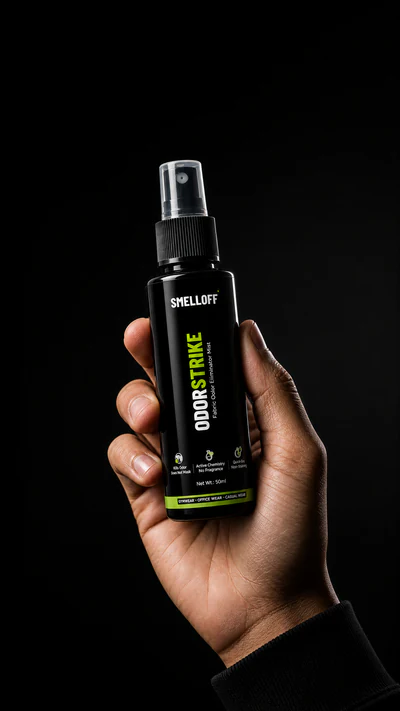
ODORSTRIKE — Fabric Odor Mist
50ml · ₹229 · Cash on Delivery available · For clothing fabric only
Buy now — ₹229 View product details