
Old Age Body Odour (Nonenal): Why It Happens, How to Help
Many of us have noticed a particular smell in a grandparent's room, shawl or kurta: not sweaty, not dirty, just different. It has a name and a chemistry, it is nobody's fault, and most of it lives in fabric. Here is what research says and how to help without making anyone feel bad.
What causes old age body odour?
As skin ages, its oils change, and a 2001 study found an odour compound called 2-nonenal, which smells greasy and grassy, only in people aged 40 and over. It is not a sign of poor hygiene, and a 2012 study found older people's body odour was rated less intense and less unpleasant than younger people's. Because it is oily, it clings to clothes, shawls and bedding, so washing those more often does most of the work.

ODORSTRIKE 50ml · pocket size
Clothing deodorant: neutralizes sweat, smoke and food smell in the fabric. Never on skin.
Use it when a parent's kurta or sweater will be worn again before wash day.
Cash on Delivery · Free shipping on prepaid · Ships from Hyderabad within 48 hours
We deliver within India only.
See how ODORSTRIKE worksIn this guide7 sections
In Japan it even has a name, kareishu. In Indian homes, where parents and grandparents often live with their children, it is usually just noticed and never mentioned. That silence does not help anyone, because the fix is mostly a laundry routine.
What is "old age smell"?
A real change in body odour linked to an oily compound called 2-nonenal.
- 40+
- the only ages in which a 2001 study found 2-nonenal
- 26–75
- age range of the 2001 study's volunteers
- 75–95
- donor ages whose odour was rated less intense in 2012
In 2001, researchers analysed body odour from volunteers aged 26 to 75 and found 2-nonenal, an unsaturated aldehyde with a greasy, grassy smell, only in those aged 40 and over. They traced it to the breakdown of certain skin fatty acids that increase with age. The study was small, and not every older person produces much of it, but the finding has held up.
Is it worse than other body odour?
No. It is different, not stronger. In a 2012 study published in PLoS ONE, people rated body odour samples from donors aged 75 to 95 as less intense and less unpleasant than samples from young and middle-aged donors, though they could still tell them apart. So this is not about a parent "not washing". It is about a distinctive smell that lingers.
Why does it cling to clothes and bedding?
Because it is oily, and oily smells hold on to fabric. 2-nonenal does not wash off skin easily with water alone, and it transfers to vests, kurtas, shawls, pillowcases and quilts. Older people often feel the cold, wear the same warm layer for days and wash heavy items less, so the smell builds up in fabric even when the person bathes every day.

How can you help without hurting feelings?
Make it about the laundry, not the person.
- Offer to take over washing the shawl, the sweater and the bedding, as part of the household routine.
- Buy a few more vests and nightwear sets so changing daily is easy.
- Suggest a gentle soap on the neck, chest and back, where skin oils are highest, as a winter skin-care habit.
If you do need to say something, our guide on how to tell someone they have body odour has kind wording.
What washing routine helps most?
- Vests, shirts and nightwear: after every wear.
- Pillowcases: twice a week; sheets weekly.
- Shawls, sweaters and quilts: wash or clean as the label allows, more often in winter, and air them in sun or moving air between washes.
- Dry in sun where possible. See why sun-dried clothes smell good, and how often to wash nightwear.
Can a fabric spray help?
Between washes, on clean clothes, yes; it is not a substitute for washing. For a kurta or sweater that will be worn again, a light mist with a light fabric spray for a kurta between washes on the collar, chest and back neutralises odour in the fabric. ODORSTRIKE has a light, fresh scent, dries in 15–30 seconds, and goes on clothes only, never on skin. Let it dry fully before it is worn.
When should you talk to a doctor?
If the smell changes suddenly or is unlike their usual smell. A gradual change with age is normal. A sudden, strong or unusual new smell can have a medical cause and is worth mentioning at their next check-up.
Research on age-related odour is based on small studies. Washing clothes and bedding is the main fix; a fabric spray only freshens clean clothes between washes, and is never for skin.
Sources
Haze, S. et al. 2-Nonenal newly found in human body odor tends to increase with aging. Journal of Investigative Dermatology, 2001. pubmed.ncbi.nlm.nih.gov
Mitro, S. et al. The smell of age: perception and discrimination of body odors of different ages. PLoS ONE, 2012. pubmed.ncbi.nlm.nih.gov
Frequently Asked Questions
What is 2-nonenal?
An oily compound with a greasy, grassy smell that a 2001 study found only in the body odour of people aged 40 and over.
Is old age smell caused by poor hygiene?
No. It comes from natural changes in skin oils with age. It clings to fabric, so it can linger even when someone bathes daily.
How do you get old person smell out of clothes?
Wash vests, kurtas and nightwear after every wear, wash bedding regularly, and dry them in sun or moving air.
Does soap remove nonenal?
Washing the neck, chest and back with a gentle soap helps, along with fresh clothes and bedding.
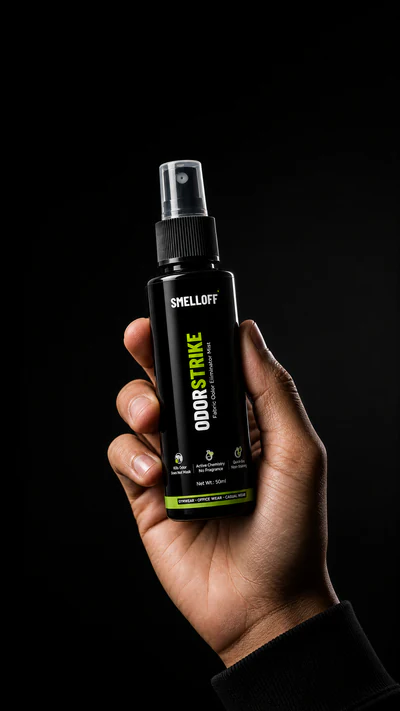
ODORSTRIKE — Fabric Odor Mist
50ml pocket spray for clothes. HPβCD traps odor molecules in the fabric and Zinc PCA neutralises them, instead of covering them with perfume. Dries in 15–30 seconds, up to 8 hours of odor protection on fabric under normal office/commute conditions. Fabric only, never skin.
Buy now View product details