
How to Tell Someone They Have Body Odour, Kindly

Everyone in the office has noticed. No one has said anything, because it feels cruel. But saying nothing is what lets it go on for months. Here is how to raise body odour with a colleague, a flatmate or a family member so it lands as help, not as an insult.
How do you tell someone they have body odour?
Say it privately, briefly and kindly, as something you would want to know yourself. For example: "I wanted to mention this quietly because I would want someone to tell me: I have noticed a sweat smell on your shirts by afternoon." Then stop, let them respond, and if it helps, point to an easy fix. At work, if you are not close to them, a manager or HR should raise it instead.
In this guide6 sections
There is a smell at the next desk, or in the shared flat, or in the car on the way home. It is not going away, and the person seems not to notice. You are not imagining it, and you are not cruel for wanting it to stop.
The kind thing is usually to tell them, once, privately, in a way that makes it easy to fix.
Should you tell someone they smell?
Usually, yes, if you are close enough or responsible for them. Most people would rather hear it from one person kindly than notice everyone moving away.
People often cannot smell their own body odour. The nose adapts to smells that are always around, a process researchers call olfactory adaptation or habituation; a review in Physiology & Behavior (Pellegrino et al., 2017) describes how quickly it sets in. So the person may truly not know. There is also a social cost they cannot see: one small study found that people make judgments about others' personalities from body odour alone (Sorokowska et al., 2012).
If you are a peer and not close, think about whether a manager or HR is better placed. At home, the person closest to them should say it.
How do you bring it up without hurting them?
Private, short, about the smell not the person, and framed as something you would want to know.

- Choose privacy. Never in a group, on a team chat or by an anonymous note. HR guidance from the Society for Human Resource Management recommends a private, in-person conversation, ideally at the end of the day so the person is not self-conscious for hours.
- Be specific and neutral. "A sweat smell on your shirts by afternoon" is fixable. "You smell" is not useful.
- Assume a simple cause. Most of the time it is the clothes, a new medication, a hard week or a broken washing machine, not hygiene.
- Say it once, then stop talking. Give them room to respond.
What exactly can you say?
A few scripts that work, depending on how close you are.
- Close colleague or friendYou, privately, once
- Peer you barely knowTheir manager or HR
- Your team memberYou, linked to policy, in private
- FlatmateYou, about the laundry and the room
- Anyone, by note or group chatDon't
- Colleague you get on with: "Can I mention something a bit awkward, because I'd want someone to tell me? By afternoon there's a sweat smell from your shirts. Probably the clothes, it happens with polyester. I didn't want anyone else to say it first."
- Flatmate: "Hey, the room has started to smell a bit, I think it's the laundry pile and the gym clothes. Can we sort a wash day this week?"
- Family member or partner: "Your blue shirts have started to hold a smell even after washing. Want me to show you what works?"
- Teenager: "This happens to everyone at your age. Here's what helps." Our guide for parents of teenage boys covers this in detail.
How do you make it easy to fix?
Point to the clothes, because that is usually where the smell lives, and to something simple.
Body odour on clothes often outlasts a shower: the sweat molecules and bacteria stay in the collar and underarms of a shirt, especially polyester, and come back when it is warm. Practical fixes are a wash after every sweaty wear, cotton shirts, a vest under the shirt and, during the day, a pocket fabric odor spray on the collar and underarms. For someone you are close to, handing over a small 50ml clothing deodorant spray for shirts can be easier than a long talk. ODORSTRIKE goes on fabric, never skin, and traps and neutralises odor in the shirt instead of covering it.
What if you are the manager?
Handle it like any other workplace issue: privately, factually, linked to policy, and with respect.
SHRM's guidance is to confirm the complaint is genuine, meet in private, refer to the dress or hygiene expectations if your company has them, focus on the effect at work, and be open to causes you cannot see, including medical conditions, religious or cultural practices and personal circumstances. Keep it confidential and do not name who complained.
What should you avoid?
Anything public, anonymous or repeated.
- Leaving deodorant on their desk without a word.
- Hints in a team chat, jokes, or "someone said".
- Bringing it up again and again.
- Assuming poor hygiene. It is often the clothes, or a medical issue.
A fabric spray helps when the smell is in clothes. If someone has sudden, strong body odour despite washing, it may be medical, and the kind suggestion is a doctor, not a product. Never spray anything on another person.
Sources
Pellegrino, R. et al. Habituation and adaptation to odors in humans. Physiology & Behavior, 2017. research.wur.nl
Live Science Some personality traits affect how you smell (on Sorokowska et al., European Journal of Personality, 2012). LiveScience.com. livescience.com
Society for Human Resource Management How to talk to a worker about body odor. SHRM.org. shrm.org
Frequently Asked Questions
How do you tell a coworker they smell without offending them?
Privately, briefly and kindly, as something you would want to know. Mention the smell, not the person, suggest it may be the clothes, then stop and let them respond.
Why can't people smell their own body odour?
The nose adapts to smells that are always around. This olfactory adaptation means people often cannot detect their own body odour or their own clothes.
Should I leave an anonymous note about body odour?
No. Anonymous notes feel like an attack and give the person no way to ask questions. A short private conversation, or a manager or HR at work, is kinder.
Can I gift a fabric spray to someone who smells?
For someone close to you, yes, as part of a kind conversation. On its own, without a word, it can feel like a hint in public.
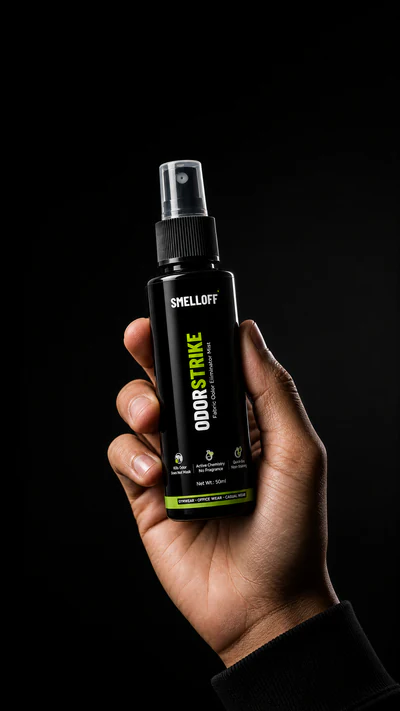
ODORSTRIKE — Fabric Odor Mist
50ml pocket spray for clothes. HPβCD traps odor molecules in the fabric and Zinc PCA neutralises them, instead of covering them with perfume. Dries in 15–30 seconds, up to 8 hours of odor protection on fabric under normal office/commute conditions. Fabric only, never skin.
Buy now View product details