
How to Know If You Smell Bad (When You Can't Smell It)

You showered, you put on deodorant, you feel fine. So why did someone just step back? The honest answer is that you are the worst-placed person to judge your own smell. Here is why, and how to check anyway.
How can you tell if you smell bad to other people?
Check your clothes, not your skin: after an hour away from them, smell the collar and underarms of the shirt you wore, or a shirt from your laundry pile. Ask one honest person you trust. Watch for repeated signs such as people stepping back. If the shirt smells, the fix is usually the clothes: wash after sweaty wears, choose cotton, and treat the collar and underarms of clean shirts between washes.
In this guide6 sections
It is one of the most common worries there is: "do I smell?" And it is genuinely hard to answer, because the one nose that is always with you is the one that has stopped noticing.
Why can't you smell yourself?
Because your nose adapts to smells that are always present, and your own smell is always present.
Scientists call it olfactory adaptation or habituation: when a smell is constant, your brain stops reporting it so you can notice new ones. A review of the research in Physiology & Behavior (Pellegrino et al., 2017) describes habituation to odours as relatively fast. It is why you stop smelling your own perfume after a while, and why you can walk into a friend's house and smell it when they cannot.
Your clothes are part of that background. A shirt that has absorbed sweat smells normal to you, because it smells like you.
How can you check your own smell?
Use a gap in time and a clean comparison. These five checks work better than sniffing your arm.
- Shirt testAway 15–20 minutes, then smell collar and underarms.
- Laundry pileYesterday's shirt is roughly you by evening.
- Second wearA worn, hung-up shirt shows tomorrow's problem.
- Room testNotice your car or cupboard after a few hours away.
- Ask one personA direct question to someone honest.
- The shirt test. Take off the shirt you wore today, leave the room for 15–20 minutes, come back and smell the inside of the collar and the underarms. Your nose will be "fresh".
- The laundry pile test. Smell yesterday's shirt from the pile. That is roughly what you smell like by evening.
- The second-wear test. Smell a shirt you have worn once and hung up. If it smells, you will by afternoon on the second wear.
- The car or room test. Notice the smell of your car, your bedroom or your cupboard when you come back after a few hours.
- Ask one person. A partner, sibling or close friend. Ask a direct question: "Be honest, do my shirts smell by evening?"
What signs from other people mean you might smell?
Repeated patterns, not one moment.
People step back, or open a window, more than once. Someone offers gum or mentions a deodorant. A colleague suggests the AC. Each on its own means nothing. Several together, especially in the afternoon, are worth a shirt test.
Where does the smell usually come from?
Usually your clothes, not your skin. If you shower daily, the most common source is fabric.

Sweat odour molecules and the bacteria that make them stay in the collar, underarms and upper back of shirts, especially polyester, which researchers at Ghent University found held far more odour than cotton after the same wear (Callewaert, 2014). The smell then comes back as soon as the fabric warms up. Jackets and sweaters do the same.
What should you change if the answer is yes?
Fix the clothes first, then the skin routine.
- Wash shirts after every sweaty wear; do not rewear a shirt that fails the sniff test.
- Choose cotton or cotton-rich shirts for long days, and wear a cotton vest underneath.
- Apply antiperspirant at night on dry skin.
- Between washes and during the day, treat the collar and underarms of a clean shirt with a fabric odor spray. ODORSTRIKE traps odor molecules in the fabric with HPβCD and neutralises them with Zinc PCA; here is the 50ml spray and how it is used.
Our guide on smelling good all day in Indian weather puts all of this into a morning-to-evening routine.
When should you see a doctor?
When your smell changes suddenly or is strong despite good hygiene.
A new, unusual body odour, a sweet or fruity smell, a strong ammonia smell without exercise, or heavy sweating in cool rooms can have medical causes. A doctor can check. Most people who worry about smelling bad turn out to be dealing with their clothes.
A fabric odor spray works on smell in clothes. It does not stop sweating, does not treat body odour from skin and is never for skin. If a shirt still smells after washing, wash it again or replace it.
Sources
Pellegrino, R. et al. Habituation and adaptation to odors in humans. Physiology & Behavior, 2017. research.wur.nl
Callewaert, C. et al. Microbial odor profile of polyester and cotton clothes after a fitness session. Applied and Environmental Microbiology, 2014. pmc.ncbi.nlm.nih.gov
Frequently Asked Questions
Can you smell your own body odour?
Usually not well. The nose adapts to constant smells, and your own smell is always there. Smelling a shirt after time away from it is a better check.
How do I know if my clothes smell?
Take the shirt off, leave the room for 15–20 minutes, then smell the inside of the collar and the underarms. That is roughly what others notice.
Why do I smell even after a shower?
Often because of the clothes. Odour molecules and bacteria stay in shirts, especially polyester, and come back when the fabric warms up.
Is it my skin or my clothes that smell?
If you shower daily and use antiperspirant, it is usually the clothes. If the smell is new or strong despite good hygiene, see a doctor.
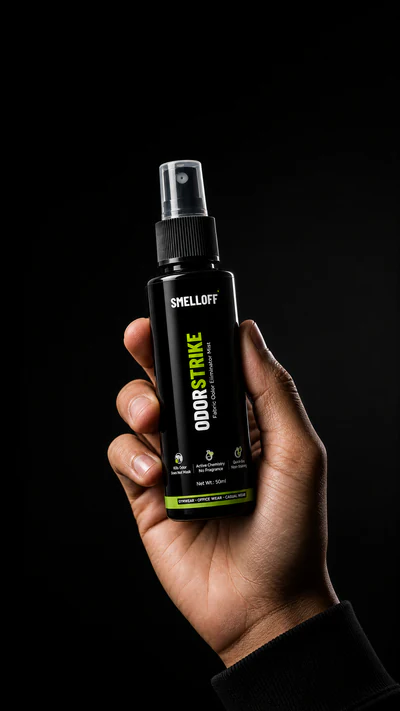
ODORSTRIKE — Fabric Odor Mist
50ml pocket spray for clothes. HPβCD traps odor molecules in the fabric and Zinc PCA neutralises them, instead of covering them with perfume. Dries in 15–30 seconds, up to 8 hours of odor protection on fabric under normal office/commute conditions. Fabric only, never skin.
Buy now View product details