
Why Do Sun-Dried Clothes Smell So Good?
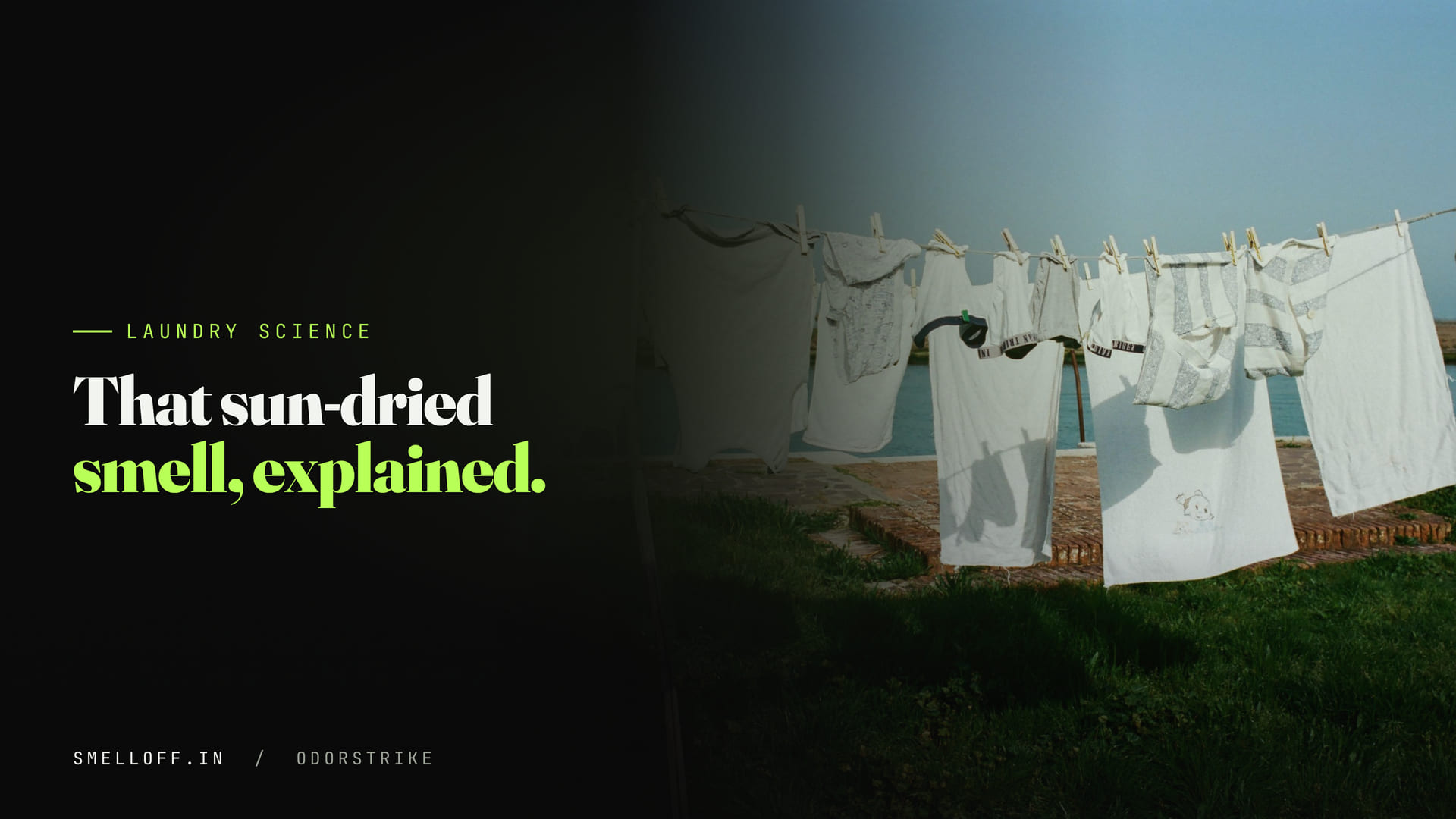
Every Indian terrace knows the smell: clothes brought in from the sun smell warm, clean and slightly sweet. It is not nostalgia. A team of chemists measured it, and the answer is a small piece of atmospheric chemistry happening on your clothesline.
Why do clothes dried in the sun smell so good?
Sunlight drives chemical reactions on wet fabric that create small amounts of new scent molecules, mainly aldehydes and ketones such as pentanal, octanal and nonanal. University of Copenhagen researchers found towels dried in direct sun released more of these compounds than towels dried in shade or indoors. Fast drying also stops the bacteria that cause musty smells.
In this guide5 sections
Bring a shirt in from the terrace after an afternoon in the sun and press it to your face. It smells of something, even though you washed it with unscented detergent. Clothes dried indoors in the monsoon smell of nothing at best, and of a wet cupboard at worst.
What actually creates the sun-dried smell?
Sunlight driving chemistry on the wet fabric surface, which produces small amounts of new scent molecules.
Dark room
Indoors
- Fewest new scent molecules
- Slowest to dry
Shaded balcony
Outdoors
- Some new compounds
- Moving air helps
Sunlit balcony
Sun
- Most aldehydes and ketones
- Pentanal, octanal, nonanal
The fresh smell is made by sunlight on wet fabric.
In a study published in Environmental Chemistry in 2020, researchers at the University of Copenhagen dried towels in three places: in a dark room, on a shaded balcony and on a sunlit balcony. They then analysed the air released by each towel. The sun-dried towels gave off a range of aldehydes and ketones, including pentanal, octanal and nonanal, compounds that smell fresh, slightly fruity or green. The team proposed that sunlight-driven photochemical reactions on the wet fabric, possibly involving ozone and other trace gases in the air, create these molecules.
In other words, the smell is not something the sun "removes". It is something the sun makes.
Why do clothes dried indoors smell worse?
Because slow drying gives bacteria time to make musty odours, and there is no sunlight to make the fresh ones.
Japanese researchers traced the classic damp-laundry smell to a bacterium, Moraxella osloensis, which produces a compound called 4-methyl-3-hexenoic acid and survives drying (Kubota et al., 2012). Clothes that dry slowly in a humid room, especially in the monsoon, give it hours to work. Clothes that dry fast in moving air and sun give it far less time.
Our guide on why clothes smell bad after drying covers the slow-drying problem in detail.
Does sun-drying kill germs?
Fast drying and sunlight both work against the bacteria behind musty smells, but sun-drying is not a disinfectant.
Ultraviolet light and heat can harm many microbes, and fast drying denies them the moisture they need. But the same study on laundry bacteria found Moraxella osloensis is unusually tolerant of drying and UV, so sun alone does not guarantee a smell-free shirt. A proper wash does most of the cleaning; sun and air finish the job.
When is sun-drying a bad idea?
For dark colours, silks, wool and anything you want to keep soft.

- Dark and bright colours: strong sun fades dyes. Dry them inside out, in shade.
- Silk, zari and festive wear: sun can fade and weaken them; dry in shade with moving air.
- Wool and knits: dry flat in shade.
- Towels and cotton in harsh noon sun: can turn stiff; a short time in sun and the rest in shade keeps them softer.
Can you get that fresh smell without sun?
Not exactly, but fast, complete drying gets you most of the way.
Indoors, spread clothes out with space between them, run a fan, keep a window open and do not overload the drying stand. In the monsoon, smaller, more frequent loads dry faster. Our monsoon drying guide has a full routine.
Once clothes are dry and in use, sweat smell is a separate problem. For a clean shirt that picks up smell during the day, a fabric odour spray for the collar and underarms such as ODORSTRIKE traps odour molecules with HPβCD and neutralises them with Zinc PCA. It does not recreate the sun-dried smell, and it is not meant to.
Sun-drying helps laundry smell fresh; it does not replace a proper wash. A fabric odour spray works on odour that builds up while clothes are worn, not on a load that dried damp and musty, which needs a rewash.
Sources
University of Copenhagen researchers Chemical analysis and origin of the smell of line-dried laundry. Environmental Chemistry 17(5), 2020. connectsci.au
Pugliese S, Johnson MS et al., University of Copenhagen. Chemical analysis and origin of the smell of line-dried laundry. Environmental Chemistry 17(5), 2020. researchprofiles.ku.dk
Kubota, H. et al. Moraxella species are primarily responsible for generating malodor in laundry. Applied and Environmental Microbiology, 2012. pmc.ncbi.nlm.nih.gov
Frequently Asked Questions
Why do sun-dried clothes smell good?
Sunlight drives reactions on wet fabric that create small amounts of aldehydes and ketones, such as pentanal, octanal and nonanal, which smell fresh. A 2020 University of Copenhagen study measured them.
Does drying clothes in the sun kill bacteria?
Fast drying and sunlight work against the bacteria behind musty smells, but sun-drying is not a disinfectant. One laundry bacterium tolerates drying and UV well.
Why do clothes dried indoors smell bad?
Slow drying gives bacteria time to produce musty compounds. Spread clothes out, use a fan and an open window, and dry smaller loads.
Which clothes should not be dried in the sun?
Dark and bright colours, silk, zari, festive wear and wool. Dry them inside out in shade with moving air.
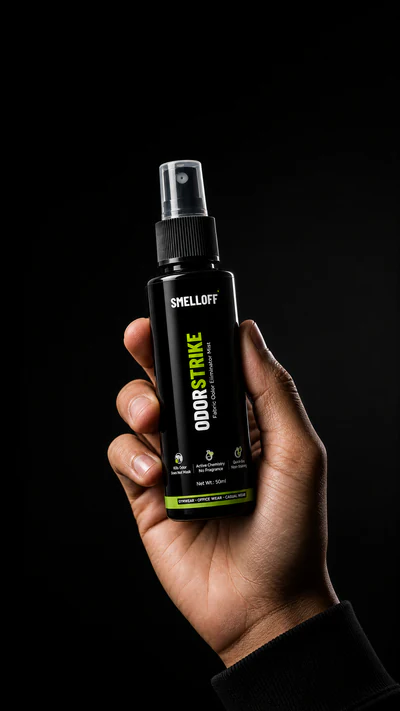
ODORSTRIKE — Fabric Odor Mist
50ml pocket spray for clothes. HPβCD traps odor molecules in the fabric and Zinc PCA neutralises them, instead of covering them with perfume. Dries in 15–30 seconds, up to 8 hours of odor protection on fabric under normal office/commute conditions. Fabric only, never skin.
Buy now View product details