
How Many Shirts Should a Man Own for the Office?

Too few shirts and you are rewearing a sweaty one on Thursday. Too many and half of them never leave the almirah. Here is a way to count that fits Indian weather, a five- or six-day week and the realities of laundry day.
How many shirts does a man need for the office?
Most men in Indian offices need seven to ten work shirts: enough for one fresh shirt per working day, plus two or three spares for laundry delays, monsoon drying and the odd second shirt on a sweaty day. Fewer is fine if you wash more often and refresh shirts between wears; more is useful if you commute in heat.
In this guide6 sections
It is Thursday morning, the machine ran late, the monsoon means nothing dried, and the only clean shirt is the one with the tight collar. Most shirt shortages are not about style. They are about how fast your laundry turns around.
How many work shirts do you actually need?
Your working days per week, plus two or three spares. For most people that is seven to ten.
Working days plus two or three spares.
- Five-day week, weekly wash: five plus two spares, so seven.
- Six-day week, weekly wash: six plus two or three, so eight or nine.
- Hot commute or field work: add two, because some days need a change at lunch.
- Washing twice a week: you can manage with five or six.
The spares matter more than the count. They cover the day a shirt gets a stain, the monsoon week when nothing dries, and the shirt at the tailor.
Why does Indian weather change the number?
Because heat and humidity cut the number of times you can wear a shirt, and slow down drying.
In a cool country, an office shirt can often be worn twice. In Indian heat, especially on a two-wheeler or a crowded bus, most shirts get one wear before the collar and underarms smell. In the monsoon, a wash can take two days to dry indoors. Both push the number up. The guide to how many times you can wear a shirt before washing gives wear counts for each garment and season.
Which fabrics should you choose?
Mostly cotton and cotton-rich blends, with a few easy-care shirts for travel.
Cotton absorbs sweat and releases odour more easily in the wash. Polyester-heavy shirts dry fast and do not crease, but hold body odour more: researchers at Ghent University collected T-shirts from 26 people after a one-hour spinning session, and 28 hours later the polyester ones smelled significantly more intense and less pleasant than the cotton ones (Callewaert et al., 2014). A practical mix for Indian offices is mostly cotton or linen-cotton, plus two or three easy-iron blends for travel days and late laundry weeks. Our fabric-by-fabric odour guide goes deeper.
Does rotating shirts make them last longer?
Yes. Fewer washes and rest between wears mean less wear on every shirt.

Each wash wears fibres, fades colour and loosens collars. A shirt that gets one wear, a night of airing, a refreshed collar and a second wear before washing takes half the washes. The UK's Waste and Resources Action Programme (WRAP) estimates that extending the active life of clothing by nine months can cut its carbon, water and waste footprints by around 20–30% each. A good rotation is also a cheaper wardrobe.
How do you get a second wear out of a good shirt?
Only if it passes a sniff test, and only after airing and a collar refresh.
- Hang it on a proper hanger in moving air as soon as you take it off.
- Next morning, check the collar and underarms. Any sweat smell, stain or damp: wash it.
- If it passes, mist the inside collar and underarms with a fabric odour spray from 15–20 cm and let it dry.
A cotton vest under the shirt makes the second wear far more likely, because it takes the underarm sweat first; the guide on whether to wear a vest under your shirt covers fit and fabric.
For that last step, ODORSTRIKE, a pocket collar spray for office shirts, is a clothing deodorant that traps odour molecules in the fibres with HPβCD and helps neutralise them with Zinc PCA. A 50ml bottle gives about 250 sprays, roughly 100 refreshes.
What should a basic office shirt set look like?
Mostly plain colours that work with everything, a few patterns, and one formal white.
- Two or three light blue or white cotton shirts.
- Two light patterns (small checks or stripes) that hide sweat patches.
- One or two darker shirts for travel days.
- One crisp white for meetings and interviews.
- Two spares of whatever you wear most.
A fabric odour spray helps a clean shirt through a second wear. It does not replace washing a sweaty, stained or damp shirt, and it is never for skin.
Sources
Callewaert, C. et al. Microbial odor profile of polyester and cotton clothes after a fitness session. Applied and Environmental Microbiology, 2014. pmc.ncbi.nlm.nih.gov
WRAP. Valuing our clothes and Sustainable Clothing Guide. Waste and Resources Action Programme (UK). wrap.ngo
Frequently Asked Questions
How many shirts should a man own for work?
Seven to ten for most Indian offices: one per working day plus two or three spares for laundry delays and sweaty days.
Is it OK to wear the same shirt twice to the office?
Yes, if it passes a sniff test at the collar and underarms after airing overnight. In heat or after a sweaty commute, wash it instead.
Are cotton or polyester shirts better for sweat?
Cotton absorbs sweat and lets odour wash out more easily. Polyester dries fast but holds body odour more.
How can I make my shirts last longer?
Wash less often by rotating, air shirts after every wear, refresh the collar for a second wear, and wash at the temperature on the label.
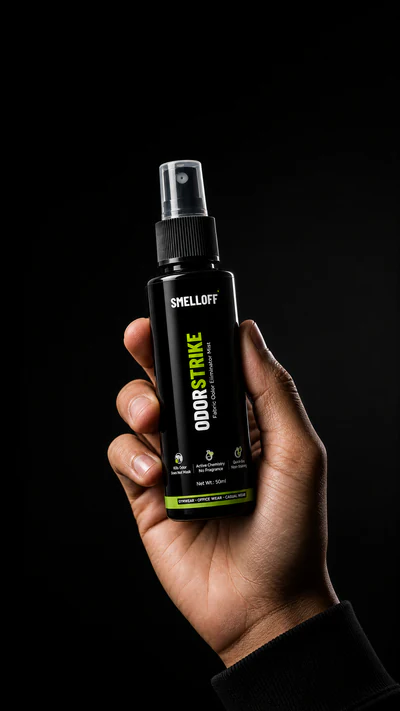
ODORSTRIKE — Fabric Odor Mist
50ml pocket spray for clothes. HPβCD traps odor molecules in the fabric and Zinc PCA neutralises them, instead of covering them with perfume. Dries in 15–30 seconds, up to 8 hours of odor protection on fabric under normal office/commute conditions. Fabric only, never skin.
Buy now View product details