
Why Does My Sweat Smell Like Onions, Vinegar or Ammonia?

Body odor is not one smell. The onion note, the sour vinegar note and the sharp ammonia note each come from different chemistry, and each behaves differently in a shirt. Here is what is behind each one.
Why does my sweat smell like onions, vinegar or ammonia?
Onion smell comes from sulphur compounds (thioalcohols) that skin bacteria release from underarm sweat. Vinegar or sour smell comes from short-chain fatty acids such as acetic and propionic acid. Ammonia smell comes from ammonia in sweat, which rises with long or hard exercise. All three bind to fabric, which is why a shirt can keep the smell after you have showered.
In this guide6 sections
You catch it lifting your arm in the lift: a sharp, oniony smell. Another day it is sour, like vinegar, from a shirt you only wore to the office. After a long cricket match it is something sharper, almost like a cleaning product. Same body, three different smells.
They are different smells because they are different molecules, made in different ways.
Why does sweat smell like onions?
Because skin bacteria release a sulphur compound from underarm sweat, and sulphur compounds smell like onion.

Fresh underarm sweat carries odorless precursor molecules. Certain Staphylococcus bacteria living in the underarm cut those precursors and release thioalcohols. The main one, 3-methyl-3-sulfanylhexan-1-ol, was identified in 2004 by researchers at Firmenich: its dominant form smells of onion and sweat. Humans can detect thioalcohols at extraordinarily low concentrations, which is why a small amount is so noticeable.
Stress makes it worse. The apocrine glands that feed these bacteria respond to adrenaline, which is why interview sweat or exam sweat smells oniony even in a cool room.
Why does sweat smell like vinegar or sour?
Because bacteria also break sweat down into short-chain fatty acids, which smell sour, cheesy or vinegary.
Acetic acid is the acid in vinegar. Propionic acid smells sharper and sour, and isovaleric acid smells cheesy. A 2013 review of the microbiology of underarm odor (James et al.) lists these acids as one of the main families of body odor molecules, alongside the sulphur compounds. They are what you smell when clothes "smell like vinegar after sweating".
Acids also stick to fabric well, especially to synthetic fibres, which is why a polyester shirt can smell sour on its second wear even after airing.
Why does sweat smell like ammonia?
Because sweat contains ammonia, and the amount goes up during long or hard exercise.
A study in the European Journal of Applied Physiology (Czarnowski et al., 1992) found that ammonia in sweat comes mainly from ammonia in the blood. During long or intense effort, the body produces more ammonia as it breaks down protein for fuel, and more of it ends up in sweat. That is why the smell shows up after a long run, a day of physical work, or exercise on a low-carbohydrate diet.
Ammonia is volatile, so it fades from skin quickly after a shower. It can linger in a shirt that dried with the sweat still in it.
Why does the smell stay in my shirt after I shower?
Because the molecules bind to the fabric, and the bacteria come along with them.
Onion
Thioalcohols
- Bacteria release sulphur compounds
- From underarm (apocrine) sweat
- Worse with stress
Vinegar
Fatty acids
- Acetic, propionic, isovaleric acid
- Sour, cheesy notes
- Cling to polyester
Ammonia
From the blood
- Rises with long, hard exercise
- Volatile, fades from skin
- Lingers in a shirt that dried sweaty
All three can stay in fabric after you shower.
A shower cleans your skin. The shirt you wore still holds the thioalcohols, the acids and some of the bacteria that made them. When Ghent University researchers collected T-shirts from 26 people after a spinning class and left them for 28 hours, the polyester shirts smelled significantly more intense and less pleasant than the cotton ones, and odour-linked micrococci turned up on almost all of the synthetic shirts (Callewaert, 2014). When you rewear that shirt and warm it up, the smell comes back. Our guide on why body odor comes back on clothes covers that cycle.
How do you get these smells out of clothes?
Wash sweaty clothes properly; between washes, treat the collar and underarms of clean clothes so the smell does not build.
- After heavy sweating: wash. A spray is not a substitute for detergent on a drenched shirt.
- Before the wash: do not leave a sweaty shirt balled up in a bag; hang it so it dries.
- For a clean shirt you want to wear again: air it inside out, then treat the underarms and collar with a fabric odor spray and let it dry.
A fabric spray for shirts that smell of onion or vinegar sweat is built for that last step. ODORSTRIKE is a clothing deodorant: HPβCD, a cyclodextrin, traps odor molecules in the fabric and Zinc PCA neutralises them, instead of covering them with perfume. Mist the underarm fabric and the inside of the collar from 15–20 cm, 2–3 sprays per zone, and let it dry for 15–30 seconds before you wear the shirt. You can read the mechanism in our HPβCD explainer.
When is a strange sweat smell a reason to see a doctor?
When it is new, persistent and not explained by exercise, food or stress.
A sudden change in body odor, a fruity or acetone-like smell, a strong ammonia smell without exercise, or heavy sweating at night or in cool rooms are worth mentioning to a doctor. Most of the time the explanation is ordinary, but body odor can occasionally reflect diet, medication or a metabolic condition, and only a doctor can check.
A fabric odor spray works on odor held in clothes. It does not change how your sweat smells, does not stop sweating and is never for skin. For body odor itself, washing, antiperspirant and, if it changes suddenly, a doctor are the right tools.
Sources
Troccaz, M. et al. 3-Methyl-3-sulfanylhexan-1-ol as a major descriptor for the human axilla-sweat odour profile. Chemistry & Biodiversity, 2004. archive-ouverte.unige.ch
James, A. G. et al. Microbiological and biochemical origins of human axillary odour. FEMS Microbiology Ecology, 2013. academic.oup.com
Czarnowski, D. et al. Plasma ammonia is the principal source of ammonia in sweat. European Journal of Applied Physiology, 1992. pubmed.ncbi.nlm.nih.gov
Callewaert, C. et al. Microbial odor profile of polyester and cotton clothes after a fitness session. Applied and Environmental Microbiology, 2014. pmc.ncbi.nlm.nih.gov
Frequently Asked Questions
Why does my sweat smell like onions?
Skin bacteria release sulphur compounds called thioalcohols from underarm sweat. The main one smells of onion and sweat, and people notice it at very low levels.
Why do my clothes smell like vinegar after sweating?
Bacteria break sweat into short-chain fatty acids such as acetic and propionic acid, which smell sour. These acids cling to fabric, especially polyester.
Why does my sweat smell like ammonia after exercise?
Ammonia in sweat comes mainly from ammonia in the blood, which rises during long or intense exercise, especially when the body uses protein for fuel.
Can a fabric spray change how my sweat smells?
No. It works on odor already held in clothes. It does not change your sweat or stop sweating, and it is never for skin.
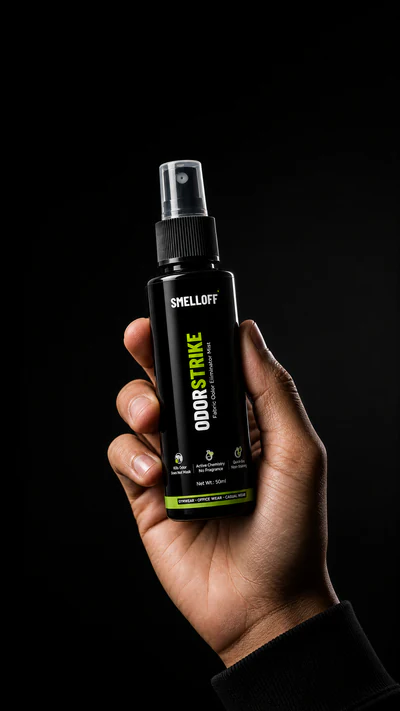
ODORSTRIKE — Fabric Odor Mist
50ml pocket spray for clothes. HPβCD traps odor molecules in the fabric and Zinc PCA neutralises them, instead of covering them with perfume. Dries in 15–30 seconds, up to 8 hours of odor protection on fabric under normal office/commute conditions. Fabric only, never skin.
Buy now View product details