
Why the Collar and Armpits Still Smell After Washing
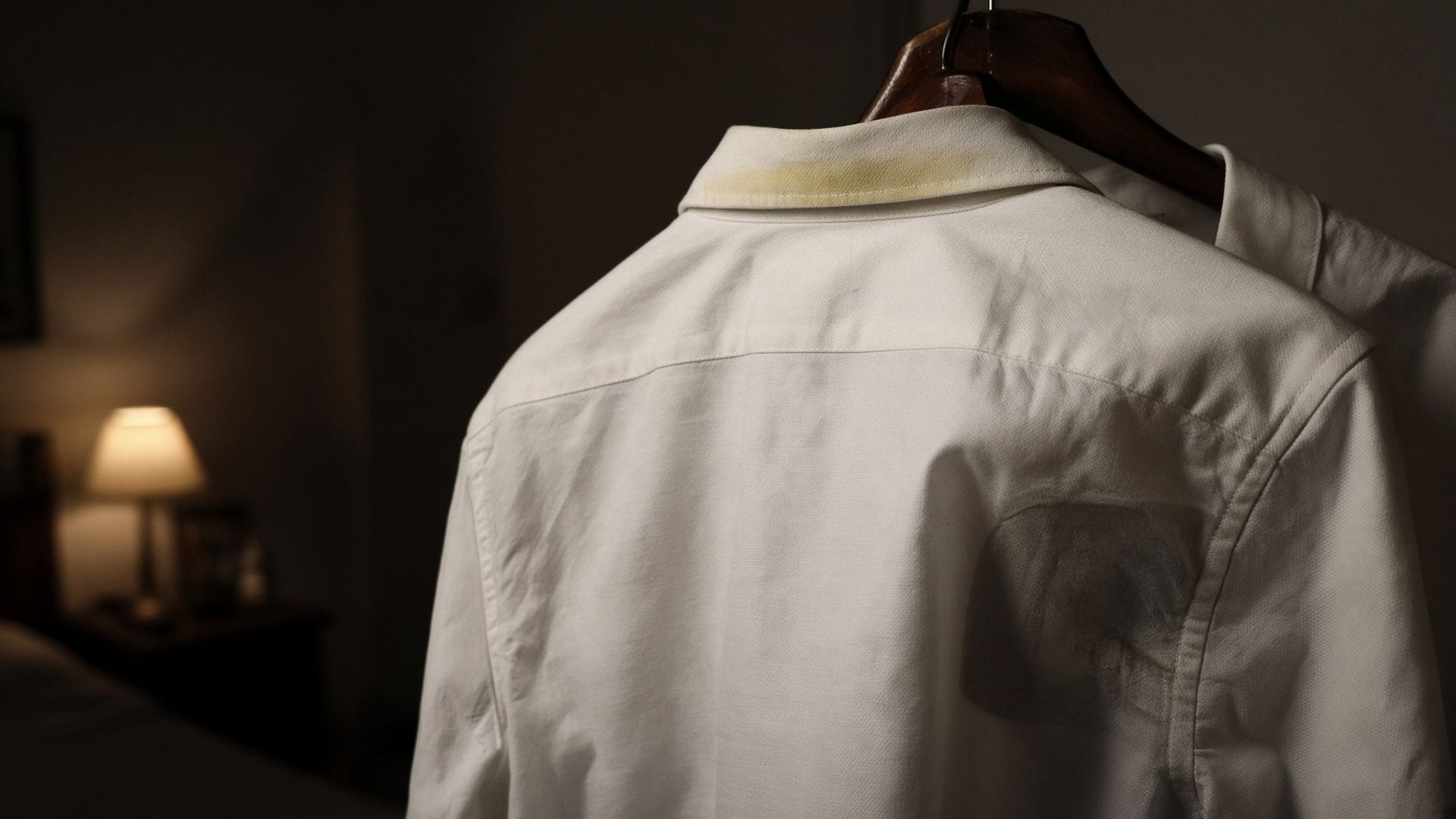
Two contact zones. Two soils. One wash that treated the shirt as a single object.
The collar and the armpits smell after a wash because they are two different soils on one garment. The collar is a sebum-and-dead-skin ring packed into a band, a fold, and a placket. The pits are heat, lipid, and a multi-layer seam that a 30°C colour cycle treats as just more cloth. A wash that treats the shirt as a single object leaves both zones. Cotton office shirts do this. Polyester does it louder. Neither zone is a machine mystery until you have ruled the garment out.
In this guide11 sections
- The wash treated one object. The soil is two.
- Why the collar still smells after washing
- Band, fold, placket — three collar soils
- Why shirt armpits smell after washing
- Micrococcus likes the pit more than the rest of the shirt
- Zone map of an Indian office shirt
- Cotton office shirts do this. Polyester is louder. Neither is the whole story.
- What a short colour wash actually leaves behind
- Why the smell returns when the shirt is back on the body
- Treat the zones, not the shirt
- When a mist is honest, and when you need a second wash
You hung the shirt. It looked clean. You put it on at 8:40 and by the time the lift doors opened the collar was already talking. Or the pits. Or both. The rest of the cloth is fine. That is the tell. This is not a dirty-laundry problem. It is a zone problem.
A washing machine does not know you have a neck. It does not know you have armpits. It has a drum, a dose, a temperature, and a spin. The shirt went in as one object. The soil did not.
The wash treated one object. The soil is two.
Sweat is mostly water, salt, and a little urea. It is not the smell. The smell is what bacteria make from what the sweat carried, plus what the skin already left: sebum, dead cells, deodorant film, last week's aftershave. Those soils do not land evenly. They land where the cloth is pressed, folded, stitched, or held against hot skin for eight hours.
Two contact zones do almost all of the work on an office shirt. The collar: neck oil, stubble grease, the inner band that never sees a brush. The armpits: apocrine lipid, heat, a seam that is three layers thick. The yoke, the placket below the second button, the hem — usually innocent. If the whole shirt stinks coming out of the machine, that is a different page. If only the collar or only the pits come back, you are looking at architecture.
Odor is not a headcount
McQueen, Laing, Brooks and Niven (Textile Research Journal, 2007) wore cotton, wool and polyester knits in the axilla and then counted bacteria. After one day, counts were similar across fibres. Odor intensity was not. Polyester rated high. Cotton and wool sat mid-low. The smell was a fibre-and-soil story, not a simple 'more germs' story. A later wear-and-wait study (McQueen 2008) found short-chain acids building in the headspace above polyester after seven days, and not above cotton or wool. Intensity tracked how poorly the fibre held water — not how many colonies you could plate.
Why the collar still smells after washing
A collar is a sebum ring. Your neck sheds oil and keratin all day. The inner band sits against that. In a cotton formal — the Peter-England-cut, the Van Heusen, the white you take to the metro — the band is a folded sandwich: face cloth, interlining, inner cloth. Detergent has to wet three layers, lift a lipid that does not want water, and leave before the rinse. A short colour cycle at 30°C is polite to dyes. It is not ambitious about neck oil.

Munk, Münch, Stahnke, Adler-Nissen and Schieberle (Journal of Surfactants and Detergents, 2000) washed axillary-soiled swatches in a mild 30°C colour wash. The organic acids that dominate fresh underarm sweat came off. What stayed, and what you then smell as 'washed but not clean', were aldehydes, esters and ketones — lipid-oxidation products from sebum triglycerides. A collar is sebum-heavy. That is exactly the soil a short wash is worst at finishing.
You can see it if you look. A faint yellow at the fold. A grey line on the inner band. A stiffness the rest of the shirt does not have. That is not 'age'. That is a ring of skin soil the machine went around.
Band, fold, placket — three collar soils
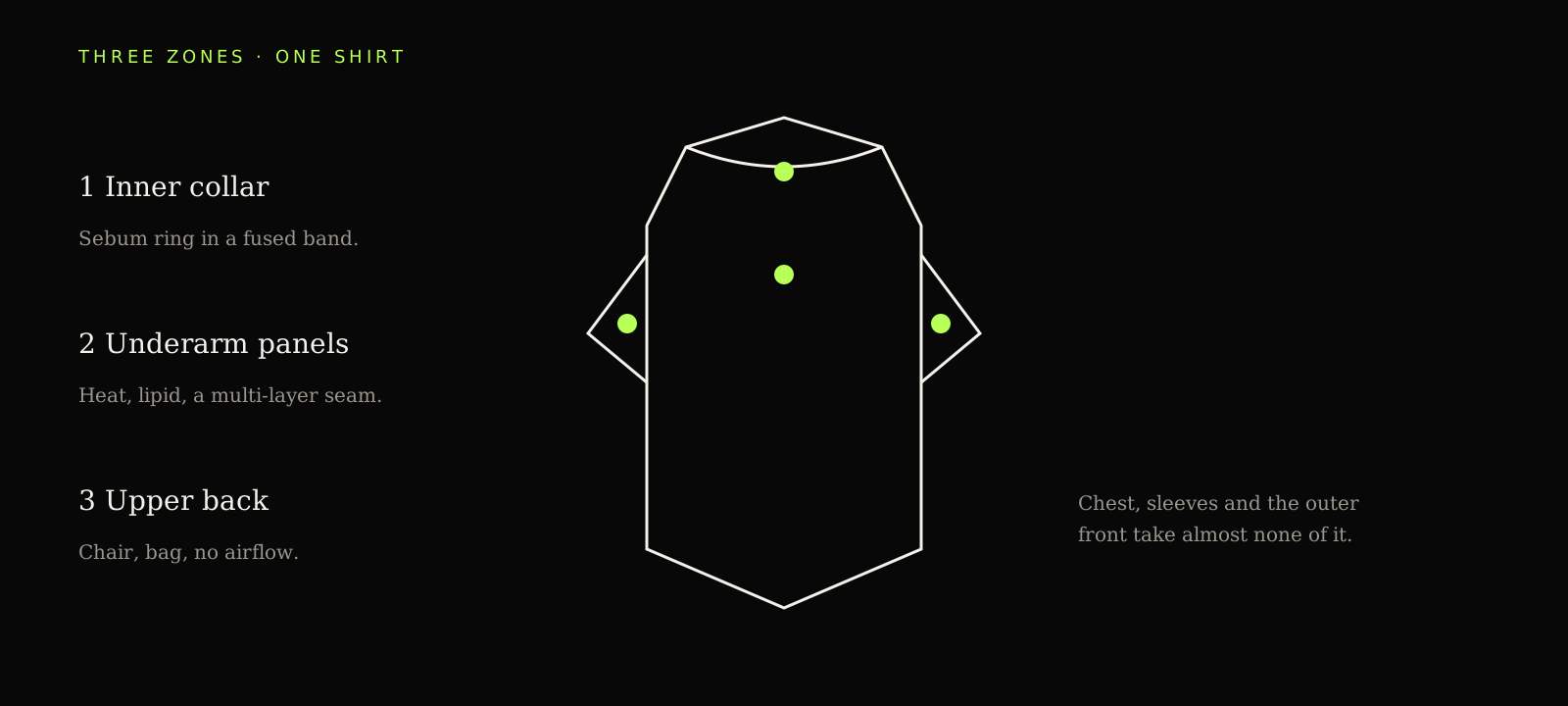
Treat the collar as one stain and you will keep missing it. It is three geometries.
- Inner bandTouches the neck; sebum soaks in with nowhere to rinse to.
- FoldThe crease is a capillary: soil wicks up and sits in a line.
- PlacketTwo overlapping layers: a pocket the rinse does not always empty.
Treat the collar as one stain and you will keep missing it.
The inner band
This is the cloth that actually touches the neck. On a fused collar it is backed by interlining. Sebum soaks in and has nowhere obvious to rinse to. In a humid Hyderabad or Chennai week the band never fully dries between wears if you hang the shirt on a crowded rod. Damp lipid is a better substrate than dry lipid. The next day the band is louder before you have even sat down.
The fold
The crease at the top of the collar is a capillary. Soil wicked up from the band sits in a line that a tumbling drum does not open. You only smell it when you turn the collar up, or when someone stands behind you. A brush and a spot of detergent on that line, before the wash, does more than a second cycle.
The placket
Two layers of shirt, overlapping, with buttonholes. Neck sweat, fingers, aftershave, the odd dab of fairness cream. The overlap means the inner face of the placket is a pocket. In a front-loader that pocket fills with suds and does not always empty. What you get is a mixed note: last perfume plus skin. People blame 'the deodorant'. The placket was never rinsed as a surface.
Why shirt armpits smell after washing
The pit is not a collar. It is hotter, wetter, and built from more layers. Apocrine glands sit in the axilla. They put out a lipid-rich fluid that skin bacteria — and, once the shirt is on, textile bacteria — turn into the classic underarm note. Eccrine sweat adds water and salt. Deodorant adds aluminium salts and fragrance. The cloth under the arm is doing chemistry all day, in a closed, 36°C pocket, on a bus or in an AC office that you leave for a 38°C pavement.
Then there is the seam. Most office shirts put a double-needle underarm seam, sometimes a gusset, sometimes a side panel that meets the sleeve in a sandwich. Three layers of cotton, or a cotton-poly blend, stitched into a channel. Lipid and water wick into that channel and stay. A wash wets the outside of the seam. The inside of the seam is a rope of soil. You smell it when you raise an arm. You do not see it on the ironing board.
Heat is the multiplier. A collar is warm. An armpit is an incubator. Callewaert's group at Ghent (Applied and Environmental Microbiology, 2014) took T-shirts off 26 people after a spinning class, waited 28 hours, and asked a trained panel. Polyester was less pleasant, more intense, more musty, more ammonia, more sour. The fibre effect is real. It is not only a gym-polyester story. A 65/35 office shirt has enough polyester in the pit panel to behave like a quieter version of the same thing. A 100% cotton formal still holds lipid in the seam. The volume is lower. The zone is the same.
Micrococcus likes the pit more than the rest of the shirt
Callewaert isolated micrococci from almost every synthetic shirt in that study, and almost only from synthetics. Staphylococci were abundant on both cotton and polyester. Corynebacteria — the classic axillary odor genera on skin — were not enriched on the cloth. The textile is not a copy of the armpit. It is a different habitat. Micrococcus does well in the aerobic, lipid-holding weave of a synthetic. It catabolises fatty acids into the sour-sweat volatiles people describe as 'this shirt is dirty even though I washed it'.
On a cotton office shirt the same genera are present in smaller numbers. The seam still gives them a wet, protected run. If you under-dose detergent, wash cold, and dry the shirt on a monsoon rod with the sleeves pinned shut, you have built a Micrococcus hotel in the underarm stitching. The body of the shirt can still smell of detergent. The pits will not.
Zone map of an Indian office shirt
Read the garment as a map, not a verdict on your hygiene. Most of the cloth is doing fine. Two or three patches are not.
| Zone | What lands there | Why a wash misses it | What you smell |
|---|---|---|---|
| Collar inner band | Sebum, keratin, neck sweat | Fused sandwich; lipid does not want water | Sour-sweet, 'unclean neck' |
| Collar fold | The same soil, wicked into a crease | The crease never opens in the drum | Same note, only when the collar is up |
| Placket | Fingers, aftershave, neck sweat | Two overlapping layers; a pocket | Perfume mashed with skin |
| Pit panel | Apocrine lipid, eccrine sweat, deodorant film | Heat plus oil; a 30°C cycle is polite | Classic underarm |
| Pit seam / gusset | The same, trapped in stitching | Three layers; a channel, not a surface | Sour, gym-bag, even on cotton |
| Yoke and hem | Dust, AC, little skin oil | Usually rinsed clean | Almost never the complaint |
A cotton formal in a closed bathroom
Most of the shirts this page is about are not gym kits. They are cotton or poly-cotton formals washed with everything else, cold, in a front-loader that lives in a windowless bathroom. The gasket stays wet. The load is packed. The collar band does not open. The pit seam does not rinse. Then the shirt hangs on a ceiling rod over a bucket, sleeves in, monsoon at 80% RH. You iron it in the morning and call it clean. The zones were never given a job of their own.
Cotton office shirts do this. Polyester is louder. Neither is the whole story.
People want a fibre villain. Polyester holds hydrophobic odorants more tightly through a wash — Munk showed that in 2001, with aldehydes and guaiacol sticking to polyester while cotton let them go. Hammer, Berner-Dannenmann and Hoefer, working with radiolabelled isovaleric acid, found the opposite end of the same stick: polyester released the volatile into the air faster. After three hours, about 3% of the labelled acid was still on polyester, against roughly half on cotton and almost all on wool. Polyester can smell stronger because it dumps the molecule at your nose, not because it 'holds more germs'.
That is a fibre ranking. This page is not a fibre ranking. A 100% cotton office shirt with a fused collar and a double-needle pit seam will still smell in those two zones after a lazy wash. The cotton body of the shirt may even help: it wets, it rinses, it fools you. You sniff the chest. Fine. You have not sniffed the inner band or the underarm channel.
Blends sit in the middle. A 65/35 or 80/20 office shirt is what a lot of Indian formals actually are. The polyester fraction in the pit panel is enough to keep lipid through a short cycle. The cotton fraction is enough to hold water in a monsoon dry. You get both problems, quieter.
What a short colour wash actually leaves behind
Indian households wash mixed loads, cold or 30°C, colour detergent, often without bleach. Munk 2001 ran exactly that kind of wash on cotton, with Staphylococcus epidermidis, S. aureus, E. coli and Pseudomonas aeruginosa. In colour detergents without bleach, all four survived and transferred between textiles. Gram-negatives survived in greater numbers. US-style short 30°C washes left more than EU-style 40°C, 30-minute washes. Bleach-containing detergents were the ones that cleared the board.
You do not have to bleach a white formal every time. You do have to stop pretending a 20-minute eco cycle on a packed drum is a collar-and-pit protocol. The acids of fresh sweat leave, as Munk 2000 showed. The sebum-oxidation aldehydes do not, especially on polyester and in seams. The bacteria that will make the next day's smell can still be there. Slow indoor drying then lets microbial odor dominate — Munk's own conclusion for laundry dried slowly.
If the whole load comes out sour, look at the machine: gasket biofilm, a wet load left overnight, a detergent drawer that never dries. Gattlen, Amberg, Zinn and Mauclaire sampled biofilms from washing machines on three continents. Recommended detergent concentration did not fully remove cell debris and slime. That is a drum problem. It is not this page's main story. A shirt that is fine on the chest and loud at the collar is still a zone problem even in a clean machine.
Why the smell returns when the shirt is back on the body
Residue that is quiet on a hanger gets loud on a neck. Heat, humidity, and a little fresh sweat redissolve what the wash left in the band and the seam. The molecules go into the air next to your face. That is why a 'clean' collar announces itself in a meeting room and not on the clothesline.
Water is a volume knob. A monsoon commute, a damp auto ride, a shirt that was ironed while still a little wet at the seam — any of those will turn residue into smell faster than a dry AC office. The soil was already there. The water told you.
Treat the zones, not the shirt
A collar-and-pit wash that matches the map
- Turn it, look at it, name the zones — Inner band, collar fold, placket overlap, pit panel, underarm seam. If a zone is yellow, grey, or stiff, it is soil, not 'age'. If the rest of the shirt is fine, do not rewash the whole pile on a prayer. Work the two zones.
- Open the architecture — Unbutton the collar. Pull the placket flat. On the pits, stretch the seam open with your fingers so the channel is a surface. A drum will not do this for you.
- Pre-treat lipid as lipid — A drop of the same detergent, or a little bar soap, worked into the inner band, the fold, and both pit seams. Give it ten minutes. You are not disinfecting. You are giving surfactant time against sebum. Extra detergent in the drawer does not replace this. It just oversuds the rest of the load.
- Wash with room to move — Half a drum, not a stuffed one. 40°C if the care label allows, especially for white cotton formals. Colour loads can stay at 30°C if you have pre-treated. Rinse extra if your water is hard — Hyderabad, Chennai, much of the north. Residue is a second film on the same zones.
- Dry to the seam — Hang on a hanger, not a rod pile. Collar open. Sleeves out. Pit seams facing air, not facing each other. A ceiling fan in a 2BHK is not a garden, but spacing is the whole game. If the seam is cool-damp at two hours, it is not done. Ironing a damp pit seam cooks the residue in.
When a mist is honest, and when you need a second wash
A fabric mist can quiet volatiles that are already in the cloth you are about to wear. It cannot lift a sebum ring. It cannot rinse a seam. If the inner band is yellow, wash. If the pit smells at 10cm on a hanger, wash. If the shirt is dry, looks clean, and only announces itself once it is on a warm neck, a mist on those two zones is a legitimate morning move — and a confession that last night's wash did not finish the job. Do the zones properly the next cycle.
Do not spray skin. Do not spray a damp shirt and call it dry. Do not treat a mist as perfume for a dirty collar. The honest use is narrow: dry fabric, no visible soil, a few hours to get through, then a real wash.
- Pre-treat the inner collar band, the fold, and both pit seams as their own jobs.
- Wash with space in the drum. Open the collar. Dry the pits facing air.
- Smell the zones on a hanger, at 10cm, before you decide the shirt is clean.
- Use 40°C on white cotton formals when the label allows, especially after a heavy day.
- If only the chest smells fine, believe the collar anyway.
- Do not run a packed 20-minute eco cycle and then blame the detergent.
- Do not iron a pit seam that is still cool-damp. You are setting the residue.
- Do not scrub only the outside of the collar. The inner band is the soil.
- Do not treat a cotton formal as 'safe' because polyester is the internet villain.
- Do not spray deodorant or perfume on a sour collar. That is a mash, not a fix.
ODORSTRIKE is a 50ml fabric mist, formula v3.1, made in Hyderabad. ₹229 prepaid. Cash on Delivery available. It is for dry cloth, not skin, and it does not replace a wash. Light, subtle scent — not unscented, not a perfume. Dries in 15–30 seconds, 30–60 in humidity. Up to 8 hours on fabric under normal office conditions is a working window, not a guarantee. Honest on a clean-looking collar that only speaks on a warm neck. Useless on a yellow band or a wet seam. Those need surfactant and a rinse.
50ml fabric-only mist. Formula v3.1. Prepaid UPI ₹229. Cash on Delivery available. Light, subtle scent. Not a wash. Not for skin.
- McQueen RH, Laing RM, Brooks HJL, Niven BE. Odor intensity in apparel fabrics and the link with bacterial populations. Textile Research Journal. 2007;77(7):449–456. — After wear, polyester knits rated high in axillary odor; cotton and wool rated mid-low. Bacterial counts after one day were similar across fibres — odor intensity was not a simple function of how many bacteria were present. Source
- Callewaert C, De Maeseneire E, Kerckhof F-M, Verliefde A, Van de Wiele T, Boon N. Microbial odor profile of polyester and cotton clothes after a fitness session. Applied and Environmental Microbiology. 2014;80(21):6611–6619. — After a spinning class and 28 h incubation, polyester T-shirts smelled less pleasant and more intense than cotton. Micrococci were isolated from almost all synthetic shirts and almost solely from synthetics. Staphylococci were abundant on both. Corynebacteria were not enriched on the textiles. Source
- Munk S, Münch P, Stahnke L, Adler-Nissen J, Schieberle P. Primary odorants of laundry soiled with sweat/sebum: influence of lipase on the odor profile. Journal of Surfactants and Detergents. 2000;3:505–515. — After a mild 30°C colour wash, the organic acids characteristic of axillary sweat were effectively removed. Remaining primary odorants were aldehydes, esters and ketones from sebum lipid oxidation. Lipase in the wash slightly increased those aldehydes. Source
- Munk S, Johansen C, Stahnke LH, Adler-Nissen J. Microbial survival and odor in laundry. Journal of Surfactants and Detergents. 2001;4:385–394. — In 30–40°C colour detergents without bleach, test bacteria survived and transferred between cotton textiles. Hydrophobic odorants adhered more strongly to polyester than to cotton through the wash. Microbial odor formation dominated when laundry was dried slowly. Source
- Hammer TR, Berner-Dannenmann N, Hoefer D. Quantitative and sensory evaluation of malodour retention of fibre types by use of artificial skin, sweat and radiolabelled isovaleric acid. Flavour and Fragrance Journal. 2013;28(3):238–244. — Radiolabelled isovaleric acid was released fastest from polyester: after 3 h roughly 3% remained on polyester versus about 50% on cotton and 98% on wool. Polyester smelled stronger in the sensory tests because it dumped the volatile, not because it bound more of it. Source
Frequently Asked Questions
Why does only the collar smell after washing?
Because the soil is sebum and dead skin packed into a fused band and a fold, not 'dirt' on the chest. A short colour wash removes the water-soluble acids of fresh sweat and leaves lipid-oxidation odorants in the ring. Smell the inner band, not the front of the shirt.
Why do shirt armpits smell after washing when the rest is fine?
Heat, apocrine lipid, and a multi-layer seam. The pit is an incubator. The stitching is a channel. Detergent wets the panel and under-rinses the seam. Micrococcus does particularly well on synthetics; cotton seams still hold enough lipid to come back sour by afternoon.
Does this happen on cotton office shirts, or only gym polyester?
Cotton office shirts do this. The fused collar and the underarm seam are enough. Polyester and poly-cotton blends are often louder, and hydrophobic odorants survive a wash on polyester more readily. Fibre is a volume knob. Zone is the map.
Should I pre-treat the collar and pits every wash?
If you wear the shirt against skin in Indian heat, yes, at least the inner band and both pit seams. A drop of detergent and ten minutes beats a second cycle. You do not need a special product. You need contact on the architecture the drum will not open.
Can I just spray the collar and pits instead of rewashing?
Only if the cloth is dry, not stained, and the smell is a volatile that appeared once the shirt was on a body. A mist does not lift sebum. A yellow band is a wash. A wet monsoon shirt is a dry-first, then decide.
Why does the smell come back as soon as I wear it?
Heat and a little moisture redissolve residue that was quiet on the hanger. The molecules go into the air next to your face. That is reactivation, not a new soil in the first twenty minutes. The wash left something in the zone.
Is my washing machine the problem?
It can be, if the whole load comes out sour or musty. Biofilm in the gasket and a wet load left overnight are real. If the chest is fine and the collar is not, the machine is not the main actor. Treat the zones. Clean the gasket on a separate day.
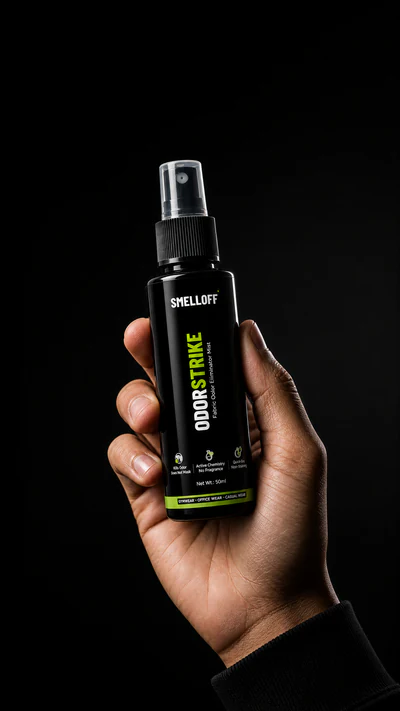
ODORSTRIKE — Fabric Odor Mist
50ml · ₹229 · Cash on Delivery available · For clothing fabric only
Buy now — ₹229 View product details