
Does Food Change Your Sweat Smell? Garlic, Methi, Onion

People ask it quietly: does the food I eat make me smell? Indian kitchens use garlic, onion and methi every day, so it is a fair question. What the research actually found — including one result most people do not expect — and the difference between what is in your sweat and what is in your shirt.
Does food change the smell of your sweat?
Some foods do. Compounds from garlic, onion and fenugreek (methi) can be released through skin and breath, and fenugreek can give sweat a maple-syrup smell. But one study found garlic made armpit odor more pleasant to raters. Most clothing odor still comes from skin bacteria and sweat building up in fabric.
In this guide6 sections
Indian food is built on a base of onion, garlic and spices, and many families add methi seeds, leaves or kasuri methi to dal, sabzi and parathas. The idea that this makes you smell is common, and it is half right. Some food compounds do reach your sweat and breath. But what most people notice on a shirt at the end of the day has another cause.
Can garlic and onion come out in your sweat?
Yes, some sulphur compounds from garlic and onion are released through breath and skin after you eat them. That is why the smell of a garlic-heavy meal can linger on the breath for hours after you have brushed your teeth.
But the effect on how sweat smells to other people is not what you might expect. In a study published in Appetite in 2016, researchers in Prague and Stirling had 42 men eat garlic or not, collected their armpit odor on pads, and asked 82 raters to score it. After the men had eaten a larger amount of garlic, their armpit odor was rated more pleasant, attractive and less intense. The authors suggested garlic's effects on skin bacteria as a possible reason.
In the Appetite study, armpit odor was rated more pleasant after a garlic-rich meal, not less.
Does methi (fenugreek) make sweat smell?
Yes — fenugreek is the clearest case of food changing sweat smell. Fenugreek contains sotolon, the compound that gives it its maple-syrup aroma, and sotolon can be excreted in sweat and urine after eating it. A 2011 study by Mebazaa and colleagues in Food Chemistry tracked sotolon in people's sweat after they consumed fenugreek, and found the smell lasts for hours. People who eat a lot of methi sometimes notice a sweet, curry-like note on their skin and clothes.
This is not a health problem. It is simply one of the few food smells that reliably comes through sweat.
Does spicy food make you sweat more?
Chilli does. Capsaicin triggers the same heat-sensing receptors as a rise in temperature, so many people sweat on the face and scalp during a spicy meal. More sweat gives skin bacteria more to work with, and it lands on your collar.
So why does your shirt smell after a meal?
Mostly because of where you were, not what you ate. Two other things usually explain it.
- Cooking and restaurant smoke. Tadka, frying and tandoor smoke settle directly onto fabric. That is a much bigger source than anything from your sweat. The cooking smell guide deals with it.
- Ordinary body odor. Skin bacteria breaking down sweat produce most body odor, whatever you ate, as the American Society for Microbiology describes. On a shirt worn all day, that builds up at the collar, underarms and back.
| Source | Where the smell comes from | What helps |
|---|---|---|
| Garlic, onion | Mainly breath; some through skin | Time, water, brushing; not your shirt |
| Methi (fenugreek) | Sotolon in sweat, for hours | Shower; fresh clothes; wash what you sweated in |
| Chilli | More sweat, so more body odor | Vest; dry off; treat the shirt |
| Kitchen and restaurant smoke | Settles on fabric | Air out; fabric odor spray |
| Everyday body odor | Skin bacteria and sweat in fabric | Wash; refresh between washes |
What can you do about food smell on clothes?
Deal with the fabric, because changing your diet is rarely the answer.
- Wear a cotton vest so sweat does not sit in the shirt.
- After a meal in a smoky restaurant or kitchen, hang the shirt in moving air.
- Treat the collar, front and underarms with a fabric odor spray from 15–20 cm and let it dry for 15–30 seconds. ODORSTRIKE uses HPβCD to trap odor molecules and Zinc PCA to neutralise them, rather than covering them with perfume.
- Wash clothes you sweated heavily in, especially after a methi-rich meal on a hot day.
When should you see a doctor about body odor?
When it changes suddenly or a lot without an obvious reason. A new, strong or unusual body odor, especially with other symptoms, is worth raising with a doctor. Food explains a small part of how people smell; it does not explain a sudden change.
ODORSTRIKE is for fabric only. It does nothing for breath or skin and does not change how your sweat smells. It deals with odor in clothes and does not replace washing.
Sources
Fialová, J., Roberts, S. C., Havlíček, J. Consumption of garlic positively affects hedonic perception of axillary body odour. Appetite 97, 8–15, 2016. dspace.stir.ac.uk
Mebazaa, R., Rega, B., Camel, V. Analysis of human male armpit sweat after fenugreek ingestion: characterisation of odour active compounds by gas chromatography coupled to mass spectrometry and olfactometry. Food Chemistry 128(1), 227–235, 2011. Summary by NutritionFacts.org. nutritionfacts.org
American Society for Microbiology. The Microbial Origins of Body Odor. ASM.org, 2021. asm.org
Frequently Asked Questions
Does garlic make you smell bad?
Garlic mainly affects breath. In one 2016 study, armpit odor was actually rated more pleasant after people ate more garlic.
Why does my sweat smell like maple syrup or curry?
Fenugreek (methi) contains sotolon, which can come out in sweat for hours after eating it and has a sweet, maple-syrup, curry-like smell.
Does Indian food cause body odor?
Not on its own. Most body odor comes from skin bacteria breaking down sweat. Cooking smoke on clothes is a bigger source of "food smell" than sweat.
Can a fabric spray remove food smell from clothes?
It helps with smell in the fabric, such as kitchen or restaurant smoke. It does not change your breath or your sweat.
Should I stop eating methi to avoid smelling?
There is no need for most people. Shower, wear fresh clothes and wash what you sweated in.
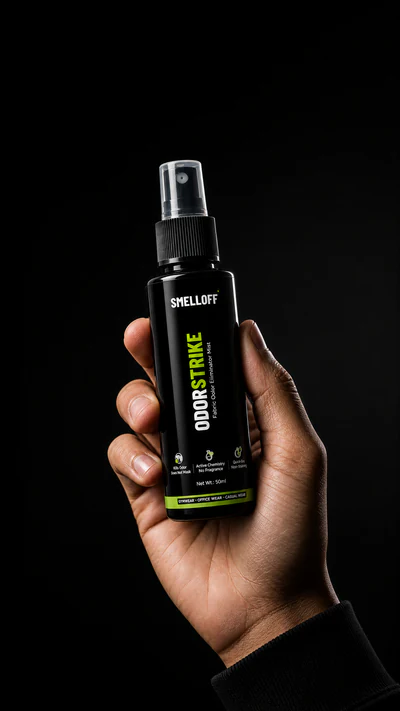
ODORSTRIKE — Fabric Odor Mist
50ml pocket spray for clothes. HPβCD traps odor molecules in the fabric and Zinc PCA neutralises them, instead of covering them with perfume. Dries in 15–30 seconds, up to 8 hours of odor protection on fabric under normal office/commute conditions. Fabric only, never skin.