
Why Clothes Smell Worse When Wet or Humid
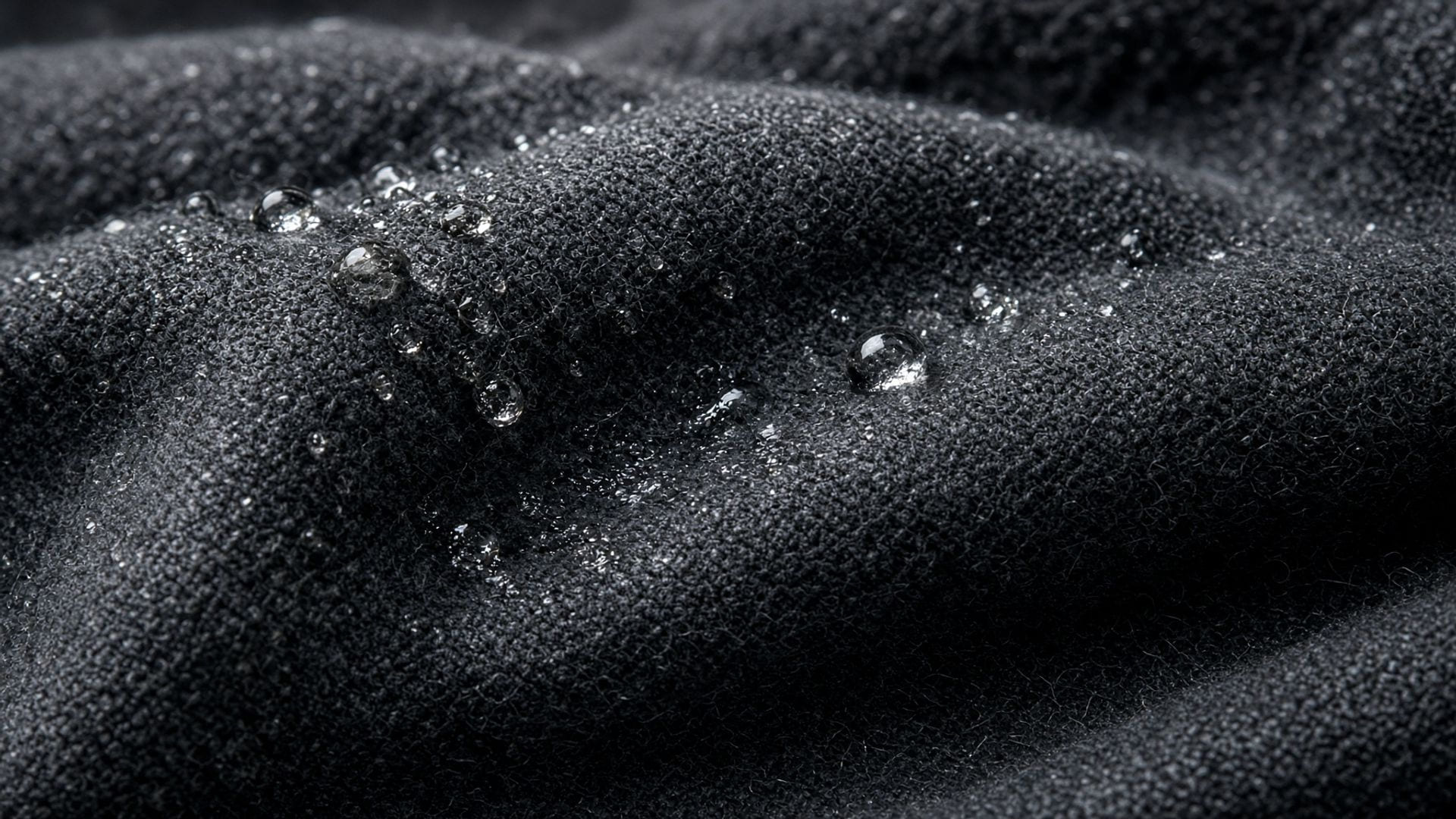
A dried shirt that smells again in the rain, and the same shirt that is louder at 80% RH, are one physics story.
Water does not create clothing odor. It turns the volume up on odorants already sitting in the fibre, and it slows the evaporation of fresh sweat so bacteria get more time. A dry shirt that reeks in a drizzle, and the same shirt that is louder at 80% RH, are two readings of one physics story — not monsoon mould.
In this guide10 sections
- The smell was already in the fibre
- What water actually does to an odor molecule
- Clock one: volatility. Wet-again reactivation
- Clock two: humidity. Bacteria get more time
- The two clocks on one shirt
- This is not monsoon mould
- Cotton, polyester, and the same water
- What to do with a shirt that got loud
- When humidity is the whole day
- Honest limits
You hung the shirt. It was quiet. Then it rained on the way to the auto stand, or the bathroom steamed up, or Mumbai simply sat at 82% humidity, and the same cloth started talking. People blame the weather as if humidity invented a new molecule. It did not. The molecule was already in the weave. Water changed how easily it could leave.
This page is the water-odor relationship: wet-again reactivation plus humidity as extra bacterial time. It is not the monsoon mould page. Geosmin and 1-octen-3-ol from slow-dried laundry are a different smell, with a different job. Here the shirt was already worn. The residue was already there. Water made it louder.
The smell was already in the fibre
A clean-looking shirt is not a chemically empty shirt. One wear leaves sweat acids, sebum fragments, and skin-derived volatiles in the yarn. On a dry, cool hanger they sit. You do not smell them because they are not in the air in front of your face at a concentration your nose cares about. They are adsorbed, tucked into the fibre and the finish, waiting for a reason to move.
That is why the surprise feels personal. The shirt passed the sniff test at 7am. At 11am, after a light rain on the scooter, it did not. You did not suddenly become unhygienic between those two hours. You added water to a reservoir.
Quiet when dry is not the same as empty
A dry sniff is a test of what is currently volatile. It is not a test of what is stored. Water is the switch that moves stored odorants into the air.
What water actually does to an odor molecule
Water is a solvent and a competitor. It wets the fibre surface, loosens odorants that were parked there, and gives them a liquid film to travel in. Some of those molecules then jump into the air. That jump is what you call smell. Textile labs transfer sweat odorants to yarn in an aqueous solution for this reason: liquid water is how the chemistry actually arrives on cloth, and how a lot of it leaves again.

There is a second, ruder effect as the water itself starts to go. The most volatile compounds flash off first. What remains — medium-chain fatty acids, the sour and goatish notes — concentrates in the shrinking wet film. The shirt can smell worse halfway through drying than it did when it was soaked. Anyone who has sniffed a damp office shirt on a balcony at 4pm already knows this, even if they never named it.
Two mechanisms, not a vibe
McQueen's group showed odorants move onto fibre through liquid sweat and then release into the headspace on a clock. Møllebjerg's group showed that as the water phase evaporates, less-volatile acids concentrate and keep driving odor. Humidity and temperature sit on both clocks: they change how fast volatiles leave, and how long bacteria stay active.
Clock one: volatility. Wet-again reactivation
Wet-again is the rain version, the sweat-again version, the bathroom-steam version. The residue dried. The odorants went quiet. Water returned — rain on the commute, a second sweat in a 3pm meeting, steam from a bucket bath in a closed bathroom — and the same compounds became mobile. The shirt did not get a new soil. It got a solvent.
This is why a shirt that survived yesterday can fail in a ten-minute drizzle. The drizzle is not dirty. It is wet. The collar and the pit, where residue is densest, get loud first. The hem, which barely met your skin, often stays polite. That map is a residue map, not a weather map.
- Rain on a previously worn commute shirt: reactivation, not a new source.
- A second sweat on a shirt that had dried at the desk: the dried film rehydrates.
- Bathroom steam on a hung shirt: the room wets the cloth without you wearing it.
- A spritz of plain water 'to freshen it': you just did the experiment on purpose.
Clock two: humidity. Bacteria get more time
Humidity is wet-again without a visible drop. Above roughly 70% relative humidity, sweat evaporates slowly from skin and from cloth. Fresh sweat is almost odorless. Bacteria on the fibre and in the skin-cloth gap need time with that liquid to turn it into volatiles. Slow evaporation is extra time. Extra time is extra smell.
This is the Indian-city version of the same physics. Mumbai, Kochi, Chennai, coastal Andhra, a Hyderabad active-monsoon week — the air is already full of water. Your sweat has nowhere to go. The shirt stays a damp bioreactor for hours instead of minutes. Delhi in January does the opposite: the same body, the same shirt, a shorter bacterial window, a quieter afternoon.
Eighty percent RH is a time machine for bacteria
A Pune December afternoon and a Mumbai July afternoon are not the same experiment. The body is similar. The evaporation clock is not. Humidity does not add a new odorant. It lengthens the shift the existing microbes get with your sweat.
The two clocks on one shirt
You can have both at once. A worn shirt in humid air is louder because stored odorants are more willing to leave, and because new sweat is lingering long enough to be metabolised. That is why 'the monsoon makes my clothes smell' is true in two different ways, and why people argue past each other. One person means the cupboard went musty. Another means the office shirt got rude by lunch. Both are water. Only one is this page.
Clock one: volatility
Wet again
- Rain, sweat or bathroom steam
- Stored odorants loosen and leave the fibre
- Happens in minutes
Clock two: humidity
Bacteria get time
- Above about 70% relative humidity
- Sweat lingers on skin and cloth
- More of it turns into odor
First, stop adding water. Then dry the shirt before you treat it.
| What happened | What you are smelling | What water did | Wrong fix |
|---|---|---|---|
| Worn shirt, then rain / second sweat / steam | Sweat acids and sebum notes you already made | Rehydrated stored odorants; raised volatility | Spraying more water, or perfume on a damp pit |
| Worn shirt at high RH, no rain | Fresh bacterial volatiles, produced slowly all day | Slowed evaporation; bacteria kept a wet workplace | Blaming the detergent for a humidity clock |
| Washed laundry dried for hours in monsoon air | Musty, earthy, wet-cupboard (geosmin / 1-octen-3-ol) | Never finished drying; mould chemistry on clean cloth | This page. That smell has its own monsoon article |
This is not monsoon mould
If the shirt smells like an old almirah, like first rain on soil, like a towel forgotten in a bucket — that is the slow-dry laundry problem. Mould and certain bacteria mint geosmin and mushroom alcohol on cloth that stayed damp too long after a wash. The fix is drying, then dealing with that residue. It is not the same as a worn office shirt that got loud when it got wet.
Confusing the two is how you end up re-washing a shirt that needed air, or airing a shirt that needed a hot wash. Sniff for the note. Sweaty-sour and goatish is residue plus water. Earthy-musty is the other page.
Cotton, polyester, and the same water
Water does not pick a fibre and ignore the rest. Cotton holds liquid in the yarn; a cotton shirt can stay a wet film longer, which feeds clock two. A hydrophobic weave does not drink the water — it leaves a damp microclimate against skin, which also feeds clock two, and it is greedy with oily odorants, which feeds clock one when heat and moisture return. The ranking of which fibre holds odor longest is a different article. Here the point is narrower: whatever you are wearing, added water makes the existing load easier to smell.
What to do with a shirt that got loud
First, stop adding water. Do not spritz the pit with tap water. Do not hang it in the bathroom while someone is bathing. Do not bag it damp in a backpack 'until evening'. You are running the experiment again.
A loud-when-wet shirt, in order
- Get it dry in moving air — Unbutton. Hang so the pits and the collar see air, not each other. Fan if the room is still. Shade is fine. The job is evaporation, not sunlight theatre. Do not iron a damp odor in.
- Sniff when it is actually dry — Seams last. If the pit still talks when the cloth is dry to the touch, that is stored residue, not humidity. If it goes quiet when dry, you were smelling clock one, and you can wear it with caution.
- Treat dry fibre, not a wet film — A fabric odor mist belongs on dry cloth. On a wet shirt it dilutes, spreads, and then you wait anyway. Light fragrance that fades is not a rain jacket for smell.
- Wash when the soil is soil — Yellow pit, salt rings, a shirt that has been loud dry and wet — that is a wash. Water-as-volume-knob is not a reason to skip laundry forever. A mist does not remove oils.
- Air the shirt fully dry before you decide it is finished.
- Treat reactivation as evidence of residue, not as a new mystery.
- On humid days, change the shirt if it has already been through one sweat-dry-sweat cycle.
- Keep hung shirts out of bathrooms and closed wet kitchens.
- Do not spray plain water on a smelly pit 'to refresh it'.
- Do not perfume a damp shirt. Alcohol flashes off. The mash stays.
- Do not bag a rain-wet commute shirt until night. You are incubating.
- Do not call monsoon mould and wet-again the same problem.
When humidity is the whole day
You cannot argue with 80% RH. You can shorten the bacterial shift. Cotton that is actually cotton, a bit of room in the pit, a change of shirt after a soaked commute, a fan on the hanging rail at home. Indoor drying protocol lives on the apartment-drying page. Here the rule is smaller: do not give yesterday's residue today's humidity for free.
Office AC can fool you. The cabin is cool, so you think the shirt is dry. The microclimate under the arms is not the cabin. You walk out into the humidity at 6pm and clock one and clock two start together. That is not the AC-stale page either. That page is closed recycled air. This is water.
Honest limits
You cannot spray your way out of a climate. You cannot mist a soaked shirt and call it washed. You cannot dry a load in a closed room at 85% RH and then complain that physics is unfair. Water will keep doing this. The useful move is to know which clock you are on, dry the cloth, and only then decide between wear, mist, and wash.
A mist is not a dehumidifier
Fabric odor mist traps what is already on dry fibre. It does not stop rain. It does not pull humidity out of Mumbai. It does not replace a wash when the soil is visible. Used on a wet shirt, it is just more water.
After the shirt is dry — not while it is raining on you, not in the bathroom steam — ODORSTRIKE 50ml v3.1 is a fabric-only mist for the residue the water just revealed. Made in Hyderabad. ₹229 prepaid. Cash on Delivery available. Light, subtle scent; not unscented, not a perfume. Dries in 15–30 seconds, 30–60 in humidity. Up to 8 hours on fabric under ordinary office or commute conditions is a window, not a guarantee. Does not replace washing. Not for skin. Useless on a soaked shirt. Dry first.
50ml fabric-only mist. Formula v3.1. Prepaid UPI ₹229. Cash on Delivery available. Light, subtle scent. Not a wash. Not for skin.
- Van Herreweghen, F., Amberg, C., Marques, R. & Callewaert, C. (2020). Biological and Chemical Processes that Lead to Textile Malodour Development. Microorganisms, 8(11), 1709. — Humidity, temperature and drying time affect both the evaporation of volatiles from textiles and the growth of malodour-forming bacteria. Slow, humid drying raises microbial load; the drying stage is part of the odor system. Source
- McQueen, R. H., Eyres, G. T. & Laing, R. M. (2024). Textile sorption and release of odorous volatile organic compounds from a synthetic sweat solution. Textile Research Journal, 94(21-22), 2392–2405. — Body odorants typically reach fibre through liquid sweat. Headspace release of ketones, aldehydes and acids then follows a time course that depends on fibre and on that aqueous transfer — water is the carrier, not a spectator. Source
- Møllebjerg, A., Gonzales Palmén, L., Gori, K. & Meyer, R. L. (2021). The Bacterial Life Cycle in Textiles is Governed by Fiber Hydrophobicity. Microbiology Spectrum, 9(2), e01185-21. — As the water phase evaporates from a textile, less-volatile fatty acids concentrate and keep driving odor release. Moisture regain also changes how long bacteria stay active after the cloth starts to dry. Source
- Díez López, C., Van Herreweghen, F., De Pessemier, B. et al. (2025). Unravelling the hidden side of laundry: malodour, microbiome and pathogenome. BMC Biology, 23, 40. — Malodours introduced during wear are reduced by washing, then reappear through humid-drying. Drying at about 80% RH increased odor intensity and favoured Gram-negative growth — humidity as a production window, not just a storage condition. Source
Frequently Asked Questions
Why do my clothes smell worse when they get wet?
Because water mobilises odorants already in the fibre and helps them reach the air. The smell was stored. Wetting is the volume knob, not the source.
Why does humidity make clothing odor worse even if the shirt looks dry?
High RH slows sweat evaporation. Bacteria on skin and fibre get more time with liquid sweat, so they produce more volatiles. The shirt does not need to look soaked for that clock to run.
Is this the same as monsoon musty smell?
No. Musty after a wash is mould chemistry on laundry that never finished drying. Wet-again is worn-shirt residue getting volatile. Earthy cupboard versus sweaty-sour. Different pages, different fixes.
Can I spray water on a shirt to freshen it?
That is how you run the reactivation experiment. Water is the problem you are describing. Dry air, then a fabric mist on dry cloth if the residue is still there.
Why does the smell come back when I start sweating again?
Sweat is water plus a little salt and precursor. It rehydrates the dried film in the pit and collar. Stored odorants lift, and bacteria get a fresh wet workplace. Same two clocks, body-shaped.
Does a fabric mist work on a wet shirt?
Poorly. You want contact with dry fibre. On a wet film the product dilutes and you still have to dry the garment. Dry first. Mist is not a wash and not a rain cover.
Will this keep happening every monsoon?
The physics will. Humidity will keep slowing evaporation, and rain will keep rewetting residue. What you can change is how much residue you leave in the fibre, and whether you dry the shirt before you treat it or wear it again.
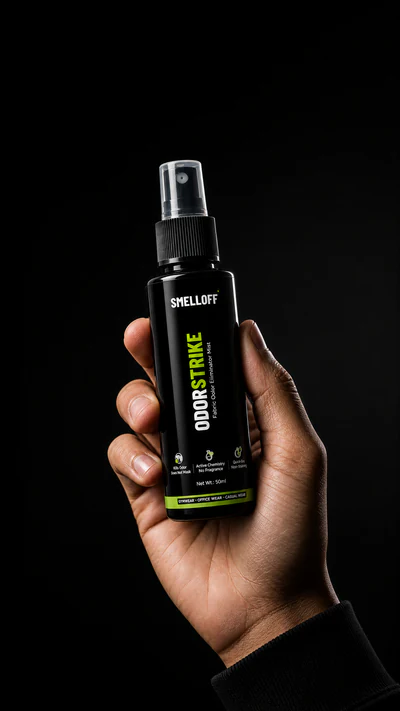
ODORSTRIKE — Fabric Odor Mist
50ml · ₹229 · Cash on Delivery available · For clothing fabric only
Buy now — ₹229 View product details