
Why Sweat Smells Stronger on Some Shirts
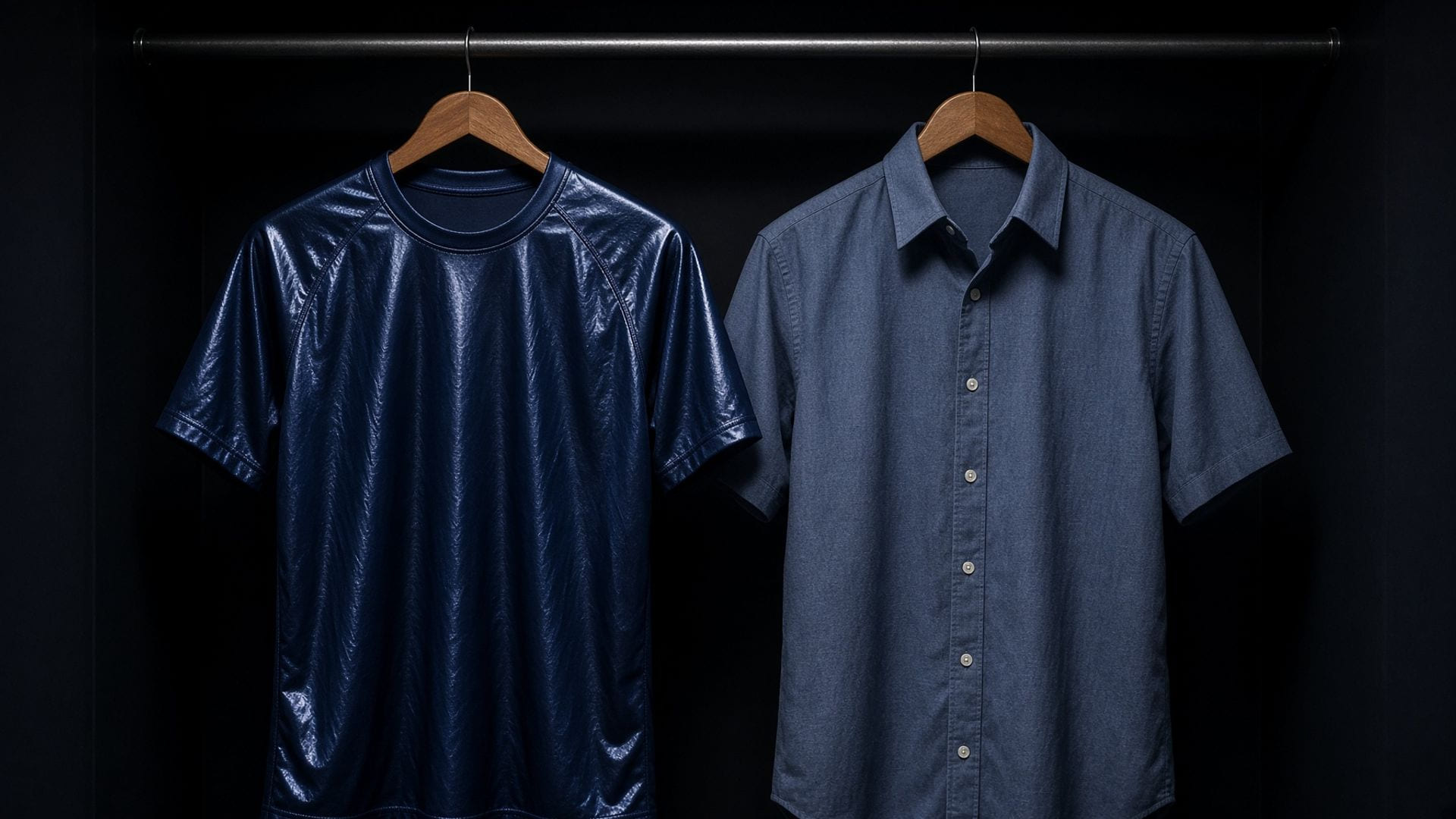
Loudness is a stack: fibre, finish, fit, residue age, and whether the last wash actually stripped it. Polyester is one layer, not the whole story.
Same body. Louder shirt. Loudness is a stack: fibre, finish, fit, how old the residue is, and whether the last wash actually stripped it. Polyester is one layer of that stack, not a personality verdict and not this page's ranking. Two shirts from the same cupboard can come home smelling like two different days because they did not start the morning as the same object.
In this guide10 sections
- Same sweat. Different shirt. Different afternoon.
- Fibre is a layer, not a verdict
- Finish: the coating the tag will not mention
- Fit: time-on-skin is a volume knob
- Residue age: last week is still speaking
- Under-washing: the cycle that looked like a wash
- The loudness stack
- Two shirts, one cupboard, one Tuesday
- What you can change this week
- When a mist helps, and when it is theatre
You wore both. You took the same metro. You ate the same lunch. One shirt comes off the chair in the evening like a person. The other comes off like a complaint. The temptation is to blame your chemistry. Your chemistry went to work in both of them.
Same sweat. Different shirt. Different afternoon.
Sweat leaving you is mostly water, salt, a little urea, a little lipid. It has almost no smell. The smell is what bacteria make from what the cloth holds, and how long they get to work, and how willing the fibre is to give those volatiles back to the room. A louder shirt is not a louder person. It is a better trap, a tighter fit, a finish that holds oil, a residue that is three wears old, or a wash that looked like a wash and was not.
The wearer is not the only variable
If it were, every shirt in the cupboard would fail on the same clock. They do not. Diagnose the garment the way you would diagnose a stain: what is it made of, how does it sit, what is already in it, and what did the last laundry actually do.
Fibre is a layer, not a verdict
Fibre matters. It is the first thing people reach for, and it is not imaginary. Synthetics tend to grip skin lipids. Cotton tends to take on water and give more of it up in a proper wash. That comparison is a ranking, and the ranking already has a home: why polyester holds odor longer than cotton, and the fibre-by-fibre list. This page will not rerun it. You already know, in your bones, that the gym polyester from 2019 and the office cotton oxford are not the same animal.

What this page needs is the rest of the stack. Because a well-washed, loose cotton kurta can still come home loud if you wore it tight under a jacket in August. And a polyester shirt that was stripped, dried to the seam, and hung in air can outlast a 'natural fibre' that has been under-washed since Holi. Fibre sets a tendency. It does not finish the sentence.
Finish: the coating the tag will not mention
A lot of what you wear is not the fibre. It is the fibre plus a factory finish plus whatever you have been putting on it. Easy-care resins. Stain-release. Moisture-wicking coatings. Softener films from the last six washes. A cheap 'fresh' rinse that left a waxy hand. These layers change how oil and water sit. A wicking finish that is still open will move sweat along the yarn. The same finish, clogged with softener and sebum, becomes a greasy mesh that holds odor against the skin. You did not change fibre. You changed the surface.
This is why two 'same' polyester formals — one from a full-price rack with a clean finish, one from a pile that has been through a shared machine with extra Comfort — can behave like cousins, not twins. The loud one often feels slightly coated. The quiet one still feels like cloth.
Fit: time-on-skin is a volume knob
A slim-fit formal that kisses the pit all day is a different climate from a straight-cut shirt that tents. Tight cloth spends more hours wet, with less air changing against the skin, at a temperature the body is trying to dump. Bacteria like that weather. Transfer is also mechanical: more rub, more sebum into the yarn, more of the collar band polishing your neck into a ring. The fibre could be identical. The pattern is not.
Jackets do this to good shirts. A cotton oxford that is fine on its own becomes a greenhouse under a blazer in a closed AC cab. You took the jacket off at 6 and blamed the cotton. The cotton spent seven hours as lining.
The client-day shirt
Many Indian wardrobes have one 'good' slim-fit for meetings — dark, synthetic or a blend, worn slightly too often because it photographs well and dries overnight on a hanger in a closed bedroom. It is not louder because you are. It is louder because it is tight, under-washed, and never fully dry at the seam before it goes back on. The weekend cotton does not get that job, so it does not get that reputation.
Residue age: last week is still speaking
Odor on a shirt is not only today's sweat. It is today's sweat landing on yesterday's film. Skin lipids and the leftovers of bacterial work bind, dry, and wait. Next wear, water arrives — your sweat, the humidity, a rain splash — and the old film becomes volatile again. That is why a shirt that smelled acceptable on the hanger can open up an hour after you put it on. You did not suddenly produce a new person. You rehydrated an old one.
Age has a smell of its own. Fresh-day odor is sharper. Old-residue odor is flatter, a little sweet-stale, sometimes described as 'this shirt is tired'. People wash around it with more detergent and more softener. That often adds film. The honest move is a strip: hotter or longer wash if the care label allows, less product, more rinse, dry with actual air. Until that happens, every new day is stacked on the last.
Biofilm is why 'I washed it' is not always a reset
Once bacteria hold onto a textile, they can form a film that ordinary cycles do not fully remove. Dried, that film can still hold malodor compounds and pigments. Research on textiles is blunt: irreversible adhesion is a laundry problem, not a perfume problem. A louder shirt is often an older film, not a more dramatic Tuesday.
Under-washing: the cycle that looked like a wash
Under-washing is not laziness in a moral sense. It is a 15-minute quick cycle, a packed drum, cold water on a synthetic that is holding oil, a skip of the extra rinse because the bill is the bill, hanging a still-damp shirt in a closed room, or fabric softener used as if it were detergent. The shirt comes out looking worn-and-returned. It is not clean at the pits or the collar. Those two zones are a map of their own — sebum ring versus heat-lipid seam — and a whole-garment cycle that is too short will spare both.
Monsoon makes this worse without changing your body at all. A shirt that would have dried to the seam in March spends six hours damp in July. Damp time is bacterial time. The fibre did not switch. The clock did.
The loudness stack
Read it top to bottom. Any layer can dominate. Most loud shirts are two or three at once.
Louder
Two or three at once
- Oil-loving synthetic, dense knit
- Clogged wicking coat or softener film
- Slim fit, jacket on all afternoon
- Last week’s residue, quick wash
Quieter
What you can change
- A fibre that wets and rinses well
- An open finish, no softener
- Ease in the armhole, air moving
- A proper wash and a real dry
| Layer | What it changes | Loud version | Quieter version |
|---|---|---|---|
| Fibre | How lipids and water sit in the yarn | Oil-loving synthetic with a dense knit | A fibre that wets and rinses more honestly — ranking lives on the polyester page |
| Finish | The surface oils actually meet | Clogged wicking coat, softener film, cheap easy-care hand | An open finish, or a cloth that still feels like cloth after washing |
| Fit | Hours of wet contact and airflow | Slim pit, tucked tight, jacket on all afternoon | Ease in the armhole, air moving, jacket off when you can |
| Residue age | What today's sweat lands on | Three wears, hanger in a closed room, 'it still looks fine' | Stripped recently, dry to the seam, no sweet-stale on the hanger |
| Under-washing | Whether the last cycle was a reset | Quick cold load, packed drum, extra softener, damp overnight | Pit and collar pretreat, enough water, actual dry air |
Two shirts, one cupboard, one Tuesday
Shirt A: a two-year-old slim-fit blend, client rotation, washed Sunday night on quick, hung in the bedroom with the AC on and the door shut, put on slightly cool but not dry at the side seam. Shirt B: a cotton straight-cut, washed on a longer cycle two days ago, dried at the window, worn without a jacket. You are the same man at 9am. At 4pm Shirt A is a story and Shirt B is a shirt. Nobody in that office smelled your glands. They smelled A's stack.
What you can change this week
You cannot rebuild a fibre. You can stop asking one garment to do every day. Rotate. Give the tight formal a strip wash and a real dry. Skip softener on anything that already holds odor. Unbutton the jacket in the cab. Hang inside-out with space, not in a packed cupboard against last week's jeans. If a shirt is loud on the hanger before you put it on, that is residue age — it is already talking. Do not perfume it into the office.
Which layer is loud — a ten-minute audit
- Smell it on the hanger, dry, off your body — If it is already sour or sweet-stale, you are in residue age or under-washing. Today's sweat has not happened yet. Wash properly before the next wear. A mist will quiet a light leftover; it will not strip a film.
- Check the hand of the cloth — Waxy, coated, slightly crunchy pits: finish plus product plus sebum. Plan a strip, not another softener. If it still feels like open cloth, fibre and fit are more likely.
- Compare fit against a quieter shirt from the same day — If the loud one is the slim, tucked, jacketed one, treat ease and air as the fix for the next wear. Do not wait for a new fibre.
- Look at the last wash, not your last shower — Quick cycle, packed drum, damp overnight, monsoon indoor hang — that is under-washing. The body did its job. The machine did not.
- Only then blame fibre — If two garments had the same wash, same dry, same fit, and the synthetic is still the loud one, now you are on the polyester page. Send the question there. This page's job is the rest of the stack.
- Rotate the 'good' shirt. One formal cannot be Monday through Thursday in April.
- Pretreat pits and collar. Those zones fail first, on cotton and synthetic alike.
- Dry to the seam, not to the back panel. Damp side seams are a second climate.
- If two shirts from the same day smell different, audit the stack before you audit your body.
- Do not decide you 'just smell more' because one slim polyester is a problem.
- Do not add more softener to a shirt that already feels coated.
- Do not perfume a hanger-loud shirt. That is the mash from the deodorant page.
- Do not treat this as a fibre ranking. The ranking exists. This is wearer plus wardrobe.
When a mist helps, and when it is theatre
A fabric odor mist is for a clean-enough garment that has picked up a day: collar, pits, upper back, light passes, dry in 15–30 seconds. It quiets molecules sitting in the weave so they stop reaching a nose. It does not open a clogged finish. It does not replace a strip wash on a shirt that has been under-washed since the last festival. If the hanger already smells, wash. If the shirt got loud at 3pm and looks clean, a mist is a between-wash tool, not a personality transplant.
You cannot mist a film off a fibre
Up to 8 hours on fabric is a protection window on cloth under ordinary office and commute conditions, not a promise, and not a claim about a garment that is already a reservoir. Months of residue need laundry. A 50ml bottle that dries in 15–30 seconds is not a washing machine.
Once you know which shirt is loud, you still need a between-wash quiet for the ones that are clean enough to wear. ODORSTRIKE 50ml v3.1 is fabric only: trap and quiet on the cloth, light fragrance that fades, 15–30 seconds to dry, up to 8 hours under a normal office or commute — not a guarantee, not a strip wash. ₹229 prepaid. Cash on Delivery available. Use it on the garment. Then wash the ones the stack has already lost.
50ml fabric-only mist. Formula v3.1. Prepaid UPI ₹229. Cash on Delivery available. Light, subtle scent. Not a wash. Not for skin.
- Møllebjerg, Lisbjerg, et al. — Bacterial life cycle in textiles (mSphere, 2021) — Bacteria that colonise clothing can form biofilms that ordinary washing does not reliably remove. Dried film can still hold malodor. Residue age is a mechanism, not a metaphor. Source
- Van Herreweghen et al. — Biological and chemical processes that lead to textile malodour (Microorganisms, 2020) — Incomplete washing lets microorganisms and odor build across wear-wash cycles — the 'permastink' complaint. Under-washing is measurable, not a character flaw. Source
- American Society for Microbiology — The Microbial Origins of Body Odor (2021) — The smell is bacterial work on sweat components, not sweat itself. A shirt that holds those components longer, wetter, or on top of old film will read louder on the same body. Source
- Callewaert et al. — Microbial odor profile of polyester and cotton clothes (AEM, 2014) — After the same fitness session, polyester shirts were rated more intense and less pleasant than cotton, with a different microbial community on the cloth. Fibre is a real layer of the stack. The ranking of that layer lives on the polyester page, not here. Source
Frequently Asked Questions
Why do some of my shirts smell more than others if I am the same person?
Because the shirt is a variable. Fibre, finish, fit, residue age, and under-washing change how much lipid the cloth keeps, how long it stays wet, and how much old odor today's sweat can wake. Same body, different object, different afternoon.
Is it just polyester?
No. Polyester is a documented loud fibre, and that ranking is a different page. A tight, under-washed, coated cotton can beat a well-stripped synthetic on a given day. Start with the stack. Go to fibre last.
Why does a shirt smell fine on the hanger and loud after an hour?
Water. Your sweat, or the humidity, rehydrates residue already in the fibre and turns the volume up. The shirt was not clean in the odor sense. It was dry. Dry and clean are not the same, especially at the collar and pits.
Does a tighter shirt really smell more?
Often. More contact, less airflow, longer wet time, more rub into the yarn. Slim-fit is a climate. If your loud shirts are also your tight shirts, ease is a cheaper experiment than a new fibre.
I washed it. Why is it still the loud one?
The cycle may not have stripped lipids or biofilm, especially on a quick cold load with softener. Or it did not dry to the seam. Or the finish is clogged. 'Washed' is a button. Clean at the pit panel is a result. Check the result.
Can I just spray the loud shirts and ignore the stack?
You can quiet a light leftover on a clean-enough garment. You cannot ignore a reservoir. If the same three shirts are always the problem, strip them, dry them, rotate them. A mist is a layer in a week, not a substitute for the stack.
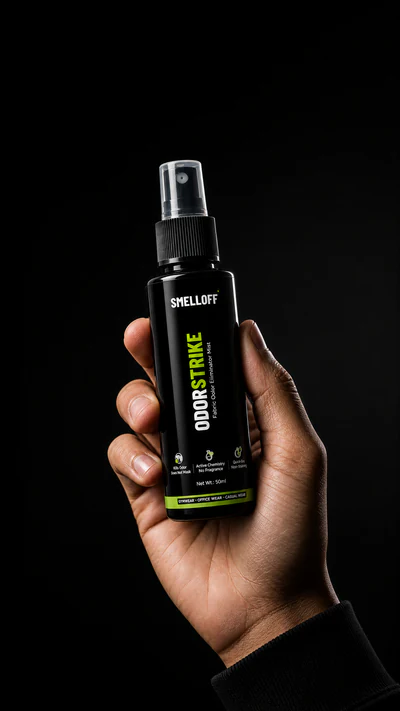
ODORSTRIKE — Fabric Odor Mist
50ml · ₹229 · Cash on Delivery available · For clothing fabric only
Buy now — ₹229 View product details