
Why I Built ODORSTRIKE: India's Pocket Fabric Spray
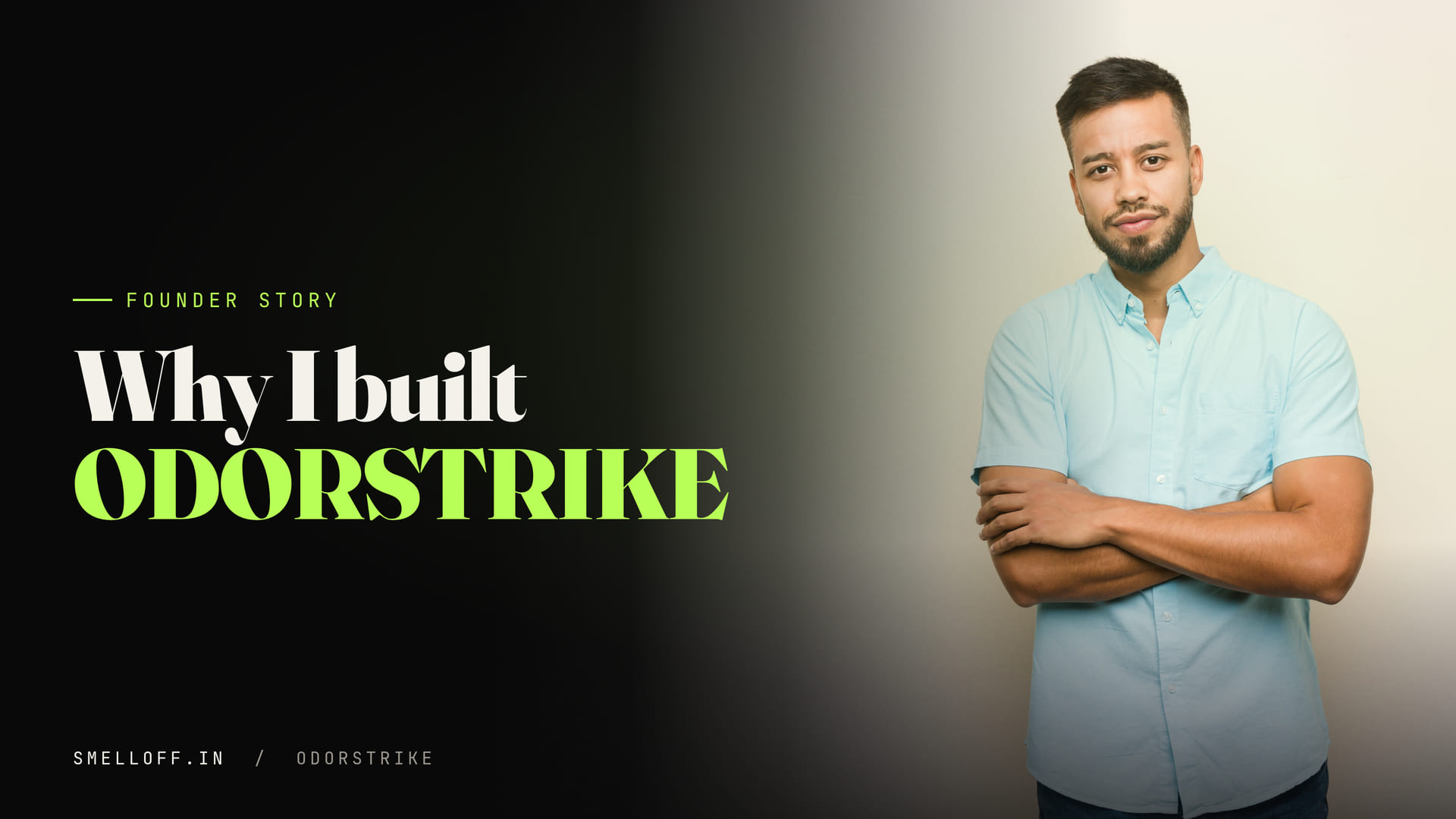
This isn't a product story. It's a slightly embarrassing personal story that turned into a product. Six months in Hyderabad, a lot of bad prototypes, and one very specific realization that changed how I thought about grooming entirely.
Why was ODORSTRIKE created?
ODORSTRIKE was created because deodorant kept failing its founder in Hyderabad's heat — the smell lived in his shirt, not on his skin. Jogdhande Nikhil Patil spent six months and many prototypes building a ₹229, 50ml pocket fabric spray that neutralises sweat odor trapped in fabric in about 30 seconds and keeps it fresh for up to 8 hours. It goes on fabric, not skin.
In this guide6 sections
It was a Tuesday in May. I'd come back from a client meeting — an hour across Hyderabad in an Ola with no working AC, May heat sitting at 41°C, traffic moving at the pace of geological change. I walked into the office, found a seat, and a colleague looked up. Nothing was said. Just a slight shift of expression. The kind that doesn't mean anything conscious. Just a reflex.
I went to the bathroom. Smelled my shirt. And I thought: I showered this morning. I put on deodorant. I do everything right. And this shirt is making me someone that people notice for the wrong reason.
That moment sat with me longer than it should have. And the more I thought about it, the more I realized the shame of it was the whole problem — not the smell itself, but the fear that someone noticed. The self-consciousness before walking into a room. The checking your collar before sitting down. The mental load that comes from not being sure.
I know a lot of people carry that. I know because I do too.
What was the realization?
The short version: by 3 PM the smell lives in the shirt fibres, not on the skin — which is why no deodorant could fix it.
After that Tuesday, I started paying more attention. I noticed that my shirt smelled worse than my skin by about 3pm on most days. I noticed that deodorant did its job perfectly — my armpits were fine — but my collar, the back of my shirt, the fabric under my arms? That was a different story.
I tried the obvious things. Better deodorant. More frequent washing. Different detergent. Sun drying. Vinegar soaks. All the advice that shows up when you search "how to stop shirt smell." None of it worked reliably. The smell came back. Every time. Because the smell was in the fabric, and nothing I was doing was treating the fabric — the core of the deodorant versus fabric mist divide I only understood later.
I started reading about how fabric holds odor. About polyester fiber structure. About the chemistry of isovaleric acid and butyric acid. About why water-based detergents can't penetrate hydrophobic synthetic fabrics. I'm not a chemist — I was learning from scratch. But the picture that emerged was clear: the product category I needed didn't exist. Not in India. Not at any accessible price point. Not designed for this climate.
What did six months of getting it wrong teach?
It took six months of failed prototypes to get a fabric mist that neutralised odor without stains or residue.
I'm going to be honest about the development process: most of it was failure.
The first few prototypes were essentially fancy water with fragrance. They smelled nice. The odor returned in 40 minutes. I threw them out.
I tried enzyme-based formulas. They worked on protein-based odors but degraded fast and had a shelf-life problem in warm storage conditions (Hyderabad in summer is not kind to enzyme stability).
I tested baking soda suspensions. Activated charcoal suspensions. Alcohol alone at different concentrations. Combinations of things that looked promising on paper and were mediocre in practice.
I found research on zinc pca — a compound used in medical-grade deodorant applications for decades, specifically valued because it actually neutralizes odor compounds rather than masking them. Getting the formulation right for fabric — the right concentration, the right alcohol carrier to help it penetrate polyester fiber, no stiff residue — took another two months. But when it worked, it was unmistakably different from everything else I'd tried.
The test that convinced me: I sprayed a polyester shirt after a full day of wear in the Hyderabad heat. Waited half a minute. Smelled it. The specific sourness — the isovaleric acid note that's the signature of hot-day shirt smell — was gone. Not overwhelmed. Gone. My brain kept looking for it and not finding it. That's when I knew the formulation was right.
Why fabric-only?
ODORSTRIKE is fabric-only because the shirt holds the smell a skin product can never reach — a different problem needing a different product.
Fresh sweat is nearly odorless; skin bacteria are what turn it into smell, and those compounds end up living in the fabric rather than on washed skin.(American Society for Microbiology)
People have asked me: why not just make a better deodorant? The Indian market definitely has room for better deodorants.
Because the deodorant problem is largely solved. The space is crowded, the efficacy is decent, and adding another player there doesn't change anyone's experience in a meaningful way.
The fabric problem — nobody was touching it. Nobody was making a pocket-sized spray, designed for Indian polyester shirts, at a price point that makes daily use sensible, with an active ingredient that actually works. That gap is enormous. And it was sitting there, unaddressed, while millions of people dealt with the same problem I had.
That's where I wanted to be.
Why not skin?
ODORSTRIKE is built fabric-first: a fast-flashing solvent system (a low-load, fast-flashing carrier in Formula v3.1) carries the actives into the fabric fibre and dries in seconds. It is not made for skin — the actives are chosen to bind odor in fibres, not to sit on your body. The choice was deliberate: optimize for fabric, not for multipurpose use. A product that does one thing well rather than two things badly.
Where does the name come from?
The name is the brief: strike odor on fabric, on contact.
ODORSTRIKE was almost called several things. I wrote a list of about 40 names over the first few weeks. Most were either too clinical or too cute. I wanted something that felt direct. Almost aggressive. Something that said: this is not a fragrance. This is not a mild, floral, gentle product. This is something that goes after the problem specifically.
Strike. The act of hitting something with precision. That's what the product does — it doesn't spray in a general direction, it hits the odor compound and deactivates it. The name stuck.
The brand — Smelloff — came separately. The idea of eliminating smell. Not covering it. Off.
Why this price?
ODORSTRIKE costs ₹229 for 50ml — around 250 sprays, priced to be an everyday habit rather than a luxury.
₹229 for 50ml.
I spent a long time on this. The temptation with any D2C product is to position it as premium — high price, aspirational packaging, luxury market. But the problem ODORSTRIKE solves isn't a luxury problem. It's something every guy in a polyester shirt in a humid Indian city deals with every day — the stacked reasons Indian men sweat-smell more. Including people who can't spend ₹500 on a spray.
₹229 is accessible. It's less than a movie ticket. It's one cold coffee. At 250+ sprays per bottle, it is ~250 sprays — about 100 refreshes at 2–3 sprays. The math works, the margin works, and most importantly — the price doesn't make someone think twice about using it when they actually need it.
The Philosophy
The real product is certainty: removing the background worry of wondering whether you smell.
I've thought a lot about what the actual fear is — the thing underneath the problem. And it's not smelling bad. Most people have some self-awareness that they might smell bad at 4pm in May. The actual fear is that someone else notices. The social fear. The status fear. The moment where you become, in someone else's perception, "the guy who smells."
That's what ODORSTRIKE is really addressing. Not just a molecule in a shirt. The self-consciousness that comes from not being able to trust what you smell like. The ability to walk into a room without a background worry running.
That's the whole point.
I've shared this story because I think it matters to understand where products come from. ODORSTRIKE wasn't built as a business idea first. It was built as a solution to a problem I lived with for years, that I couldn't find a real answer to, and that I eventually realized I'd have to build myself.
If any of this resonates — if you've had that moment in an office bathroom, in a post-gym Uber, standing at a gate — this is what I made for you. Try it. ₹229, free shipping across India.
That's all I've got.
— Jogdhande Nikhil Patil, Hyderabad
Source
American Society for Microbiology. The Microbial Origins of Body Odor. ASM.org, 2021. asm.org
Frequently Asked Questions
What is ODORSTRIKE?
ODORSTRIKE is a 50ml pocket fabric odor mist priced at ₹229, built to neutralise sweat odor trapped in clothing rather than mask it. It goes on fabric, not skin, and is not a deodorant or perfume. Its formula traps odor with HPβCD (hydroxypropyl-β-cyclodextrin) and neutralises it with Zinc PCA, drying clear with no stiff residue and holding a shirt fresh for up to 8 hours.
Who founded Smelloff and ODORSTRIKE?
Smelloff and ODORSTRIKE were founded by Jogdhande Nikhil Patil (founder) and Vineeth Kumar Duggepogu (co-founder). Nikhil built the product in Hyderabad after deodorant kept failing him in the city's heat. He spent six months and many prototypes solving one specific problem: the sweat odor that lives in fabric rather than on skin. That founder story is the origin of the whole brand.
Why build a fabric spray instead of a better deodorant?
A fabric spray was the missing product because the real problem was never the skin, it was the shirt. Deodorant treats a tiny fraction of the surface that holds odor, while sweat soaks into fabric where no deodorant reaches. Rather than add another crowded skin product, ODORSTRIKE targets the fabric directly, where the afternoon smell actually comes from.
Why is ODORSTRIKE priced at ₹229?
ODORSTRIKE is priced at ₹229 to be an easy everyday purchase rather than a premium grooming splurge; one 50ml pocket bottle lasts weeks and works out to a few rupees per use. The goal was a tool people actually carry and use daily, not one they save for special occasions. ₹229 is the single price for the one 50ml bottle the brand sells.
Why is ODORSTRIKE fabric-only instead of for skin?
ODORSTRIKE is fabric-only by design, because the smell people notice by mid-day lives in clothing, not on freshly washed skin. Making it fabric-specific lets the formula focus entirely on neutralising odor in the fibres and drying clear with no stiff residue. You keep deodorant for your skin and use ODORSTRIKE on the shirt, two tools for two surfaces.
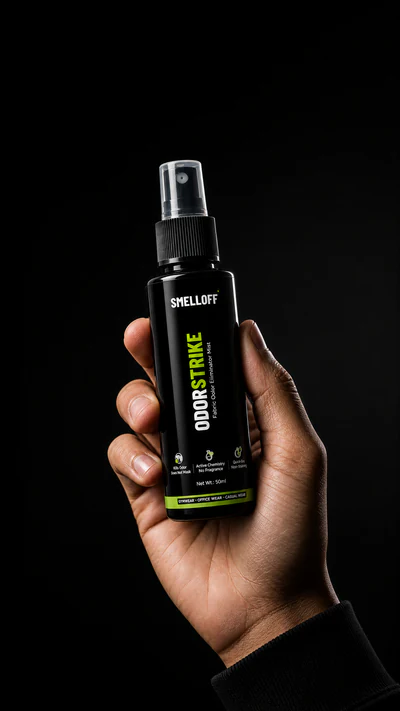
ODORSTRIKE — Fabric Odor Mist
50ml fabric odor mist. Zinc PCA + cyclodextrin (HPβCD) formula. Built and tested in Hyderabad. For the problem nobody else was solving.