Why Do Dri-Fit Shirts Smell So Fast?
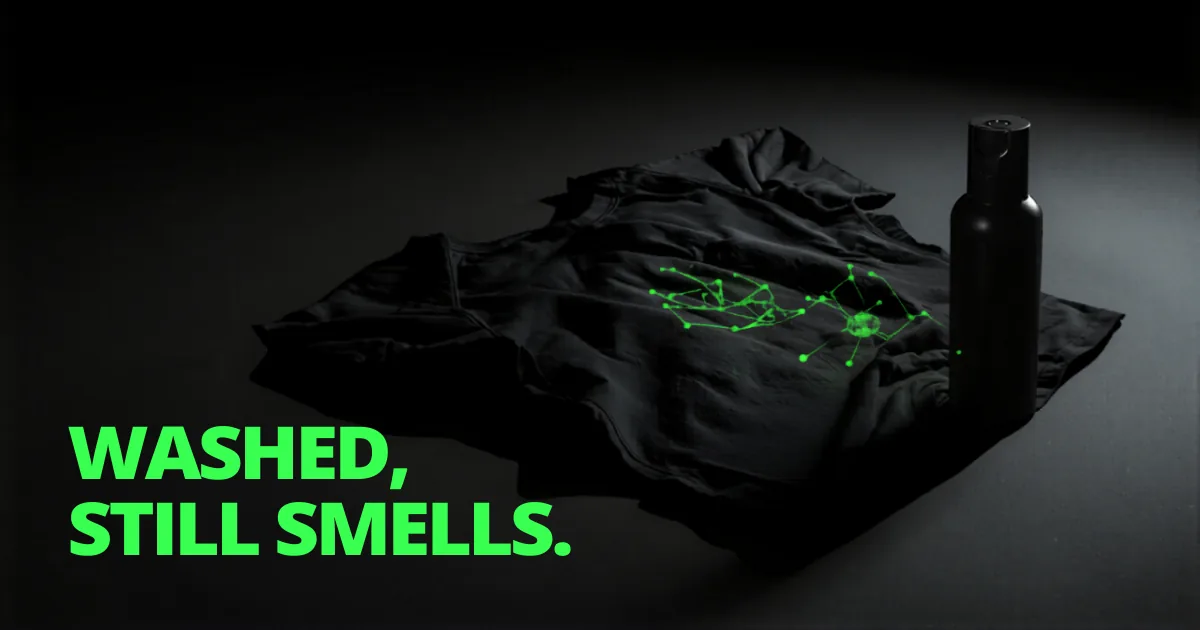
Your Dri-Fit tee can smell an hour into a workout — and still smell after a wash — while your cotton shirt comes out fine. It isn't your hygiene. It's what "performance polyester" is made of.
Quick answer
Why do Dri-Fit shirts smell so fast?
Dri-Fit shirts smell fast because they are polyester, which is oleophilic — it repels water but grips the oily sweat compounds that odor bacteria feed on, holding them deep in the fibre where washing can't reach. Fresh sweat is nearly odorless; bacteria turn it into strong-smelling compounds that concentrate in synthetic fabric. A fabric neutraliser like ODORSTRIKE breaks those compounds down in the fibre.
Dri-Fit, Climalite, Decathlon poly, generic "sports" tees — they all share one job: wick sweat off your skin and dry fast so you stay comfortable. They're brilliant at that. But the exact property that makes them perform is what makes them stink, and no amount of extra detergent changes it.
What is Dri-Fit actually made of?
Dri-Fit is Nike's brand name for a polyester performance knit; Climalite (Adidas), Dry (Uniqlo) and most activewear are the same base material. Polyester is a plastic-derived synthetic fibre engineered to move moisture, not absorb it. That's why it feels dry against your skin even when you're sweating hard — the sweat is being pushed to the surface to evaporate, not soaked up.
Why does polyester trap odor when cotton doesn't?
Polyester is hydrophobic (water-repelling) and oleophilic (oil-attracting). Sweat is mostly water and barely smells — but the oils in sweat, and the bacteria that feed on them, are exactly what oleophilic polyester grabs and holds inside the fibre. Fresh sweat is almost entirely odorless; the smell only appears once skin bacteria such as Staphylococcus and Corynebacterium break it down into volatile compounds.(American Society for Microbiology)
The difference isn't subtle. In a 2014 study in Applied and Environmental Microbiology, researchers had people wear cotton and polyester through an intense spin session: after incubation, the polyester shirts were rated significantly more intense and less pleasant, and odor-producing micrococci bacteria were found almost exclusively on the synthetic fabric.(Callewaert et al., 2014) This is the same fibre chemistry behind why polyester smells worse than cotton.
Why does Dri-Fit still smell after washing?
Because the fibre is engineered to repel water, your water-based detergent struggles to reach the oils locked inside. The surface comes clean; the deep-seated odor compounds survive, and reactivate the moment your body heat warms the fabric — 20 minutes into a warm room and the "clean" shirt smells again. Hotter washes help a little but most activewear is rated for cold or warm cycles only, and heat damages the stretch fibres. It's the same trap covered in why gym clothes smell after washing.
Extra detergent doesn't penetrate a water-repelling fibre any better — it just leaves residue that can trap more odor over time. You can't solve a hydrophobic-fibre problem by adding more water.
How do you stop Dri-Fit shirts from smelling?
Two things: stop bacteria regrowing, and neutralise what's already trapped. Wash promptly inside out and dry fully and fast — never leave a damp Dri-Fit balled up in a bag, which is a warm, airless colony. For the odor washing leaves behind, mist a fabric odor eliminator onto the underarms, chest and back and let it dry.
ODORSTRIKE was built for exactly this: a zinc-based fabric mist in a 50ml pocket spray that penetrates synthetic fibres, neutralises the trapped odor compounds instead of masking them, and dries clear in under 10 seconds with no residue. Spray a fresh tee before a workout to pre-empt the smell, and re-mist before the next wear. Match the tool to the fibre and your activewear stops carrying yesterday's session into today.
Sources
Callewaert C, et al. Microbial Odor Profile of Polyester and Cotton Clothes after a Fitness Session. Applied and Environmental Microbiology, 2014. pmc.ncbi.nlm.nih.gov
American Society for Microbiology. The Microbial Origins of Body Odor. ASM.org, 2021. asm.org
Frequently Asked Questions
Why do Dri-Fit shirts smell so fast?
Dri-Fit shirts smell fast because they are polyester, which is oleophilic: it repels water but grips the oily sweat compounds that odor bacteria feed on, deep in the fibre where washing struggles to reach. Fresh sweat is nearly odorless, but bacteria break it down into strong-smelling compounds that concentrate in synthetic fabric, so the shirt reeks within an hour of warming up.
Does washing Dri-Fit remove the smell?
Washing Dri-Fit often does not fully remove the smell, because the odor oils are trapped in water-repelling polyester and a normal cold wash cannot flush them out. The surface comes clean but the deep-seated compounds survive and reactivate with body heat. A fabric neutraliser like ODORSTRIKE breaks those compounds down in the fibre, clearing what the wash leaves behind.
Is Dri-Fit worse than cotton for smell?
Yes, Dri-Fit and other polyester activewear hold odor worse than cotton. In a 2014 study, polyester T-shirts worn during exercise were rated significantly more intense and less pleasant than cotton after the same session. Cotton absorbs sweat and releases it in the wash, while polyester grips the oils, which is why synthetics need a fabric neutraliser.
How do I stop my Dri-Fit shirt from smelling?
To stop a Dri-Fit shirt smelling, wash it promptly inside out, dry it fully and fast so bacteria cannot regrow, and never leave it damp in a gym bag. Between washes, mist the underarms, chest and back with a fabric odor eliminator like ODORSTRIKE, which neutralises the trapped compounds and dries clear in about 10 seconds rather than masking them.
ODORSTRIKE — Fabric Odor Mist
50ml pocket-sized spray. Zinc-based formula. Works on cotton, polyester, denim, linen — any clothing fabric. No residue. Dries in under 10 seconds.
Read Next
Why Gym Clothes Smell After Washing